An employee training plan isn't just another document to file away. It’s a living strategy that maps out learning goals, how you'll deliver content, and what success actually looks like. It’s the blueprint for building a smarter, more capable team and shifting your company culture from one-off training events to one of continuous growth.
Why Your Current Training Program Is Falling Short
Let's be real for a minute. Are those thick binders, static handbooks, and mandatory all-day seminars actually working? For most companies, the honest answer is no. In today's fast-paced world, these traditional training methods feel completely disconnected from the daily realities of your employees' jobs. The result? Disengagement and a terrible return on your training investment.
The fundamental problem is that old-school approaches treat learning as a passive, one-time chore. They don't grab anyone's attention, they don't cater to different learning styles, and they certainly don't provide the just-in-time knowledge that modern teams need to succeed. This disconnect creates a frustrating cycle of wasted money and missed opportunities for real skill development.
The True Cost of Ineffective Training
When training misses the mark, the consequences are felt across the entire organization. It’s not just about the money you spent on a seminar that everyone forgets a week later; it’s about the hidden costs that quietly add up.
Think about it this way:
Disengaged Employees: When content is dry and irrelevant, your team mentally checks out. This guarantees low participation and even lower knowledge retention.
Wasted Resources: Every hour someone spends in a pointless training session is an hour they could have been doing productive work. That's a direct hit to your bottom line, factoring in both program costs and employee salaries.
Stagnant Skill Sets: In a market that changes at lightning speed, a team that isn’t learning is a team that’s falling behind. This directly impacts your ability to compete, innovate, and win.
This is exactly why a well-designed employee training plan is so critical. It moves the focus from just checking a box to actively building the skills your business needs. And the numbers don't lie—organizations with structured onboarding and training see an 82% improvement in new hire retention. That's a massive win, especially when you learn that only 23% of employees worldwide feel engaged at work.
Even better, companies with comprehensive training programs report a staggering 218% higher income per employee compared to those without a formal plan. You can find more data-driven insights on why training matters on leveluplms.com.
Comparing Traditional vs Modern Training Approaches
The difference between traditional and modern training comes down to flexibility, engagement, and scale.
Traditional training is usually delivered through in-person sessions or static materials. Learning happens at fixed times, moves at a single pace, and offers limited interaction. Updating content is slow, and success is often measured by attendance rather than understanding.
Modern training is built for on-demand access. Content is delivered through short videos and interactive modules that learners can complete at their own pace, on any device. Updates are fast, and teams can measure engagement and progress in far more detail.
The result is simple: traditional training struggles to keep attention and stay current. Modern training is easier to maintain, easier to scale, and better suited to how people actually learn today.
From Static Documents to Dynamic Learning
The real challenge is bridging the gap between all the knowledge you already have—often buried in PDFs, slide decks, and procedural docs—and what your learners actually need. Many training programs fail because they neglect crucial topics, like providing sufficient effective security awareness training or other specialized skills, simply because creating engaging content seems too difficult.
This is where modern tools completely change the game.
Instead of starting from scratch, you can transform your existing materials. Imagine turning that dense, 50-page compliance PDF into a series of short, engaging video lessons led by a professional AI avatar.
A modern employee training plan doesn't just present information; it creates an experience. It meets employees where they are, with content that is accessible, relevant, and easy to consume.
By using AI-powered platforms like Colossyan, you can repurpose your existing library of content with minimal effort. That PowerPoint on a new software rollout can become an interactive, avatar-led tutorial. A technical manual can be broken down into bite-sized videos that engineers can pull up on their phones right when they need them.
This approach finally solves the engagement problem by making learning feel less like a chore and more like a valuable, personalized resource. It’s all about working smarter, not harder, to build a training program that finally delivers.
Pinpointing Skill Gaps and Setting Clear Goals
An effective employee training plan isn’t built on wishful thinking. It's engineered with data. Before you design a single module or write one line of script, you have to understand the precise gap between where your team is and where your business needs them to be.
Jumping straight into content creation is a classic mistake, and it's a surefire way to waste time and money.
The first real step is a thorough training needs analysis. Think of it as a diagnostic for your organization. It helps you zero in on the specific, measurable skill gaps that are actually holding your teams back, so you aren't just creating training for training's sake.
To get a clear picture, you'll need to pull information from a few different places. Each source gives you another piece of the puzzle.
Gathering Actionable Data
Your company's existing processes are probably overflowing with the data you need. Start with performance reviews. You'll often find recurring themes or challenges that pop up again and again. Are multiple people struggling with the same software? Are managers constantly flagging a need for better communication skills?
Next, talk to your managers directly. They're on the front lines and can see performance bottlenecks that data alone might miss. Ask them pointed questions about their team's readiness to tackle the company's big goals for the next quarter.
Finally, anonymous employee surveys are gold. Ask people where they feel least confident or what skills they think would make the biggest difference in their day-to-day work. This doesn't just uncover hidden skill gaps; it also gets your team invested in the process from the start.
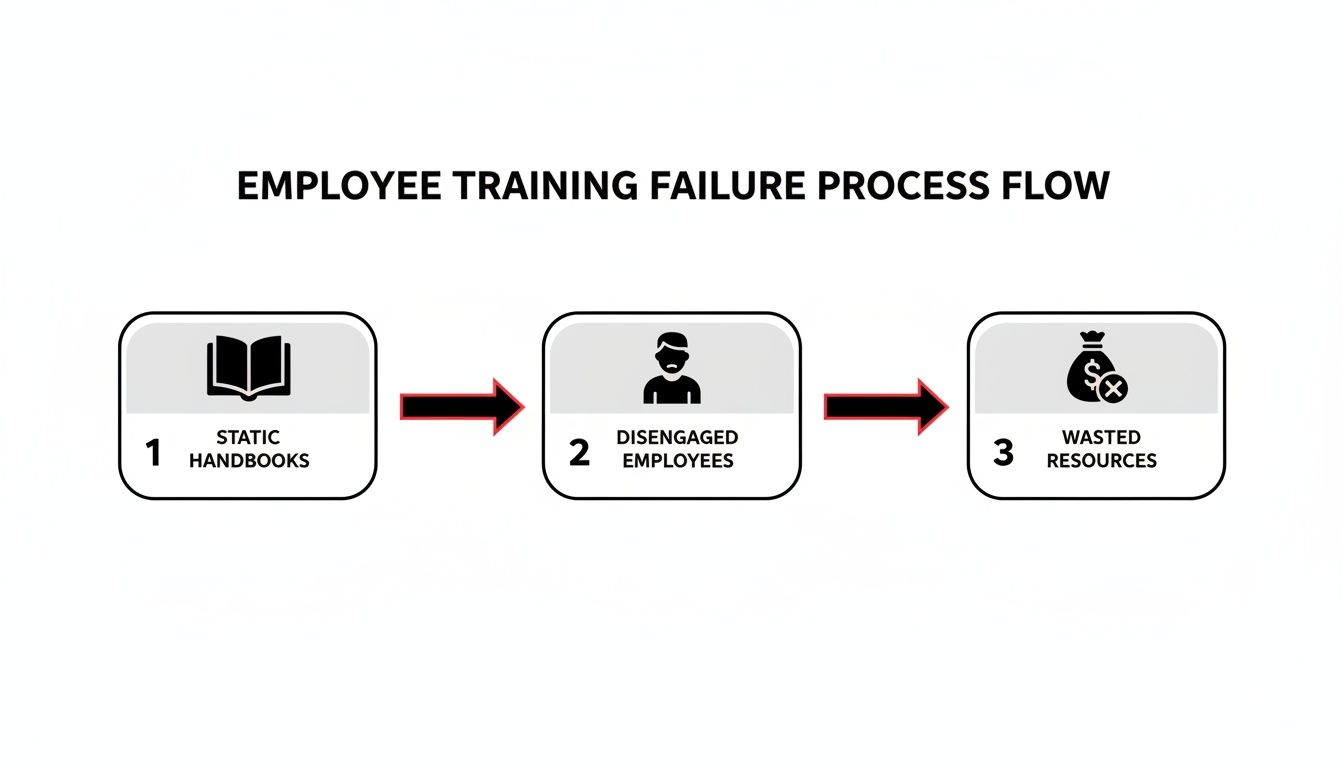
This flowchart shows the all-too-common result of skipping this step and just handing out a dusty old handbook.
As you can see, it’s a straight line from static, one-size-fits-all materials to a disengaged workforce and, ultimately, wasted resources.
Translating Insights into SMART Goals
Once you have your data, it's time to turn those findings into clear, actionable objectives. A vague goal like "improve sales skills" is basically useless because you can't measure it. Instead, lean on the SMART framework to give your goals some teeth.
Specific: What, exactly, needs to be accomplished?
Measurable: How will you track progress and know when you've succeeded?
Achievable: Is the goal realistic? Challenging is good; impossible is not.
Relevant: Does this training directly support a larger business objective?
Time-bound: When does this need to be completed?
For example, a weak goal is "Improve customer support." A SMART goal is: "Reduce average customer ticket resolution time by 15% within Q3 by training the support team on the new CRM's advanced features." This goal is specific, measurable, and clearly tied to a business outcome. You can explore more about the different types of employee training that can help you hit these specific targets.
The whole point of setting SMART goals is to create a direct link between your training investment and tangible business results. It transforms training from a cost center into a strategic driver of growth.
Focusing on internal development is more critical than ever. With 77% of organizations reporting they struggle to fill full-time roles, the ability to upskill your existing talent isn't a "nice-to-have"—it's a competitive necessity.
Prioritizing for Maximum Impact
You'll probably uncover more skill gaps than you can tackle all at once. That’s normal. The final piece is to prioritize.
Map your list of needs against your company's strategic goals for the next year. Which gaps pose the biggest threat to achieving those objectives? Which skills will unlock the most significant opportunities? Focus there first.
This is where you can start to see how modern tools can dramatically speed things up. Let's say your analysis shows a critical need for consistent product knowledge across a global sales team. Instead of flying everyone in for an expensive seminar, you can work with what you already have—like product spec sheets and sales decks.
With a platform like Colossyan, you can instantly convert those documents into a series of engaging video modules. Using AI avatars, you can even auto-translate the content into dozens of languages, ensuring every single team member gets the same high-quality training. It’s a perfect example of addressing an identified skill gap with a scalable, cost-effective solution.
Creating Training Content People Want to Use
Alright, you've got your goals locked in. Now comes the fun part: designing the actual learning experience. This is where your employee training plan moves from a document into something your team can see, hear, and interact with.
Let’s be honest. Nobody wants to sit through another mind-numbing presentation. We’ve all seen those glazed-over eyes. If the content doesn't grab them, all that strategic planning was for nothing. Engagement isn't just a buzzword; it's the price of admission for effective learning.
Blending Formats for Modern Learners
The best training programs I've ever built have never relied on a single format. They're a mix—a blend of hands-on coaching, lively group workshops, and self-paced digital lessons that people can tackle on their own time.
But there’s one format that has become the absolute cornerstone of modern training: video. The numbers don't lie. Employees are 75% more likely to watch a video than read through documents or emails. It's just how we're wired to consume information now.
This doesn't mean you need a massive budget or a full-blown video production crew. In fact, you're probably already sitting on a goldmine of content just waiting to be used.
Repurpose Your Existing Assets into Dynamic Video
The biggest hurdle to creating amazing content isn't a lack of expertise—it's the thought of starting from a blank page. Your company has tons of knowledge already captured in various documents.
PowerPoint Presentations: Think about those detailed slide decks from last quarter's all-hands meeting.
PDF Handbooks: That new-hire manual that’s incredibly thorough but rarely read from start to finish.
Procedural Documents: All those step-by-step guides for new software or internal workflows.
Screen Recordings: Those quick how-to videos that get the job done but lack a professional touch.
These aren't dead documents; they're the foundation for your video learning. Instead of letting them collect digital dust, you can bring them to life.
The smartest path to engaging training isn't starting from scratch. It's about transforming the static, valuable information you already have into the dynamic, watchable format your employees actually prefer.
This is where AI tools like Colossyan are an absolute game-changer for L&D professionals. You can feed it a dense PowerPoint, and in minutes, it will spit out a series of polished videos narrated by a professional AI avatar. The script is pulled right from your slides. You can tweak it, add visuals, and even get it auto-translated into over 80 languages for your global teams.
Just like that, a dry compliance module becomes a sharp, professional video that's easy to digest. You've created a fantastic learning asset without writing a single new word. It's about creating learning experiences people actually want without burning out your team.
Making Knowledge Stick with Proven Techniques
Once you've landed on your formats, it’s all about structuring the content so the information actually sticks. Two of my go-to techniques are microlearning and adding interactive elements.
Microlearning is simply about breaking big, complex topics into small, digestible chunks. A five-minute video is infinitely more approachable than a one-hour webinar. It respects people's time and aligns with how our brains process information, making it easier to remember the key points when they matter most.
Interactive elements shift the learner from being a passive viewer to an active participant. By adding simple quizzes, knowledge checks, or branching scenarios into your videos, you can boost engagement and see if they're really getting it. With Colossyan, you can drop interactive questions right into a video at key moments, making sure people are paying attention before they move on.
And finally, never forget the power of a good story. Even the most technical topics become memorable when framed within a real-world scenario. Storytelling forges an emotional connection, anchoring the information in long-term memory far better than a dry list of facts ever could.
Rolling Out Your Training Program for Maximum Impact
You've put in the hard work designing incredible, engaging content that's tied directly to your business goals. Awesome. But even the best training material is useless if it never reaches your team, or worse, if the launch is a total flop.
The rollout phase is where your strategic employee training plan goes from being a document on your drive to a real, tangible experience for your people. This part is all about logistics, communication, and creating a smooth runway for launch. How you introduce and deliver the training can make or break its success. A clunky, confusing rollout will kill enthusiasm before anyone even clicks "play."
Choosing the Right Delivery Platform
First up, you need to decide how you'll actually get this content in front of your learners. The platform you choose is a huge deal—it shapes the entire user experience.
A full-featured Learning Management System (LMS) is the go-to for most larger organizations. These platforms are the central command center for all things training. You can assign courses, track who's done what, and pull detailed reports to prove your ROI. They're powerful, but let's be honest, they can sometimes feel impersonal or a bit too corporate.
The alternative? You could go for simpler, more integrated channels. Think about hosting videos on your company intranet, creating a dedicated Slack or Teams channel for learning, or even embedding content right into your existing knowledge base. This approach feels much more a part of the daily workflow, but you often sacrifice the robust tracking and reporting you'd get from a true LMS.
Integrating Content Seamlessly with Existing Tools
Whichever platform you pick, the name of the game is creating a frictionless experience. This is a massive argument for using content creation tools that play nicely with your existing tech stack. From my experience, there's nothing more frustrating for an L&D team than creating amazing content that they can't easily upload or track.
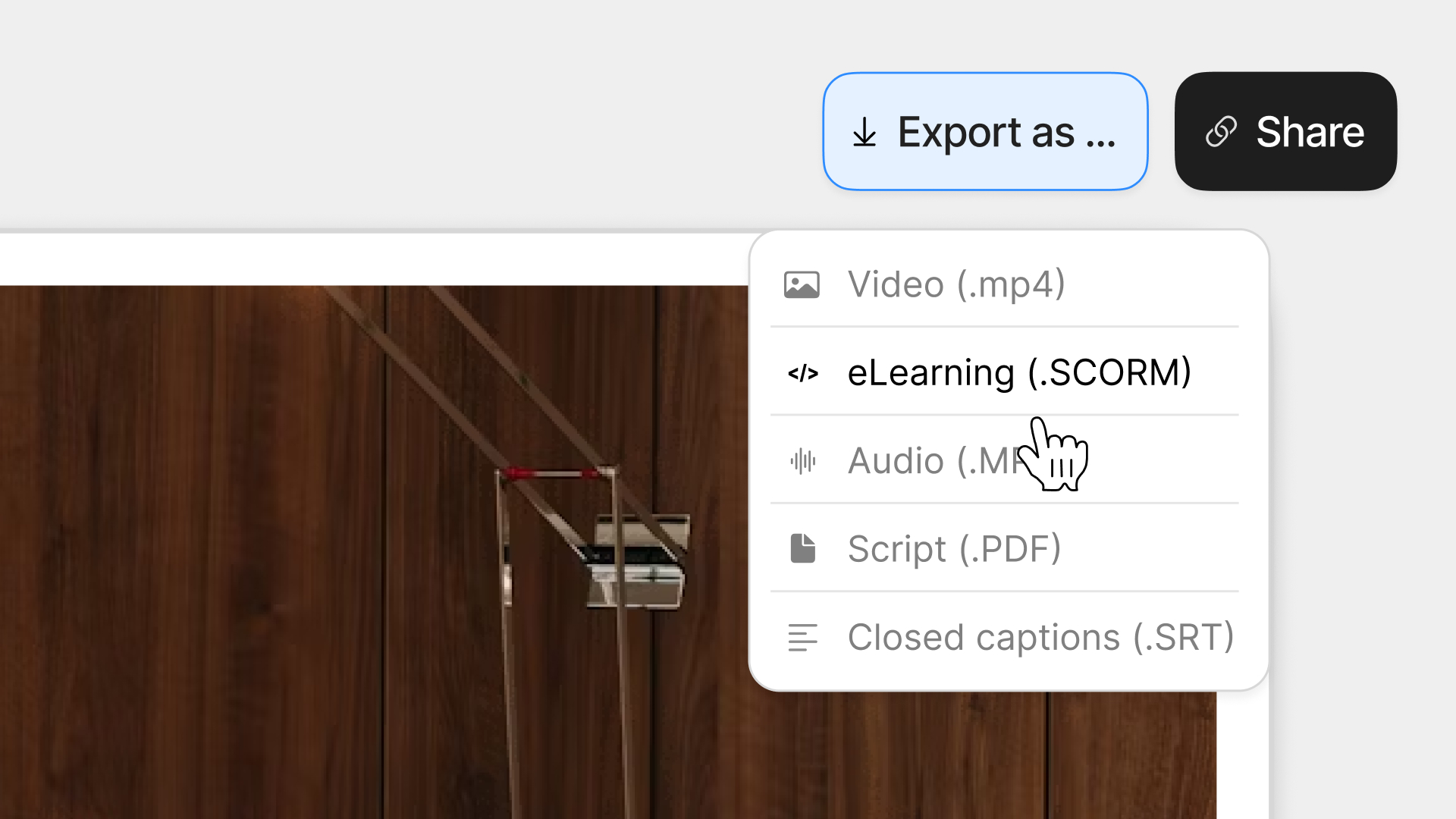
This is where a solution like Colossyan becomes a game-changer. Instead of just exporting a standard MP4 video file, you can generate a SCORM-compliant package.
What's SCORM? Think of it as the universal language that lets your e-learning content talk to your LMS. SCORM (Sharable Content Object Reference Model) is what ensures that when a learner completes a video, that progress is automatically reported back to your system. No manual data entry, no guesswork.
This direct integration is a massive time-saver. You can create your slick, avatar-led videos in Colossyan, export them as a SCORM file, and upload them directly into your LMS. All the crucial data—tracking, completion rates, and even quiz results—flows through automatically. It perfectly bridges the gap between modern, agile content creation and the structured reporting your organization needs.
Building Excitement with a Communication Plan
You can't just drop a new training module into your team's lap and expect them to be thrilled. You need a solid communication plan to build anticipation and frame the training as a valuable opportunity, not just another mandatory chore.
Here’s how to nail your communications:
Explain the "Why": Don't just list the features. Clearly spell out what employees will gain from the training. Tie it directly to their personal growth and career development, not just vague company goals. What's in it for them?
Use Multiple Channels: Get the word out everywhere. Announce the upcoming training in company-wide emails, bring it up in team meetings, and post about it on your internal social channels. One email is never enough.
Empower Managers: Your secret weapon is your managers. Give them the key talking points and empower them to champion the training with their direct reports. An endorsement from a manager carries a ton of weight.
If you're building a remote or flexible training program, it's worth checking out how different virtual tutoring platforms handle their delivery and engagement. You can pick up some great ideas.
Scheduling for Minimal Disruption
Last but not least, think about your timing. Dropping a major training initiative right in the middle of your company's busiest sales quarter is a recipe for disaster. Engagement will plummet.
Talk to department heads and figure out the best time to roll out the training. You could even consider a phased approach—launch with a smaller pilot group first to work out the kinks and gather feedback before the company-wide release.
For self-paced modules, give people a generous completion window. Life happens, and workloads fluctuate. The goal is to embed learning into the workflow, not to throw a wrench in it.
Measuring Training Effectiveness and Proving ROI
Launching your employee training plan is a huge milestone, but let's be honest—it's not the finish line. The real work begins now. How do you actually know if all that effort is moving the needle?
Here’s a hard truth: just tracking completion rates isn't going to cut it with leadership. You need to connect your training directly to business results. This is where so many L&D teams stumble. They create fantastic content and get high participation, but when asked to prove its value, they can only point to vanity metrics.
If you want to secure future budgets and earn a strategic seat at the table, you have to demonstrate a clear return on investment (ROI).
A Framework for Measuring What Matters
A simple yet incredibly powerful way to structure your evaluation is the Kirkpatrick Model. I’ve seen it work time and time again. It breaks down training effectiveness into four progressive levels, moving from initial gut reactions to tangible business impact.
1. Reaction: Did they like the training? This is the easiest level to measure, usually with a quick post-training survey. Ask learners about the content's relevance, the presenter's effectiveness, and their overall experience.
2. Learning: Did they actually pick up the intended knowledge or skills? You can measure this through quizzes, assessments, or practical skill demonstrations. This confirms that information was absorbed, not just heard.
3. Behavior: This is the crucial one. Are they applying what they learned on the job? To find out, you'll need to use manager observations, 360-degree feedback, and performance reviews to see if new skills are being put into practice.
4. Results: Did the training impact the bottom line? This is the ultimate goal. Here, you connect those behavioral changes to key business metrics, like increased sales, faster ticket resolution times, or higher customer satisfaction scores.
Focusing only on Level 1 gives you happy learners but offers zero proof of impact. A solid measurement strategy touches on all four levels to tell the complete story.
Connecting Training to Business KPIs
To truly prove ROI, you have to link your training initiatives to the Key Performance Indicators (KPIs) that your leadership team obsesses over. This means moving beyond L&D jargon and speaking the language of the business.
Start by going back to the core business problem your training was designed to solve.
Training Solution: A revamped onboarding program.
KPIs to Track:New hire retention rate, time to productivity.
Training Solution: A new module on de-escalation techniques for the support team.
KPIs to Track:CSAT scores, first-contact resolution rate.
When you tie your plan to these metrics from the very beginning, you build a clear case for its value. The data doesn't lie: companies with targeted training see a 17% increase in productivity and a 21% boost in profitability.
Proving ROI isn't about finding some magical, perfect formula. It's about building a logical, data-backed argument that connects your team's development directly to the company's success.
How Your Tools Can Provide the Data You Need
Gathering all this data can feel overwhelming, but you're probably sitting on a goldmine already. Your LMS, for instance, is tracking completion rates and quiz scores (Kirkpatrick's Level 2). Your HRIS or performance management system holds the data on behavior change and business results (Levels 3 and 4).
This is also where modern content creation platforms give you a serious edge. The built-in analytics within a tool like Colossyan, for example, give you immediate insight into learner engagement. You can see precisely where viewers drop off in a video, which sections they rewatch, and how they perform on interactive quizzes embedded right in the content.
This granular data is the first layer of your ROI story. It shows you not just if people completed the training, but how they engaged with it. For instance, high rewatch rates on a specific segment of a compliance video might signal a complex topic that needs clarification. That's an immediate, actionable insight to help you iterate and improve your employee training plan.
To really dig into the numbers, check out our guide to calculate the ROI of your video training. By combining engagement insights from your creation tool with performance data from your other systems, you can paint a complete and compelling picture of your training's impact.
Got Questions About Your Employee Training Plan?
Even the most buttoned-up training strategy can leave you with a few lingering questions. It happens to everyone. Let's walk through some of the most common hurdles L&D and HR managers run into and get you some clear, practical answers.
How Often Should We Update Our Training Plan?
If you're thinking "set it and forget it," you're already behind. A training plan isn't a static document; it's a living thing. The bare minimum is a thorough review once a year to make sure it still connects to the company's big-picture goals.
But honestly, the real answer depends on how fast things are changing in your world.
For something like compliance training, an annual refresh is probably fine. But when it comes to skills—especially in fast-paced fields like tech or marketing—you need to be much more agile. Try thinking in quarterly themes or focus areas, supported by a library of on-demand microlearning resources your team can pull up anytime they need them.
The real goal here is to move your culture away from that one big, overwhelming annual training event. Instead, you want to foster an ongoing conversation about development, backed by resources that are always current and easy to find.
How Do I Build a Training Plan for a Remote or Hybrid Team?
Training a team that's spread out across different cities and time zones requires a totally different approach. You have to lean into asynchronous, self-paced learning. Your LMS or internal knowledge base needs to become the single source of truth for all training materials.
Video is your best friend here. It's the most powerful tool in your remote-training arsenal. With platforms like Colossyan, you can quickly spin up engaging, avatar-led videos that feel personal, even if the person watching is on the other side of the world. It’s a fantastic way to repurpose existing presentations or documents into something much more polished and consistent for everyone.
For global teams, auto-translation is a game-changer. Instead of shelling out huge sums for localization, you can create one video and instantly translate it into dozens of languages. This ensures every single team member gets the exact same high-quality training. You can then sprinkle in optional, live virtual Q&As to build that team connection.
What’s the Best Format for Employee Training Content?
There isn't one. The idea of a single "best" format is a myth. The most effective training programs use a blended learning strategy, mixing and matching different methods to suit the topic and the learner.
On-the-job coaching and mentoring are unbeatable for hands-on, role-specific skills.
Live workshops (either virtual or in-person) are perfect for brainstorming, collaborative problem-solving, and team-building exercises.
Digital, self-paced learning delivers the flexibility and scale that modern teams absolutely require.
And within that digital world, AI-powered video really shines. It's this unique combination of being super engaging and incredibly efficient to produce. You can use it for short, bite-sized microlearning videos, more formal courses for your LMS, or even quick-hitter performance support guides that someone can pull up on their phone right in the middle of a task.
How Do I Get Leadership to Buy Into My Plan?
If you want to get the C-suite on board, you need to speak their language. That language is results and ROI. You have to frame your training proposal not as an expense, but as a strategic investment that solves a real business problem.
Start with the data you gathered during your needs analysis. Show them exactly where skill gaps are costing the company money—whether that’s through lost productivity, high turnover, or dipping customer satisfaction scores. For example, a recent study found that a staggering 63% of employees who left their jobs did so because they didn't see opportunities for growth. That's a powerful number to share.
Finally, present a crystal-clear proposal that ties your training plan directly to the company's strategic objectives. Lay out the expected outcomes, the exact metrics you'll use to measure success, and a realistic projection for the return on investment. When you build a data-driven business case, training stops being just an "HR thing" and becomes a core driver of business growth.
Ready to swap out those static PowerPoints for video training that people actually want to watch? With Colossyan, you can transform your existing materials into polished, avatar-led videos in minutes. Create, translate, and deliver high-impact learning experiences that truly scale.
Nikitas leads brand and content at Colossyan, shaping how knowledge is communicated, experienced, and scaled. He spends most of his time fighting unnecessary complexity and reminding people that clarity is not boring.
Networking and Relationship Building
Use this template to produce videos on best practices for relationship building at work.
Oops! Something went wrong while submitting the form.
example
Thank you - your video is on its way!
If you’d like to try out Colossyan and create a video yourself, just visit our website on your desktop and sign up for a free account in seconds. Until then, feel free to check out our examples.






.avif)





%20(1).avif)



.webp)
.webp)