


Key Takeaways
- Nobody agrees how many learning theories there are because the count depends on how each source groups them, not on the evidence
- Cognitive load and spaced retrieval have the strongest evidence and are the least applied in workplace training
- Multimodal learning is not learning styles: combining words and pictures works, matching a lesson to a learner's supposed type does not
- Most of these theories survive the move to asynchronous video, but a few only work with a person in the room
- The only argument that moves a budget holder is the one that connects the redesign to a business metric they already track
These are the learning theories that show up when someone builds workplace training, and an honest verdict on each one. If you are studying for an education degree, most of what follows will be too blunt to be useful to you. This is written for the person who has to decide what goes into the next module.
Start with the thing nobody says out loud.

Nobody agrees how many there are
Search for learning theories and you will be told there are five. Or seven. Or ten. Adult learning has four pillars, or five principles, or six, or seven rules. Every page picks a number and states it with total confidence.
The number is editorial. It depends on how each author chose to split and merge the same underlying ideas, and it is not a finding about the world. Andragogy is the clearest case. Malcolm Knowles published The Modern Practice of Adult Education in 1970 with four assumptions. A fifth and then a sixth were added across later editions, the last of them finished after his death in 1997. The exact edition-by-edition history is reported consistently across secondary sources but is surprisingly hard to pin to a page, and Loeng’s 2018 review is the careful treatment if you need to defend it. What is not in doubt is that nothing was discovered in between. The list grew because its authors kept refining it.
That matters practically. If you are waiting for the definitive list before you use any of this, you will wait forever. Use them as a review checklist for content you are about to build, and judge each one on whether it changes what you actually do.
The short version
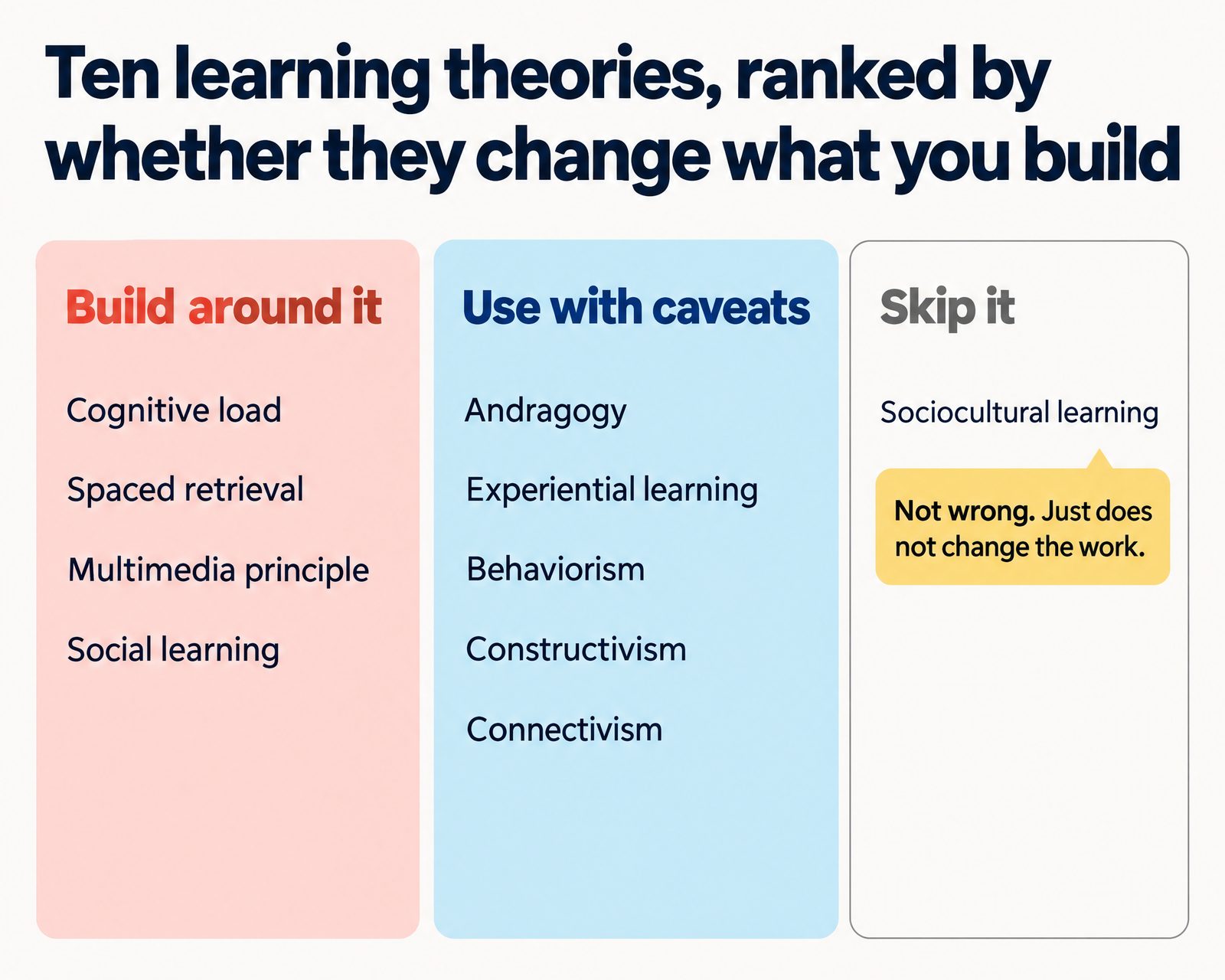
| Theory | What it claims | What it changes about what you build | Verdict |
|---|---|---|---|
| Andragogy (Knowles, 1970) | Adults learn differently from children: self-directed, experienced, problem-centered | Lead with why this matters to them, not with the syllabus | Useful, with caveats |
| Cognitive load (Sweller, 1988) | Working memory is narrow and easily overwhelmed | Break it up, sequence it, stop delivering an hour at once | Most useful on this list |
| Multimedia principle (Mayer, 2001) | People learn better from words and pictures together than words alone | Pair narration with visuals that carry meaning | Useful, and constantly confused with a myth |
| Spacing and retrieval (Ebbinghaus, 1885) | Spread practice out, and make people recall rather than reread | Build reinforcement into the program, not one session | Strongest evidence here |
| Experiential learning (Kolb, 1984) | Learning is a cycle: do, reflect, conceptualize, try again | Add a reflection and application step after the content | Partly useful |
| Social learning (Bandura, 1977) | People learn by watching others and judging what happens to them | Show a person doing the thing, not a diagram of the thing | Useful |
| Behaviorism (Skinner, 1938) | Behavior is shaped by reinforcement | Completion tracking, scores, badges | Partly useful, and already in your LMS |
| Constructivism (Piaget, 1936) | Learners build understanding onto what they already know | Start from what the team already does | A stance more than a method |
| Connectivism (Siemens, 2005) | Knowing where to find knowledge matters more than holding it | Point to the source of truth instead of copying it into a module | Interesting, contested |
| Sociocultural learning (Vygotsky, 1978) | Learning is social and mediated by culture and language | Very little, in practice | Academic only |
1. Andragogy
Knowles’ argument is that adults are not big children. They arrive with experience, they want to know why something matters before they will engage with it, and they expect some control over how they learn.
The practical version is the first thirty seconds of anything you build. If a module opens with an agenda, it has already lost. If it opens with the situation this person is actually in and what goes wrong without this knowledge, it has a chance.
The caveat is the one nobody writes down. A lot of workplace training is mandatory, and the honest answer to “why am I learning this” is sometimes “because Legal requires it”. Andragogy does not have much to say about that case, and pretending a compliance module is a self-directed learning journey fools nobody.
Verdict: useful, with caveats. Use the assumptions as a checklist. Do not treat the count as settled, because it never was.
2. Cognitive load
Sweller’s 1988 work says working memory is narrow, and that instruction which overloads it produces worse learning regardless of how good the content is.
Cognitive load is definitely a risk where you are just making people sit down and digest a huge topic which is complex after all. That is what an overloaded module looks like in practice. Not a badly written slide, but forty minutes of dense material delivered in one sitting to someone who has a job to get back to.
Microlearning really has a chance to help here, because you can show it one by one rather than all at once. Interactive video is one thing the industry keeps reaching for, because you can showcase the content sequentially and at the right time in the flow of work.
One honest caveat, because this is where most articles on this subject quietly cheat. The claim that shorter segments improve retention is consistent with cognitive load theory, and it is a reasonable inference from it, but the workplace-specific evidence base for microlearning is thin and mostly published by people selling microlearning. You will see figures like a twenty percent retention lift quoted with no traceable study behind them. Treat the principle as sound and the percentages as marketing.
Verdict: the most useful theory on this list, and the one most often cited without being applied.
3. The multimedia principle, and the myth attached to it
This is the section to read carefully, because two different ideas share a name and one of them is false.
To me multimodal learning is a personalization. If you are traveling on the train and you would rather listen, then you listen to the content. If you are sitting in the comfort of your home, then you digest maybe a video. It is the ability to consume that learning in a personalized manner.
That is a delivery argument, and it is a good one. It is not what the research means by the term, and the difference is worth holding onto.
What the research supports is Mayer’s multimedia principle: people learn more deeply from words and pictures presented together than from words alone. That is a claim about how you design one piece of content, and it holds for most people.
What the research does not support is the idea that people are visual or auditory learners and that matching instruction to their type improves outcomes. Pashler, McDaniel, Rohrer and Bjork looked for evidence of this in 2008 and found none. Kirschner restated it in 2017, and Newton and Salvi showed in 2020 that belief in it remains widespread among educators anyway.
So both things are true. Combine words and pictures inside the content, because that works. Offer people a choice of format for their circumstances, because that is a genuine convenience. Just do not build a system that labels someone an auditory learner and serves them less video, because you would be building on a finding that does not exist.
Verdict: useful, and the theory most often confused with a myth.
4. Spacing and retrieval practice
The oldest idea here and the best evidenced. Hermann Ebbinghaus published his forgetting experiments in 1885, and the finding that survived is that memory decays quickly without reinforcement and that spreading practice out beats cramming it.
Modern work is stronger still. Cepeda and colleagues synthesized 839 assessments across 317 experiments in 2006 and found distributed practice reliably beats massed practice. Roediger and Karpicke, the same year, found that a group who practiced retrieving material recalled 61 percent of it a week later against 40 percent for a group who simply reread it.
Two warnings. First, the number you have seen quoted, that people forget seventy percent within a day, is loosely in the range of Ebbinghaus’s own data, but that data came from one man memorizing nonsense syllables in the 1880s. Meaningful, structured content decays more slowly, and using his number as a general law of workplace training is not supportable. Second, the reason this theory is so rarely applied is structural: it requires a program rather than an event, and most training budgets are built around events.
Verdict: the strongest evidence on this list, and the least used.
5. Experiential learning
Kolb’s 1984 cycle runs from concrete experience to reflection to abstract concepts to active experimentation, and round again.
As a design checklist it earns its place. If your module ends the moment the content ends, you have built one quarter of the cycle. Adding a reflection prompt and a real task afterwards is cheap and it is the difference between watching and learning.
The part to leave behind is the learning styles inventory built on top of it, which sorts people into divergers, assimilators, convergers and accommodators. That is the same meshing idea the evidence does not support.
Verdict: partly useful. Keep the cycle, drop the inventory.
6. Social learning
Bandura’s 1977 book Social Learning Theory holds that people learn by observing others and by noticing what happens to them as a result. He later renamed it social cognitive theory, in 1986, adding self-efficacy.
This is the theory that most directly argues for video over documentation. Watching a colleague handle an objection badly and then well teaches something a bulleted list of objection-handling principles cannot. If you are building training videos, you are already applying this whether you meant to or not.
Verdict: useful, and probably the strongest argument for showing a person rather than a diagram.
7. Behaviorism
Skinner’s work on reinforcement, from The Behavior of Organisms in 1938 through his 1954 Harvard Educational Review paper on programmed instruction, is the ancestor of every completion bar and quiz score in your LMS.
It works for what it works for: driving completion, building habits, drilling procedural knowledge. It does not produce understanding, and a training program that optimizes only for completion will hit its completion target and change nothing else. Most organizations are already doing more of this than they realize.
Verdict: partly useful, and already running in your LMS whether you chose it or not.
8. Constructivism
Piaget’s developmental work, first published in French in 1936, holds that people build new understanding onto structures they already have. The instructional methods that carry the constructivist label came later and from other people, so be careful attributing a teaching prescription to Piaget himself. He did not write one.
For workplace training the useful residue is simple: start from what this team already does, not from first principles. A module explaining a new process to people who have run the old one for six years should begin with the difference, not with the definition.
Verdict: a stance more than a method. Worth holding, hard to point at in a finished module.
9. Connectivism
Siemens proposed connectivism in 2005 on the argument that when knowledge changes faster than you can memorize it, knowing where to find the current answer matters more than holding the old one.
Whether it qualifies as a learning theory is genuinely contested among academics. As a practical instinct for L&D it is sharp, and it has a specific implication: when information changes monthly, do not copy it into a training module that will be wrong by the next quarter. Point at the source of truth and teach people how to use it.
Verdict: contested as a theory, useful as an instinct about what not to build.
10. Sociocultural learning
Vygotsky’s work, compiled posthumously in English as Mind in Society in 1978, holds that learning is fundamentally social and mediated by culture and language, and gives us the zone of proximal development: the gap between what someone can do alone and what they can do with help.
This is the one I would tell you to skip. The idea is not wrong. It is simply that almost everything it recommends for a workplace, which is roughly “pair people with someone slightly more expert”, is something any competent manager already does and does not need a theory to justify. The remaining value is academic, and the search results for it bear that out: the audience reading about Vygotsky is studying psychology, not designing onboarding.
Verdict: academic only. Know the term, do not build around it.
Three things on these lists that are not true
Worth naming, because they appear constantly in training decks and all three are false.
The learning pyramid. The one claiming we remember 10 percent of what we read and 90 percent of what we teach others. There is no study behind those percentages. Edgar Dale’s actual 1946 Cone of Experience contained no numbers at all, and the institute associated with the figures has acknowledged the underlying data no longer exists.
70-20-10 as a law. The idea that development is 70 percent on the job, 20 percent from others and 10 percent formal came from a survey of around 200 executives in the 1980s. Clardy’s 2018 review points out that it surveyed only successful executives and relied on self-report. It is a directional heuristic, not a ratio to budget against.
The eight-second attention span. The claim that humans now have a shorter attention span than a goldfish traces to a statistics site whose sources could not be found when a journalist checked them. The Microsoft report it is usually attributed to does not contain the figure.
A worked example
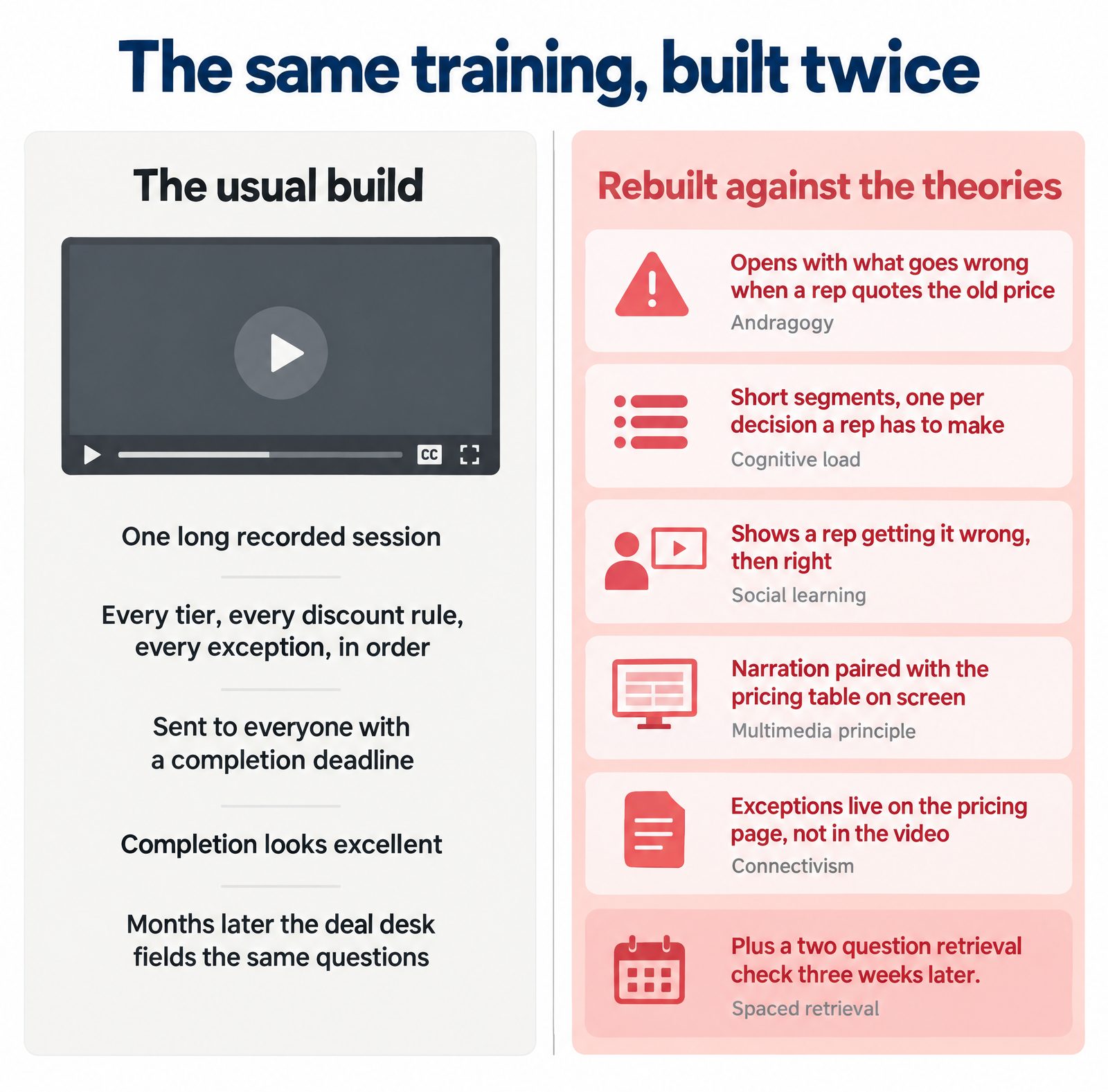
Theory is easy to nod along to and hard to see. So here is a constructed example, not a customer story: the same training built twice.
A sales enablement module on a new pricing structure, built the usual way. One long recorded session. The pricing lead walks through every tier, every discount rule and every exception in order. It goes out to the whole sales team with a completion deadline. Completion looks excellent. Months later the deal desk is still fielding the same handful of questions.
The same content, rebuilt against the theories that earned a verdict above. It opens with what goes wrong when a rep quotes the old pricing, which is the why. That is andragogy doing actual work. The one long session becomes a handful of short segments, one per decision a rep actually has to make, watched in the flow of work rather than in one sitting, which is cognitive load. Each segment shows a rep in a call getting it wrong and then right, rather than describing the rule, which is social learning. Narration is paired with the pricing table on screen rather than read aloud over a title card, which is the multimedia principle. The exceptions, which change quarterly, are not in the video at all; the video points to the live pricing page, which is connectivism. And three weeks later a two-question retrieval check goes out, not a survey asking whether people enjoyed it, which is spaced retrieval.
Nothing in the second version costs more to produce. It is the same information, sequenced differently and reinforced once. The difference is that the first version was designed around the calendar and the second was designed around how people actually take information in. If you want the mechanics of building content this way, our guide to instructional design best practices covers the production side.
What changes when the medium is generated video
Every theory here was written before anyone learned anything from a phone, and all of them assume a human being is delivering.
You can apply the logical principle of most of these theories to an asynchronous learning experience. The principle survives the change of medium even when the delivery method the theorist had in mind does not. Spacing does not care whether a person or a video delivers the reinforcement. Cognitive load does not care either, and video is easier to segment than a workshop is.
Some of them cannot make that move. A few of these theories can only be truly utilized in person, or through a synchronous setting, and pretending otherwise is where a lot of theory-led redesign goes wrong. Anything that depends on someone reading confusion on a face and adjusting in the moment needs a room.
The genuinely new thing is that generated video makes the expensive parts cheap. A handful of short segments instead of one long recording used to mean several times the production work. Reshooting because the pricing changed used to mean rebooking a studio. When updating a module means editing a script, the theories that ask you to break content up and reinforce it over time stop being aspirational. Most online training modules are long because production was expensive, not because anyone decided long was better. And if people are watching on a phone between other things, mobile content has its own constraints on top.
How to argue this to someone holding the budget
Instructional designers read this material. The people approving the spend have not, and they are not going to.
Translating it to business practices and business KPIs works. Nothing else does. Take sales enablement. If the salespeople are able to memorize a piece of information better, then the conversion rates will increase. That is the argument you have to follow, and it is the shape every version of it has to take: this change to how we build the content moves a number you already track.
What loses is any sentence containing the word andragogy. Nobody outside L&D is going to approve a budget line for a theory. They will approve one for ramp time, or error rates, or the number of tickets deal desk fields about pricing.
What it looks like when it worked
Twelve months after a team genuinely rebuilds their training around any of this, the signal is the lagging indicators, the business metrics. If those are moving and basically nothing else has changed, that is the one to look at.
Not engagement rate. Not satisfaction scores. Those measure whether people liked the training, which is not the same question and often not even correlated. If you rebuilt sales enablement, look at ramp time and win rate. If you rebuilt compliance, look at incident counts. If nothing downstream moved in a year, the redesign did not work, however good the completion numbers looked.
Where we stand
We sell the tooling that makes this kind of content cheap to produce, which makes us close to the least credible people in the room on how people learn. Worth saying plainly rather than hoping you did not notice.
So here is the test. Almost nothing above requires our product or anyone’s. Spacing needs a calendar. Starting with why needs a rewritten first paragraph. Pointing at a source of truth instead of copying it needs restraint. The only place the tooling genuinely changes the maths is the one named above: when producing several segments costs what one used to, the theories that ask you to break things up stop being unaffordable.
If you want to see what that looks like in practice, our course creator is where we do this, and there are interactive learning patterns worth stealing whatever you build with. But the honest summary of this article is that most of what is here is free, and the reason it does not get done is not budget. It is that designing around a calendar is easier than designing around how people take information in.
Frequently asked questions
The five most commonly listed are behaviorism, cognitivism, constructivism, humanism and connectivism. Be aware that this grouping is a convention rather than a finding. Other sources list four, seven or ten, because they split and merge the same underlying ideas differently.
Lists of seven usually add experiential learning, social learning and transformative learning to the standard five. There is no authoritative list of seven. The number tells you how the author chose to group them, not how many theories exist.
No. Bloom's taxonomy is a classification of learning objectives, from recall at the bottom to evaluation and creation at the top. It describes what you are asking someone to do, not how learning happens. It is useful for writing objectives and it is often miscategorized as a theory.
Pedagogy describes teaching children, where the teacher decides what is learned and when. Andragogy is Malcolm Knowles' term for teaching adults, who bring experience, want to know why something matters, and expect some control over the process. In workplace training the line is blurrier than the binary suggests, because a compliance module gives an adult learner very little self-direction.
The six commonly listed are: adults need to know why they are learning something, they are self-directed, they bring relevant experience, they are ready to learn what applies to their situation, they are problem-centered rather than subject-centered, and they are motivated internally. Knowles' original 1970 formulation had four assumptions. A fifth and a sixth were added across later editions, which is why sources disagree on the number.
The five-principle version is the six-principle list without the need to know, or without internal motivation, depending on the source. This is the clearest sign that the count is editorial rather than empirical. Treat any of these lists as a checklist for reviewing training content, not as a law.