


Key Takeaways
- Synchronous learning happens live at a fixed time; asynchronous learning happens on the learner's own schedule
- Keep it live when the skill needs a person in the room to correct you, or when the content is not meant to be memorized and practiced all year
- Running everything live breaks down at scale, on time zones, on venue and facility costs, and on the number of sessions you have to hold
- AI is making asynchronous delivery feel synchronous, which is collapsing the distinction the question assumes
Synchronous learning happens live, with the trainer and the learners present at the same time. Asynchronous learning happens on the learner’s own schedule, with no one waiting on anyone else.
This is a decision guide for L&D teams choosing between the two for workplace training. If you are a student picking a course format, most of what follows will not apply to you.
It is important to highlight that all kinds of training have their own place and their own use case. It is not one or the other. Technology gave us the chance to go with more interactive and on-demand training, and there has definitely been a shift, a larger shift, towards asynchronous learning that way. That shift is real, but it is not the whole story, and the part most people miss is at the end of this article.
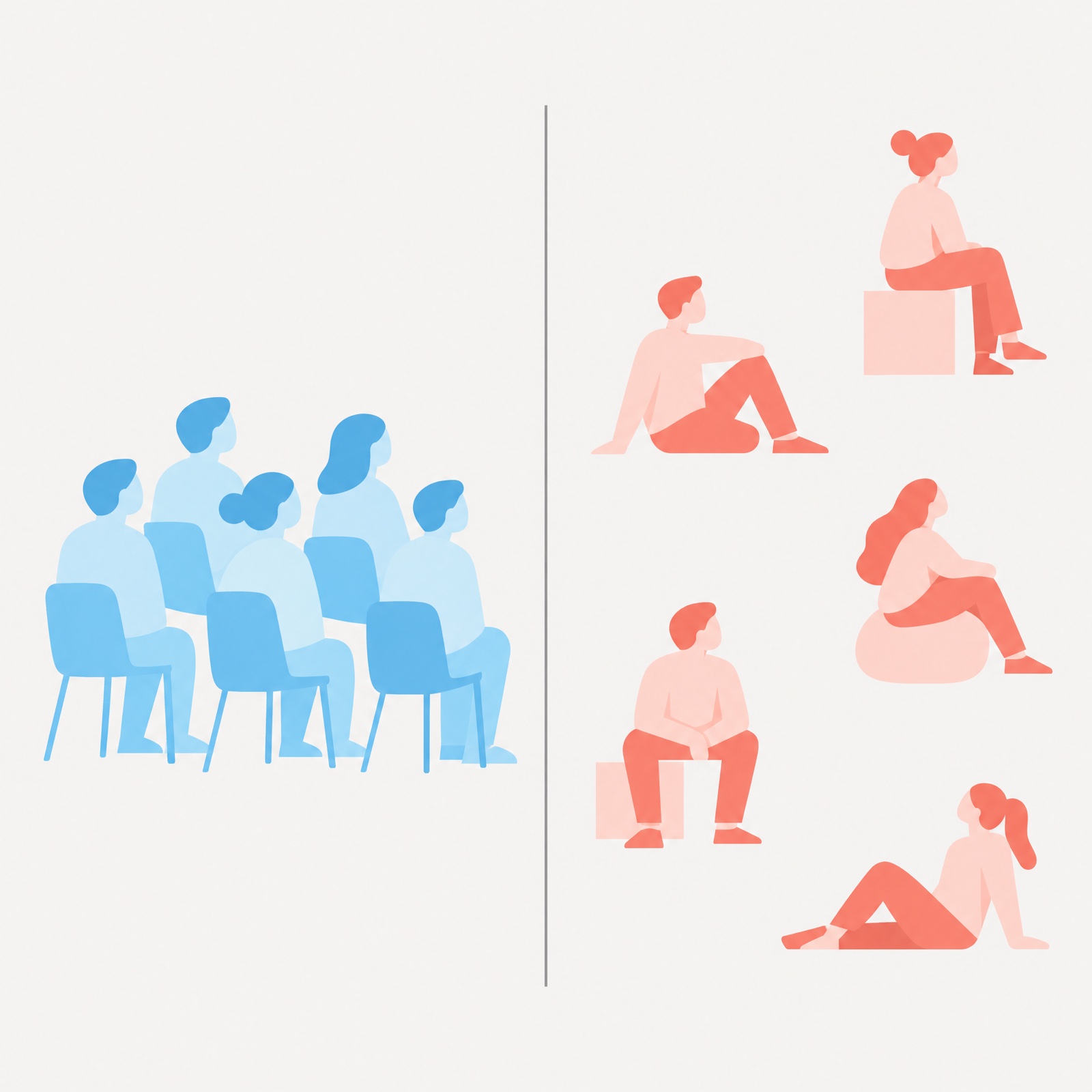
What synchronous learning is
Synchronous learning is any training where people have to be present at the same time. A classroom session, a workshop, a live Zoom call. The defining feature is not the room or the software, it is the schedule. Everyone is there together, and the session can change course in the moment.
In a workplace that usually means the sessions people have to attend at a set time, where they need to ask a question and get an answer immediately.
What asynchronous learning is
Asynchronous learning is any training a person completes on their own schedule. Recorded video modules, written guides, self-paced courses. Nobody waits for anybody.
In a workplace that usually means compliance and product knowledge, and anything people come back to later when they actually need the detail.
Synchronous vs asynchronous learning, side by side
| Dimension | Synchronous | Asynchronous |
|---|---|---|
| Timing | Fixed. Everyone attends at once | Open. Each person chooses when |
| Interaction | Live, two way, immediate | Delayed, usually through comments or assessments |
| Feedback | Instant, and the trainer can adapt mid session | Built in ahead of time, through quizzes and checks |
| Cost as you scale | Rises with every session, venue and trainer | Paid once at build, then flat |
| Best fit content | Practice, role play, negotiation, difficult conversations | Compliance, product knowledge, onboarding, anything repeated |
When each one wins
The general trend is to shut down most synchronous learning practices and move to asynchronous, which I think in some cases is not the right move, because there are circumstances where in-person training can indeed help. You really have to navigate this per use case.
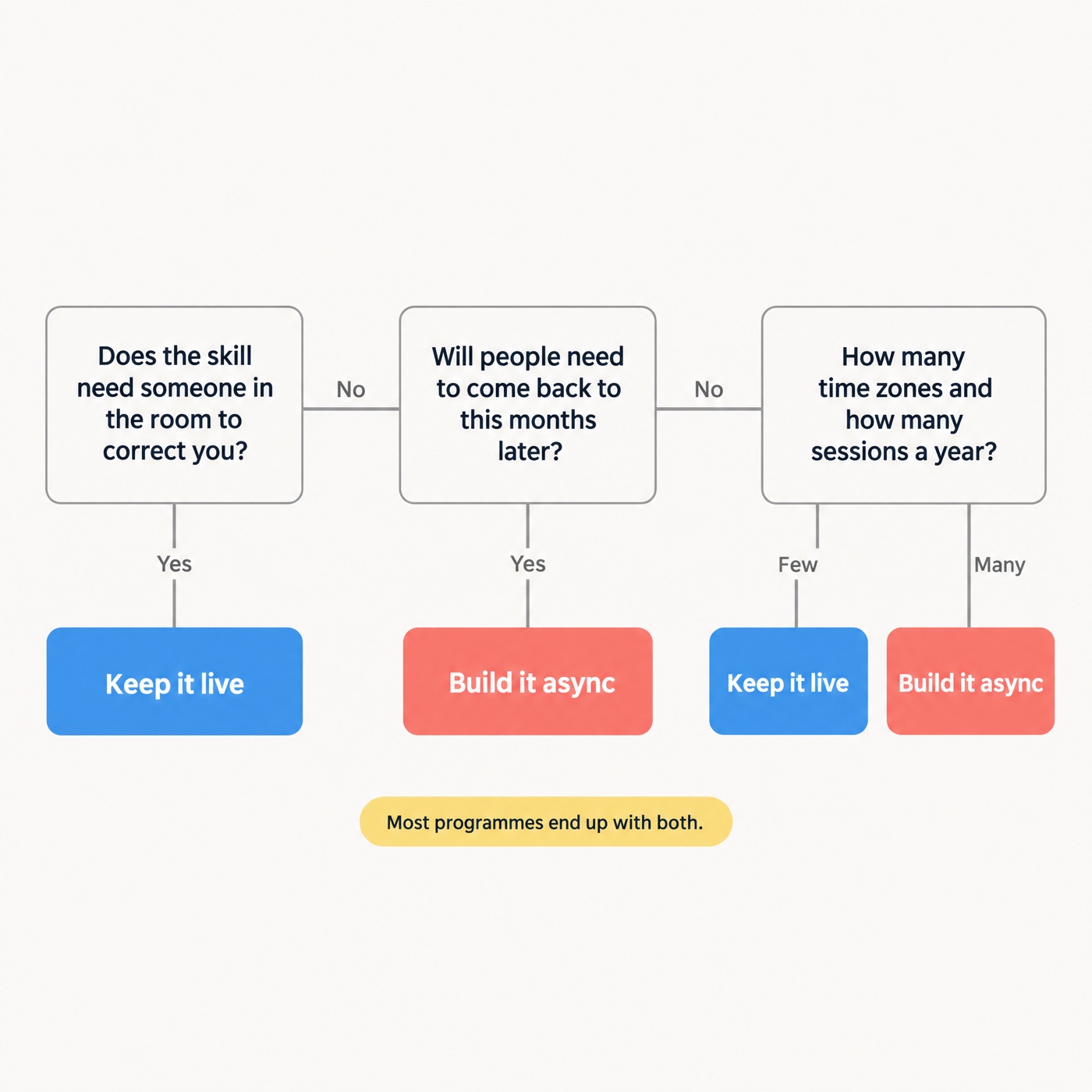
Three tests, and any one of them is enough to keep a session live.
Does the skill need someone in the room to correct you? If a person has to be told they are getting it wrong while they are getting it wrong, that is a room, not a recording. The correction has to land in the moment or it does not land at all.
Does the content need to be memorized and practiced throughout the year? If it does not, the live version can still be worth more, given its learning impact. One good session people actually attend beats a recording nobody returns to.
How many time zones, and how many sessions a year? At a handful of each, the cost argument for async is weak and live is fine. It is the quantity of people and use cases that makes live training hard to scale, not live training itself.
What breaks at scale is running everything live. Time zones are definitely one aspect. Then there are the cost factors. I get continuous cost complaints about the venues and the facilities needed, and the technologies on site that are only used for these use cases. That is a pain that corporates face.
Beyond that, the more functions there are, the more disciplines you need to maintain, and the more training sessions you need to hold. If those sessions have to be live, it gets harder to scale, given the quantity of people and use cases.
When not to go asynchronous
There is a significant cost benefit to async video. But you would be surprised that sometimes the gap is smaller than you expect, given how much vendors charge for both technologies, and for live training too.
If your live training does not need to be memorized and practiced throughout the year, there are cases where the live version is more beneficial for you, given its learning impact. On balance I would just stick with the video.
The honest version is that in-person training genuinely helps in some circumstances, and the fashionable move of cutting all of it is not automatically the right one. We sell tooling for asynchronous video, so take the recommendation with that in mind, but the answer still depends on your use case.
What this looks like at four companies
None of this is hypothetical, and the four public examples below do not all point the same way.
IBM ran the experiment at scale, and it rebounded. MIT Sloan’s case study of IBM’s learning system tracked what happened when the classroom closed in March 2020. Classroom and event learning fell from 15 percent of learning time to under 3 percent, and asynchronous online learning rose from 68 percent to more than 83 percent. Then live learning came back. By April it was more than 43 percent of all learning hours, and it settled at around 30 percent in the months after. Online learning overall accounts for 95 percent of time spent. Roughly a third of it went back to being live as soon as it could.
Walmart kept the room. Since 2016 the company has opened 200 physical Academies and estimates it trained 2 million associates by the end of 2019. The program combines facilitator-led instruction with hands-on sales floor training. Walmart does not frame that as a synchronous versus asynchronous decision, but floor training under a facilitator is the first test in practice.
GitLab is handbook-first and still runs live sessions on purpose. The company is all-remote, and its handbook is the primary source of learning. The interesting part is what it kept live. Its L&D team uses live courses “as an opportunity to build relationships and a sense of community with team members”, not to move information around, because the handbook already does that.
Unilever went online because of the map. With more than 155,000 employees across 68 locations, cross-border communication is a business requirement rather than a preference. Its English language training moved to a flexible online format and reports an 81 percent adoption rate, with close to 400 employees a year in Latin America using the platform. That is the third test, settled by the shape of the company rather than by a view about how people learn.
What a hybrid model actually looks like
We can now genuinely use AI for this, because AI can personalize the learning journey and make the whole thing feel more synchronous. Colossyan is trying to build a feature set that aligns much better with synchronous learning practices, for example when you are in a classroom. You can use training videos even in a classroom setting, where they align with the data points and measuring tools you are deploying there anyway.
Colossyan does not need to be the complete opposite of synchronous physical learning. We can be there too, and the same goes for other digital solutions.
Where AI video changes the equation
Here is the thing the general population still does not fully understand. We can now use the power of AI to push synchronous learning asynchronously.
What I mean is that we do not need teachers, or a room, or even Zoom, to get the outcome those things were there to produce. We can enable more adaptive learning practices to meet the goals we set out to achieve previously, which is really powerful. AI, technology and agents can genuinely help us get there.
So in that regard, I would say the world is going more towards synchronous learning, not asynchronous, given that change. That is one thought worth sitting with. The delivery is asynchronous. The experience is becoming synchronous. That is why framing it as synchronous vs asynchronous is already less useful than it looks, and why a page that only tells you to pick one of two boxes is answering an older version of the question.
This is also where the cost argument stops being theoretical. Building the content once as AI generated video changes the shape of the cost. It is the same economics behind AI instructional videos generally, and it runs across the workplace training use cases we see most, from onboarding to compliance training.
How Paramount cut training video production from weeks to hours
Paramount replaced manual video production with Colossyan's AI avatars, cutting production time from weeks to hours across their global L&D team.
Read the full story →What buyers get wrong
Practice and repetition, and the quality of both, are not as figured out in live training as they are with video or any digital and asynchronous tooling.
With video you can always come back to it. If you do a synchronous offline training, the knowledge disappears so quickly. So it comes down to the repetition, and to fetching the knowledge again. It is the same reason nobody finishes training docs.
How you know it worked
Twelve months later, the signal is the measurements, the business impact, the KPIs.
In the case of sales enablement, how are their key KPIs changing? In the case of compliance, has everyone actually upskilled? It depends on the use case again, but you need to really try to measure end to end, not just engagement rate or satisfaction scores. Those are not the same thing as business impact, which is the point behind why content alone does not change behavior.
The part most L&D leaders will disagree with
Synchronous learning offline still has a place, and digital tools like ours still need to support customers who embark on that journey, because it is not going to go anywhere.
But you can already create more synchronous digital flows today, using AI platforms.
Frequently asked questions
The synchronous vs asynchronous learning distinction comes down to scheduling. Synchronous learning happens live, with the trainer and the learners present at the same time. Asynchronous learning happens on the learner's own schedule, with no one waiting on anyone else. Most workplace programs use both.
Asynchronous training is any training a person completes in their own time rather than at a scheduled session. Recorded video modules, written guides and self-paced courses are all asynchronous.
Onboarding modules a new joiner works through in their first week, product knowledge refreshers, compliance courses, and recorded walkthroughs a person can return to when they need the detail again.
There is no one in the room to read confusion on a face and adjust. Skills that need live practice and correction, such as negotiation or difficult conversations, are hard to build from recorded content alone.
Self-paced training is asynchronous. Online training is not necessarily either, because a live session on Zoom is online and synchronous at the same time. The question is whether anyone has to be present at a set time.
A live Zoom session is synchronous. A recording of that session, watched later, is asynchronous. The tool does not decide it, the scheduling does.