
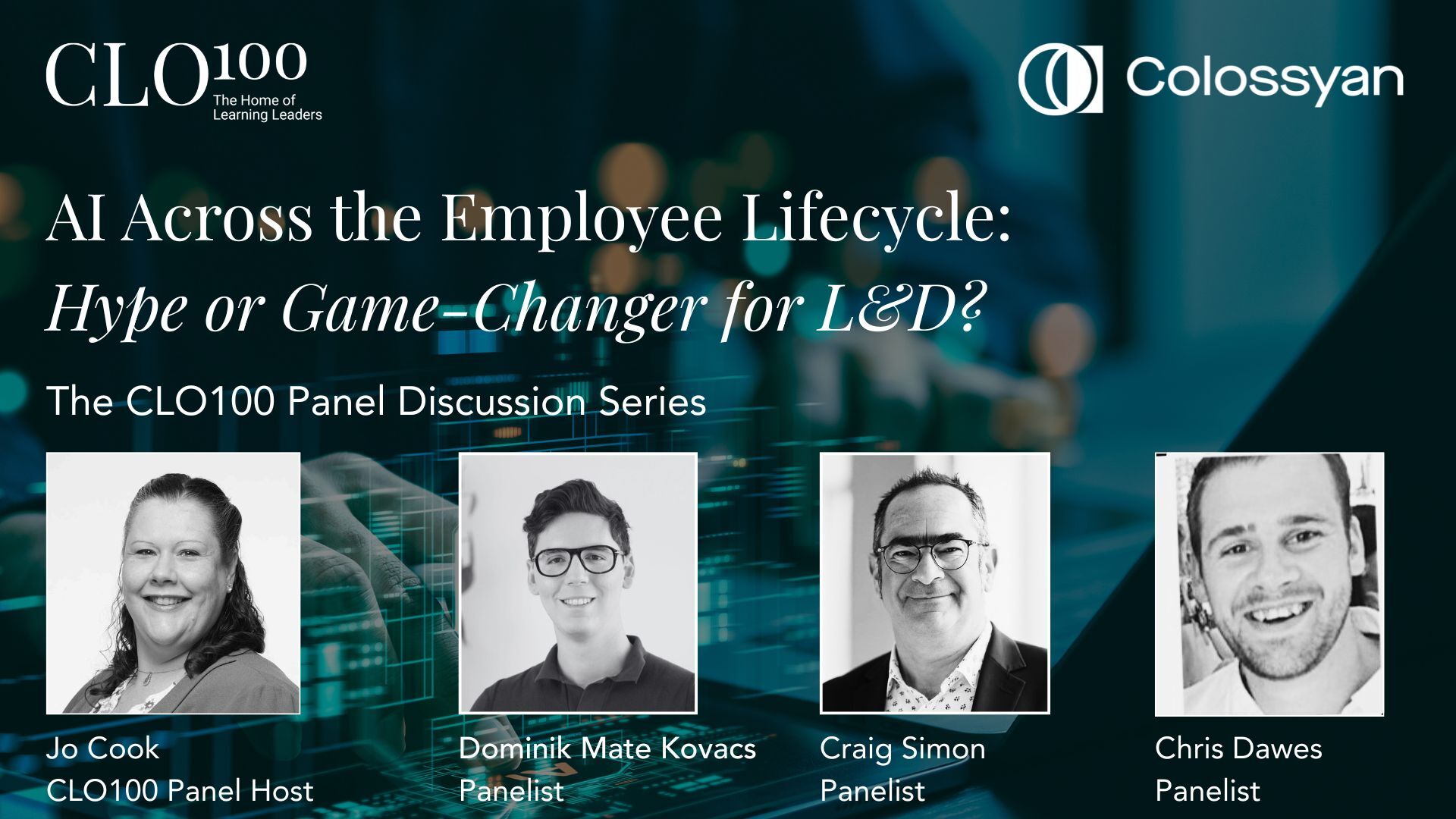
AI Across the Employee Lifecycle: Hype or Game-Changer for L&D? - CLO100 Panel Discussion
Join CLO100 and Colossyan for a panel on where AI delivers real value across the employee lifecycle, from onboarding to upskilling and retention.

How AI is reshaping the employee journey through the lens of Learning & Development?From onboarding and compliance to upskilling, career growth, and retention, we’ll explore where AI is delivering real impact — and where the hype still outweighs results.Join CLO100 and Colossyan to learn how L&D leaders are using AI to personalise learning, scale content delivery, and boost engagement across every stage of the employee lifecycle.What We'll Cover:
- Where AI is adding real value across the employee lifecycle
- Practical ways AI is helping L&D scale, personalise, and modernise learning
- How leaders can adapt learning strategies for an AI-enabled workplace
There will also be a dedicated Q&A session, giving you the chance to interact with our expert panel and pose your most pressing questions.Who Should Attend:This session is for L&D leaders and professionals who want to understand where AI delivers real value across the employee lifecycle.Reserve your place today to join the conversation!om
What this session covers
This CLO100 panel brought together Chris, global digital learning leader at Primark, Craig, CEO and co-founder of Rockmouse, and Dominik Kovacs, founder and CEO of Colossyan, with a CLO100 host moderating. The brief was to look past content creation and ask where AI changes the employee lifecycle itself, and whether it makes L&D more effective or only busier.
The conversation ran through four topics. The first was where AI delivers value, from onboarding and in-the-flow support to assessment and offboarding. The second was how to redesign learning strategy for an AI-enabled workplace, which included a live audience poll on where people most want to apply AI. The third was AI as a strategic lever for L&D rather than a set of tools. The last half hour was audience Q&A, mostly on fear of AI, leadership expectations of “learning” and where generative AI is gaining traction.
The panel kept returning to the same tension: efficiency is the lowest-value argument for AI, and the teams that gain most tie learning to business outcomes, experiment in small steps and treat AI as a partner rather than a tool.
Key takeaways
- Chris says to start from the business problem, not the technology. He frames it around skills: what it costs to acquire, build or borrow a skill, and how long the business keeps its value. He also suggests borrowing data models from marketing and customer teams, who are often ahead on AI.
- Dominik sees value almost everywhere in the lifecycle: onboarding connected to knowledge bases, bots inside Teams or Slack, and conversational simulations such as practicing a difficult feedback conversation as a new manager. He notes that this extends coaching-style experiences to individual contributors, not only senior leaders.
- Craig argues L&D should stop building long programs and start building assets: short, personalized performance support that sits close to the moment of need.
- Offboarding is the gap Craig points to. Knowledge walks out the door, and AI agents or digital twins of experienced staff could capture it. Dominik and the host agree this is underused, especially in high-turnover areas.
- Chris recommends sorting needs into three buckets: what people need to know, what they need to be able to do, and what they need to know how to find. A lot of L&D work, he says, falls in the third.
- Governance cannot be skipped. Chris describes internal debate when Primark launched an avatar: who owns a leader’s likeness, what data feeds the models and how outputs get checked.
- Craig makes the case that instructional designers are well placed to write good prompts and agents, because both are clear, outcome-focused instructions written for a specific audience.
- To move leaders off classroom habits, Chris prices it out. Compare the cost of a room full of people for a day with an asset delivered in two or three weeks, and ask how quickly they need it.
Questions answered in this session
How can organizations reduce fear of AI?
Craig says it starts at the top: senior leaders should admit they do not know everything and show their own experiments and failures. He also suggests changing the framing, treating AI as an intern, mentor or assistant that people stay in control of.
Where is generative AI gaining most traction in L&D?
Dominik says content creation is the most widely used area, because anyone can adopt it bottom-up and the time savings are clear. Linking learning to business outcomes is harder, since it needs wider organizational buy-in and more complex implementation.
What is the one piece of advice from the panel?
Dominik says the organizations that succeed will measure impact, run pilots tied to outcomes and keep security and compliance in view. Chris adds that people are already using AI at work, so the job is getting the business ready for it. Craig asks teams to stop treating faster, cheaper content as the goal.
Who should watch
L&D leaders and heads of learning who need to explain AI strategy to executives will find the most here, particularly the arguments for performance support over programs and for measuring against business outcomes. It also suits enablement and HR leads thinking about onboarding, offboarding and knowledge capture.