
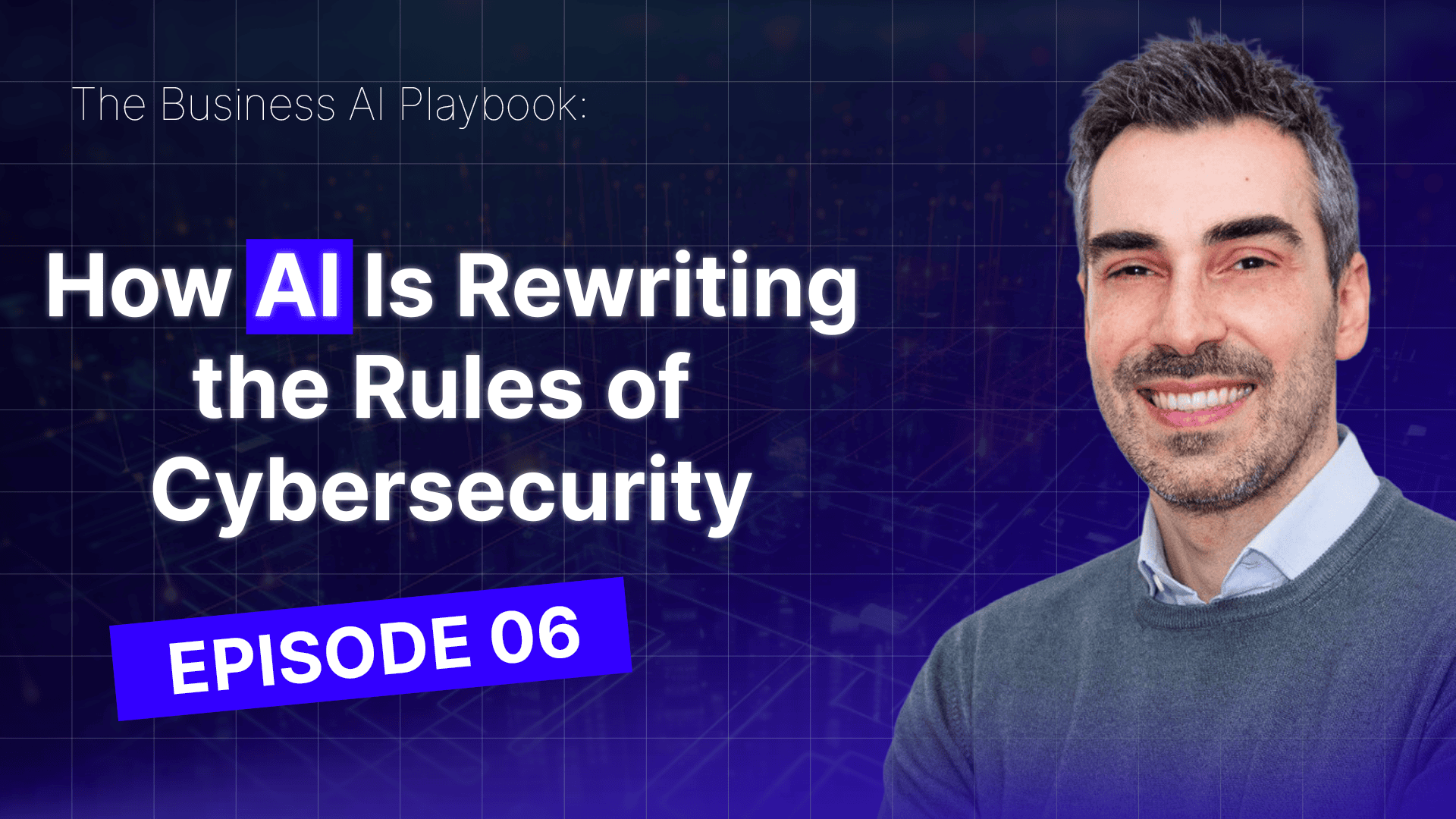
How AI Is Rewriting the Rules of Cybersecurity with Carmine Valente
Dominik talks with Carmine Valente about adopting AI responsibly in high-stakes industries, from real-world security risks to governance that scales.

AI is transforming how enterprises work—but it’s also transforming the threat landscape. In this episode of Business AI Playbook, Dominic talks with Carmen (AI & Data leader at Con Edison, formerly leading AI initiatives at Paramount) about what it takes to adopt AI responsibly in traditional, high-stakes industries.
We cover real-world security considerations (phishing, social engineering, expanded attack surface), plus the operating model that makes AI safer at scale: use-case-driven governance, cross-functional AI committees, and building internal alternatives so employees don’t need to rely on public tools.
🧠 Guest: Carmine Valente
🎙️ Host: Dominik
00:00 – Welcome + episode setup
00:23 – Carmen’s background (Con Edison, ex-Paramount)
01:44 – AI adoption & the expanding attack surface
04:13 – Why GenAI/LLMs became a new target
06:17 – Phishing, deepfakes, and tailored social engineering
10:33 – Security fundamentals + layered controls
12:14 – Fighting AI with AI: behavioral analysis + deception/poisoning
13:33 – IAM, vendors, and third‑party AI risk
14:50 – Step one: map how your org is actually using AI
17:06 – Continuous monitoring: user + network behavior analytics
20:54 – Security as an enabler (AI’s “cloud moment”)
24:34 – Use‑case driven AI committee (legal/compliance/privacy/cyber)
28:00 – Practical guidance for business leaders using GenAI
30:19 – How to educate teams using familiar examples
32:12 – Why “just block it” fails + lessons from shadow AI
36:03 – Building internal AI capabilities
37:27 – Agentic AI & why humans stay in the loop (for now)
41:33 – Key takeaways: awareness, adaptation, governance
What this session covers
Dominik talks with Carmine Valente, AI and data leader at Con Edison, who previously led AI initiatives at Paramount. The conversation is about the security side of enterprise AI: how it enlarges the attack surface, how defenders respond, and how a company can let people use AI without losing track of its data.
Carmine starts with the shift he saw around 2022 and 2023, when generative AI made language models a new target and gave attackers cheap, tailored tools for phishing and social engineering. He then covers defense, from layered fundamentals to behavioral analysis and deception techniques, before moving to the operating model at Con Edison: a use-case-driven AI committee and an internal alternative to public chatbots. The final third looks at how to explain risk to business colleagues and where agentic AI is heading.
Key takeaways
- Carmine says AI “democratizes hacking”: tasks that once took technical skill, such as writing convincing phishing emails, are now open to almost anyone using public tools.
- He also describes AI as a multiplier. Automation, behavior analysis and external AI integrations mean a company may face thousands of attackers acting at once, which is why hiring more defenders cannot be the answer.
- His two-part response is to strengthen the fundamentals with multiple layers of control, and to fight AI with AI, using behavioral analysis and deception technology that feeds misleading data to attacker models.
- Behavioral analysis started with machine learning. Generative AI makes the review of outliers faster and deeper, and the same approach applies to user logins, network traffic, infrastructure and operational technology.
- Step one is to find out how your organization is actually using AI. When Carmine’s team looked in 2022, leaders said usage was low, but the analysis turned up many third-party AI tools receiving data.
- Blocking public AI tools is a short-term measure at best. People reach them from phones and personal computers, so Carmine recommends understanding the use case and protecting it. He compares the moment to early cloud adoption.
- Con Edison’s AI committee includes technology, development, legal, compliance, privacy and cybersecurity, and exists to define business cases first, with security and legal controls built around each use case.
- Carmine expects humans to stay in the loop for a long time, and says he cannot picture a fully automated security operations center.
Questions answered in this session
What does AI change about phishing and social engineering?
Carmine says tools now let attackers analyze behavior and build tailored campaigns for an organization, department or person, including cloned voices. The barrier to entry has dropped and the volume has risen.
Why not simply block public AI tools?
He says early blanket blocks were a mistake he made too. People get around them on personal devices, and the data risk moves out of sight. He suggests using the block as a stopgap while you work out the use case and the right controls, and offering an internal alternative.
How do you explain AI risk to non-technical colleagues?
Carmine uses ChatGPT and everyday tasks like fixing the grammar in an email. Colleagues already know what they paste in, so it is easy to show that the data goes somewhere they cannot see.
Who should watch
Security, IT and risk leaders working out an AI policy, and L&D, HR or enablement teams who need to understand why security teams respond as they do. It is also useful for business owners who want a plain-language way to start the conversation with their CISO.