


Blog
7 Best Video Editors With Built-In Voice-Over Features

Many creators and teams want to add voice-overs to their videos without piecing together three or four apps. Whether you need your own narration, AI-generated voices, or even voice clones for consistent branding, your editor should let you work all in one place. This guide looks at seven video editors that give you those built-in voice-over features - without extra complexity or lots of manual syncing.
What matters in a voice-over video editor
For this list, I looked for tools that make the process simple. The best editors let you record or generate voices, add auto-subtitles for accessibility, handle multiple languages when needed, and give you strong audio controls like volume, speed, pitch, and fades. Some go further with AI-powered dubbing, brand voice cloning, advanced analytics, or direct SCORM export for training teams.
I’ve picked options for all skill levels - beginners on mobile or desktop, agencies, marketing, and especially organizations modernizing their learning videos.
Here’s what the best editors offer:
- Record or create AI/text-to-speech voices right in the app
- Auto-generated, accurate subtitles and easy caption exports
- Tools for translating or localizing content to more than one language
- Audio controls for fine-tuning the result
- Simpler workflows: templates, script-to-VO syncing, stock media
- Collaboration features for teams, analytics where needed
- Cross-platform flexibility (web, desktop, mobile)
1) Colossyan - best for training teams who need scalable voice-over, localization, and analytics

If you need to build voice-over videos for training or learning at scale, you’ll run into problems most editors can’t handle: consistent brand pronunciation, instant translation, easy voice cloning, direct SCORM export, and analytics that measure real learning. This is where I think Colossyan stands out.
You don’t need to record your own narration. With Colossyan, you select from multilingual AI voices or even clone your own for consistency. Pronunciations for tricky names or acronyms are saved and instantly apply each time you reference them in a script.
If you’re localizing, you can use the Instant Translation feature to switch an entire video - voice, on-screen text, and all interactions - to a new language and export separate drafts for each version - a step beyond simple TTS dubbing. Timing stays in sync; you only adjust visual layout if the new language changes text length.
You can import documents, PowerPoints, or PDFs and have them auto-converted to scenes, with speaker notes turning into voice-over script instantly, which is much quicker than manual workflows found in most editors. Add pauses and script block previews to get natural delivery.
For interactivity, you can insert quizzes and branching dialogue into the video itself, set pass marks, and export as SCORM 1.2/2004 for use in any standard LMS. Real analytics track who is watching, for how long, and which questions they answer correctly.
You can also export audio-only narration or closed captions separately if you need those for compliance or accessibility.
2) CapCut - best free pick with flexible recording, AI voices, and auto-subtitles
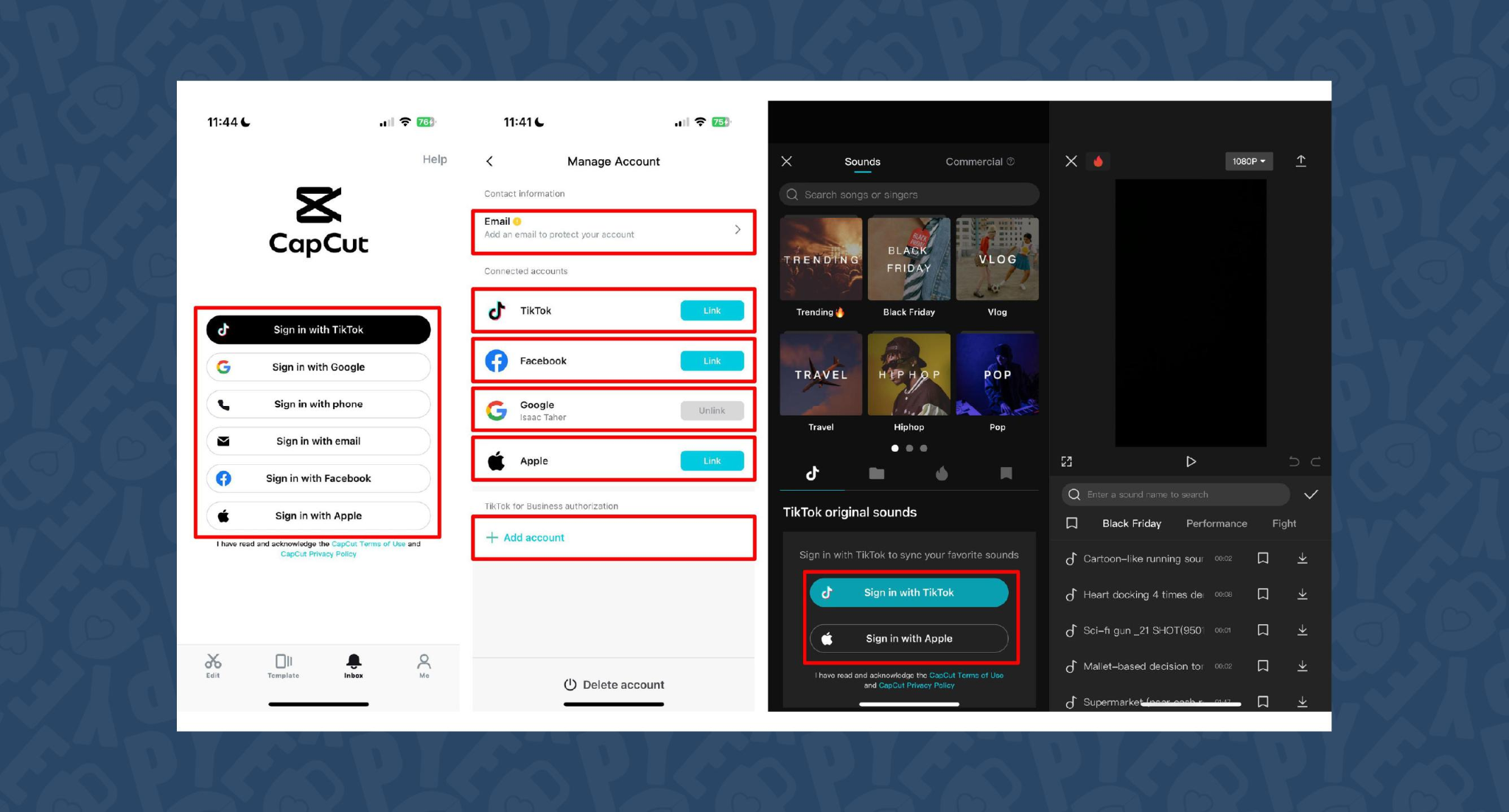
CapCut is popular because the basics are unlimited and easy. You can record voice-overs online, with no time limits, or use built-in AI for text-to-speech. It auto-generates subtitles even if the speaker’s not on screen. The editing controls let you adjust pitch, speed, volume, fades, and more, and you can mix several audio tracks. For global reach, you can use built-in AI dubbing to generate multi-language versions of your VO.
On mobile, the recording flow is in-app for iPhone (Sound > Microphone); on desktop or web, you script, record, add subtitles, edit, and export - all in one. This feels more like a professional tool than most free options.
You can use CapCut to clarify complex videos with on-screen captions, localize tutorials for other markets, or keep a consistent voice tone for social media videos.
3) VEED - best for replacing multiple tools (recording, captions, storage, sharing)
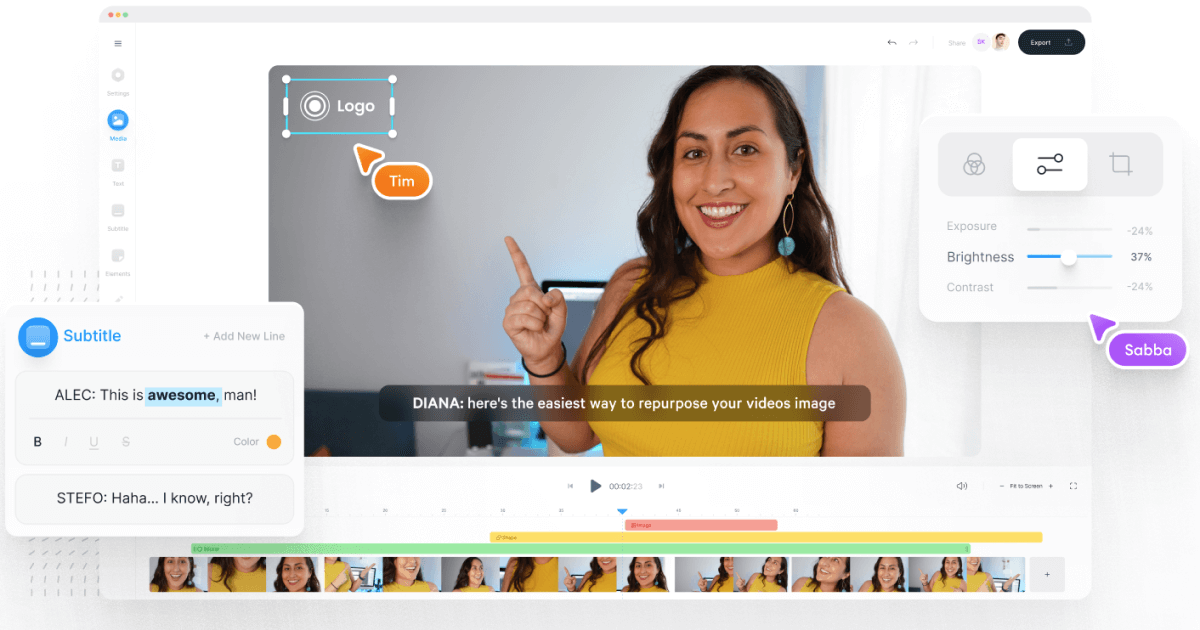
VEED has built a reputation as an all-in-one workflow. Instead of bouncing between Loom, Rev, Google Drive, and YouTube, you get everything in one place: recording, AI text-to-speech, one-click subtitle generation, and automatic audio cleanup.
User reviews are strong (4.6/5, with about a 60% reduction in editing timeaccording to one testimonial). It’s aimed at teams who need consolidated workflows and secure sharing. You edit, subtitle, and publish in one tool - no more file shuffling or switching between apps.
4) Speechify Studio - best for fast AI dubbing with a large voice library
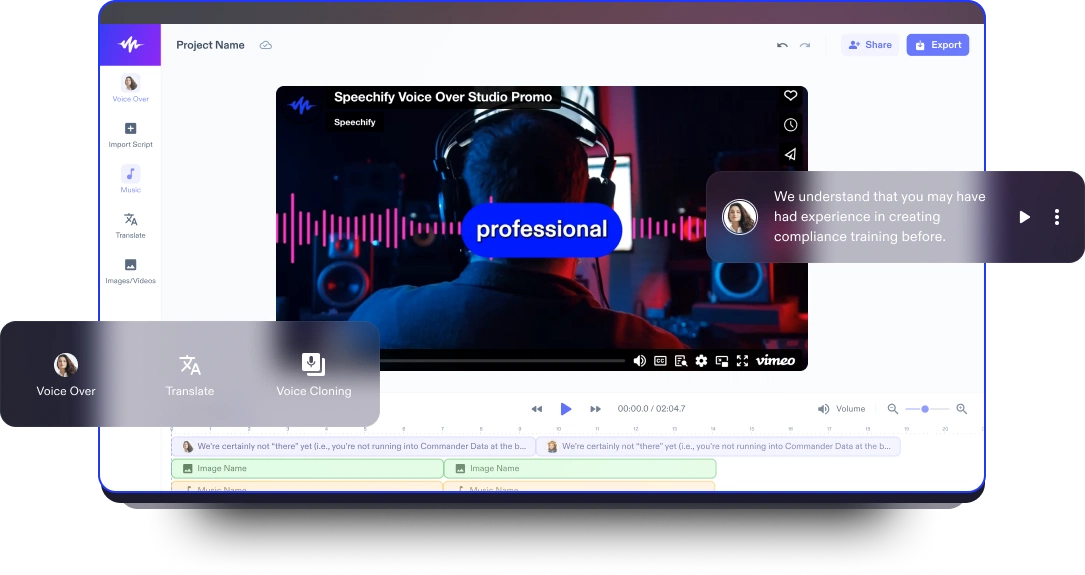
Speechify Studio focuses on AI voice versatility. You get over 200 lifelike voices in multiple accents and languages, perfect for instant dubbing or easy localization. One click dubs into new languages and generates synchronized subtitles. The editor is drag-and-drop, with templates and a vast library of royalty-free music and video assets.
Everything happens in the browser, working across platforms. You can upload your own VO or just use the AI, mix in background tracks, and export in multiple sizes (for YouTube, Instagram, etc.). For YouTube, social teasers, or education, this is one of the fastest ways to get multi-language narration without hiring VO talent.
5) ClipChamp - best free TTS variety and easy script control
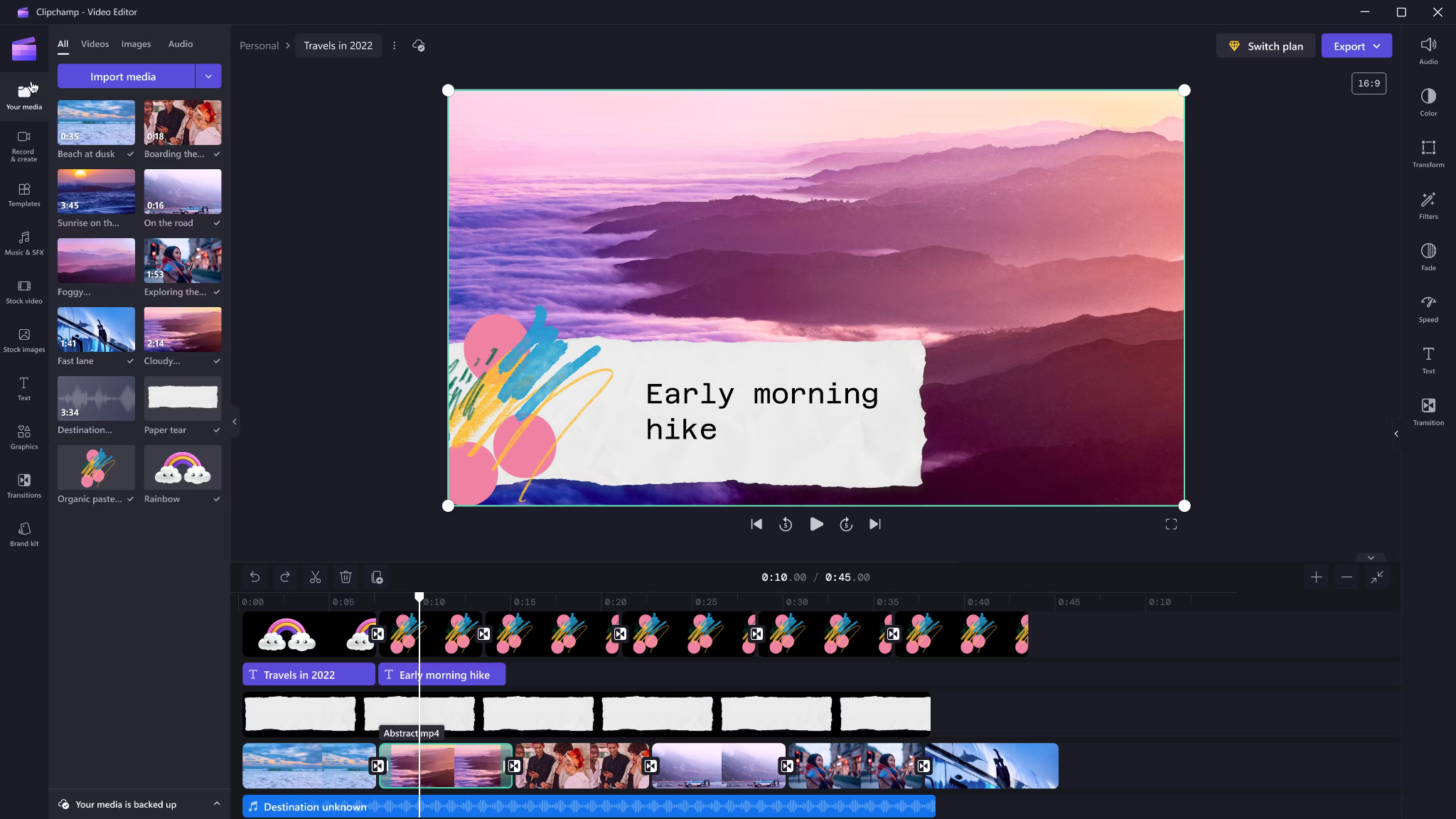
Clipchamp shines with variety and ease for AI voice-overs. It includes 400 AI voices (male, female, neutral) in 80 languages. You can tweak pitch, emotion, speed (0.5x to 2x) and control pauses/emphasis directly in your script by adding ellipses (“...”) or exclamation marks. If voices mispronounce a word, type it out phonetically.
Output options include transcript exports, subtitles, or just the audio as MP3. Every export is free and unlimited, and user reviews are high (4.8/5 from 9.5k reviews). This is a quick route for social videos, simple explainers, or business presentations.
6) Powtoon - best for animated explainers with built-in VO recording

Powtoon’s big advantage is simplicity for animated videos. It has built-in voice-over recording, lots of customizable templates, and a royalty-free music library. Major brands use it for onboarding and explainers, and it claims tens of millions of users.
You can record your narration directly in the editor, layer music, set up a branded look, and publish to social or business platforms straight from Powtoon. This works well if you want animations with matching narration, but don’t want to learn complex motion tools.
7) Wave.video - best for quick client-ready edits and layered audio tracks
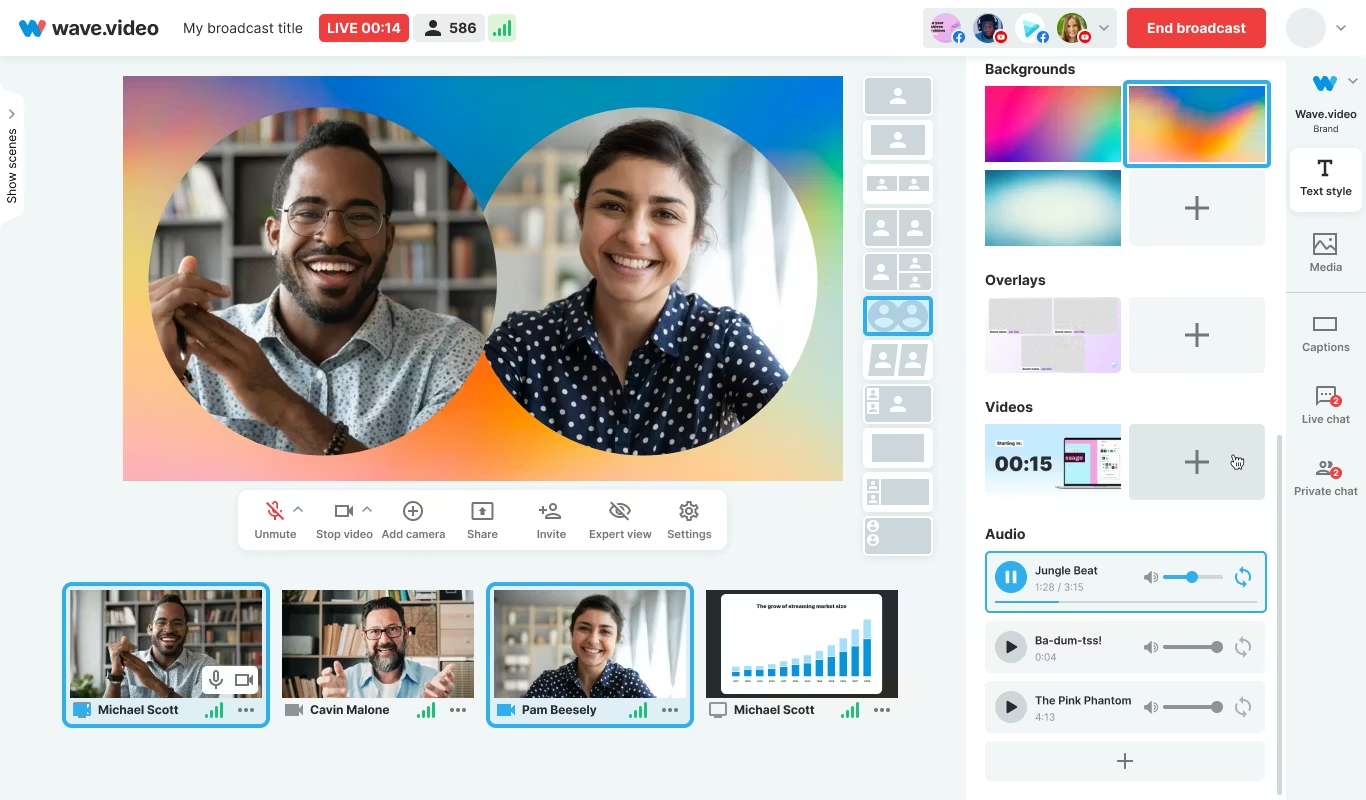
Wave.video is designed for speed and easy audio layering. You can record or upload up to three audio tracks (voice, music, sound effects), then trim and sync each on a clear timeline. Automated captions let your video communicate even if played on mute. Users report getting client-ready videos in as little as 20–30 minutes, thanks to the streamlined process.
This tool fits agencies and freelancers who need regular, clear voice-over videos with quick turnarounds.
Honorable mentions and caveats
There’s also the Voice Over Video app for iOS/iPadOS. It handles multiple VO tracks and edits, and offers a cheap lifetime unlock. However, some users find problems with longer videos: slow playback, export glitches, or audio muting bugs. It’s okay for short clips - test it before using for multi-segment training pieces.
How Colossyan maps to the needs above
I’ll be clear - most editors focus on easy voice-over for marketing or social video. Colossyan stretches further for learning and enterprise.
If you need multilingual versions, Instant Translation creates new language drafts for the whole video (script, on-screen text, interactions), maintaining layout. You can use cloned voices for brand consistency, and our Pronunciations library does what some other editors only do for one-off cases: you save pronunciation settings for product names or technical terms, and every video stays correct.
Pauses, animation markers, and script editing give you fine control over delivery and pacing - a real edge if you want natural, accurate speech. And while Clipchamp lets you control delivery with punctuation, Colossyan lets you sync these to avatar gestures and on-screen animations for even more realism.
Large teams can import docs or PowerPoints and transform them into scenes with the narration built in - saves hours compared to manual scripting. Collaboration, brand kits, and workspace organization mean even non-designers or new team members can keep everything consistent.
We support interactive learning: quizzes and branching, tracked by analytics. SCORM export means your videos fit into any LMS or training system, and our analytics track real results (scores, time watched, drop-off points). For organizations, this is a serious step up from just generating a narrated video.
Example: For compliance learning, import a policy PDF, assign a voice clone, adjust pronunciations for terms like “HIPAA,” add quizzes, export SCORM, and get analytics on where learners struggle - a complete feedback loop.
For a multilingual product rollout, create an English master, translate to Spanish and Japanese, assign native accents or avatars, export closed captions and audio-only versions for other channels, and keep all assets in sync with your brand.
For scenario-based training, use Conversation Mode to create role-play videos with branching. Learners pick responses, and you measure the impact with analytics - something most consumer editors can’t do.
The right editor for your scenario
If you’re a beginner content creator or need simple, free TTS and subtitles, CapCut or Clipchamp is enough.
Marketing teams might prefer VEED to replace multiple tools and simplify sharing, or Powtoon if you need stylish explainers fast.
If you want fast, multi-language dubbing, Speechify Studio or Clipchamp do it, but for real global training with instant translation, on-screen adaptation, and analytics, Colossyan is the stronger choice.
For building e-learning, SCORM packages, compliance training, or videos for enterprise where accuracy and engagement matter, I’d pick Colossyan every time.
Want more guidance on scripting voice-overs, localizing training, or making sure your AI voice matches your brand? Book a demo with our team and we will run through the best ways you can.
How To Make Software Training Videos: A Step-By-Step Guide

To make effective software training videos: 1) Define learner outcomes and KPIs, 2) Break workflows into bite-sized tasks, 3) Script in a conversational, step-by-step format, 4) Choose a format like screencast, avatar, or hybrid, 5) Produce with clear branding, captions, and on-screen prompts, 6) Add interactivity like quizzes and branching, track results with SCORM, 7) Localize for key languages, 8) Publish to your LMS or knowledge base, 9) Analyze watch time and pass rates, 10) Update based on analytics.
Why software training videos matter now
A lot of employees say they need better training materials. Over half - 55% - report they need more training to do their jobs well source. And people actually look for video training: 91% have watched an explainer video to learn something in 2024 source. There’s good reason for this - e-learning videos can boost retention rates by up to 82% compared to traditional methods.
This isn’t just about feels or fads. U.S. companies spend about $1,286 per learner per year on training. That’s a big investment - so it should work. Some real examples back this up: Microsoft cut its learning and development costs by about 95% (from $320 to $17 per employee) when it launched an internal video portal. Zoom cut its video creation time by 90% after moving to AI-powered video production. Berlitz made 1,700 microlearning videos in six weeks, producing faster and cutting costs by two-thirds.
The lesson: shorter, purpose-built videos not only lower costs but actually help people learn more and stay with the company.
Pick the right training video format for software workflows
Not every video needs to look the same. Choosing the best format helps learners get what they need, faster.
Screencasts are great for point-and-click steps, UI changes, or any kind of hands-on walk-through. If you’re explaining a new feature or daily workflow, a screencast with clear voice-over covers it.
AI avatar or talking-head formats add a personal touch. Use these when you need to explain why a change matters, show empathy, discuss policy, or onboard new users.
Hybrid approaches are gaining ground: start with an avatar giving context, then cut to a screencast for hands-on steps - so learners get clarity plus a human connection.
Don’t forget interactive training videos. Adding quick quizzes or branching scenarios creates active learning and gives you feedback on who actually understood the lesson.
Keep most topics to 2–7 minutes. Under 5 minutes tends to work best for engagement. Microlearning for single tasks works well at 60–90 seconds. Change scenes every 10–20 seconds and keep intros short (about 10 seconds). Always use captions.
Step-by-step: how to make software training videos efficiently
Step 1: define outcomes and KPIs
Decide what the learner should be able to do. For example: “Submit a bug ticket,” “Configure SSO,” or “Export a sales report.” KPIs might be quiz pass rate, average time to completion, watch time, or rate of errors after training.
If you use Colossyan, you can set up projects in organized folders for each workflow and use built-in analytics to track quiz scores and viewing time - especially useful if you want SCORM compliance.
Step 2: break the software workflow into micro-tasks
Split every workflow into the smallest possible tasks. This speeds up production and makes learning less overwhelming. For example, “Create a support ticket” is really several steps: open app, select project, fill summary, choose priority, submit.
With Colossyan, Templates help you scaffold these microlearning modules fast and keep things consistent, even if you don’t have a design background.
Step 3: gather your source content and SME notes
Scripts should always be based on company manuals, SOPs, or input from actual subject matter experts. Cut any fluff or redundant info.
Our Doc to video feature allows you to upload SOPs, PDFs, or even PowerPoint files; the platform then splits them into scenes, pulling out speaker notes and draft scripts.
Step 4: script a conversational, step-by-step narrative
Focus the language on step-by-step actions - don’t use confusing jargon. Keep each script to 1–3 learning objectives. Plan to include on-screen text for key steps and definitions, and change scenes quickly.
I usually rely on our AI Assistant to tighten up scripts, add Pauses for pacing, and set up Pronunciations so brand acronyms are said correctly.
Step 5: set brand and structure before recording
People trust materials that look consistent. Using Brand Kits in Colossyan, I apply the right fonts, colors, and logos across all video modules. I resize drafts to match the destination - 16:9 for LMS, 9:16 for mobile.
Step 6: produce visuals (screencast + presenter)
For actual workflows, I capture a screen recording to show the clicks and UI. Whenever possible, I add an avatar as presenter to introduce context or call out tricky steps.
In Colossyan, our Media tab supports quick screen recordings, and avatars (with custom or stock voices) let you give a consistent face/voice to the training. Conversation Mode is handy for simulating help desk chats or scenarios. Animation Markers and Shapes allow precise callouts and UI highlights.
Step 7: voice, clarity, and audio polish
Audio should be clean and clear, with no awkward pauses or filler. Colossyan has a Voices library or lets you Clone Your Voice so all videos sound consistently on-brand. You can tweak intonation and stability or download audio snippets for SME approval. A quiet music bed helps with focus, but keep it low.
Step 8: make it interactive to drive retention
Adding a quiz or decision branch makes the training stick. Interactive checks turn passive watching into active learning.
In Colossyan, you can insert Multiple Choice Questions, set branching paths (“what would you do next?”), and set pass marks that connect to SCORM tracking.
Step 9: accessibility and localization
Always include captions or transcripts - not everyone can listen, and localization helps scale training globally. Colossyan exports closed captions (SRT/VTT) and has Instant Translation to spin up language variants, matching voices and animation timing.
Step 10: review and approvals
Expect several rounds of feedback, especially in compliance-heavy orgs. You want time-stamped comments, version control, and clear roles.
Colossyan supports video commenting and workspace management - assign editor/reviewer roles to keep it structured.
Step 11: publish to LMS, portal, or knowledge base
When a module is ready, I export it as MP4 for wider compatibility or SCORM 1.2/2004 for the LMS, set up pass marks, and embed where needed. Our Analytics panel shows watch time and quiz results; you can export all this as CSV for reporting if needed.
Step 12: iterate with data
Check where people drop off or fail quizzes. Tweak scripts, visuals, or interaction. In Colossyan, you can compare video performance side by side and roll improvements out by updating Templates or Brand Kits for large programs.
Real-world patterns and examples you can use
For onboarding, I build microlearning tasks (about 60–90 seconds each): “Sign in,” “Create record,” or “Export report.” Typical structure: 8-second objective, 40-second demo, 10-second recap plus a quiz. I use Doc to video for scene drafts, add avatar intros, screen-record steps, set an 80% pass mark on the MCQ, export as SCORM, and track who completed what.
For a product rollout, the avatar explains why a new feature matters, then a screencast shows how to enable it, with branching for “Which plan are you on?” Colossyan’s Conversation Mode and Instant Translation help cover more teams with less work.
In a compliance-critical workflow (like masking PII), I use on-screen checklists, captions, and a final quiz. Shapes highlight sensitive areas. SCORM export keeps audits easy since pass/fail is tracked, and results can be exported as CSV.
How long should software training videos be?
Stick to 2–7 minutes per topic. Most people lose focus in anything longer than 20 minutes. Microlearning modules (about 60 seconds each) help people find and review single tasks fast.
Tool and budget considerations (what teams actually weigh)
Teams without heavy design skills want fast, simple tools. Expensive or complicated solutions are a nonstarter source. Platforms like Vyond are powerful but can cost more. Simple tools like Powtoon or Canva keep learning curves short.
With Colossyan, you don’t need editing or design background. Doc/PPT-to-video conversion and AI avatars keep things moving quickly - just fix the script and go. You get quizzes, SCORM export, analytics, captions, and instant translation all in one spot. Brand Kits and Templates mean everything stays consistent as the program grows.
Production checklist (ready-to-use)
Pre-production:
- Define audience, outcome, and KPIs.
- Choose format and length.
- Gather source SOPs and SME notes.
- Storyboard objectives and scenes.
- In Colossyan: Set up folder, apply Brand Kit, import doc/PPT.
Production:
- Record screens, add avatar.
- Polish scripts; add Pronunciations, Pauses, Markers.
- Add on-screen text, set up captions.
- In Colossyan: Add MCQ/Branching, music, and role-play if needed.
Post-production:
- Preview, edit pacing.
- Export captions, generate language versions.
- Collect stakeholder sign-off using comments.
- Export MP4/SCORM, upload to LMS, set pass mark.
- Review analytics, iterate.
Sample micro-script you can adapt (“create a ticket”)
Scene 1 (10 sec): Avatar intro: “In under a minute, you’ll learn to create a high-priority support ticket.”
Scene 2 (35 sec): Screencast steps, on-screen labels: “Click Create, add a clear summary, choose Priority: High. In Description, include steps to reproduce and screenshots.”
Scene 3 (10 sec): Recap + MCQ: “Which field determines escalation SLA?” Choices: Priority (correct), Reporter, Label.
Colossyan makes it easy to add Pauses, highlight fields, set quiz pass marks, captions, and export to SCORM for tracking.
Measuring success and iterating
Track watch time and where people drop off. Look at quiz pass rates - are people passing the first time or not? If possible, watch operational KPIs like error rates after training.
With Colossyan, you can review analytics by video and by learner. Export to CSV for reports, then update underperforming modules quickly using Templates.
If you’re looking to turn manuals and processes into clear, trackable, and brand-consistent training videos, it’s possible to do all of it in one platform - and you don’t need to be an expert. That’s how I build, localize, and measure software training programs at Colossyan.
How To Create Animated Videos From Text Using AI Tools
Introduction: From Text to Animation in Minutes
Turning text into animated video used to take days and a lot of design work. With text-to-animation AI, you can now enter a script, pick a style, and get a complete video - usually in minutes. This isn’t just about speed. You get consistent branding, easier localization, and it’s simple to scale training or marketing across regions and departments.
At Colossyan, we focus on L&D - helping teams quickly convert handbooks, docs, and presentations into interactive, branded, SCORM-compliant video training. Everything gets faster. You customize avatars and voices, keep everything on-brand, add quizzes, see analytics, and manage versions at scale. Here’s what I’ve found after comparing the field.
What Is Text-to-Animation AI?
Text-to-animation AI is software that builds animated scenes, visuals, motion, and AI voice narration straight from your script or document. Most tools ask for either a prompt (e.g., "Show animated coins falling into a piggy bank") or let you upload a file. They then auto-match visuals, voices, music, and subtitles. You can tweak the results without being a designer.
Common uses: training videos, explainers, tutorials, onboarding content, social videos, and ads. These aren’t just talking heads. Tools like Colossyan support different animation styles, avatars, voice cloning, captions, and language dubbing. Steve.ai reads your script, picks visuals by context, and builds social clips or onboarding in minutes. It’s almost mindless - just prep your message, and the platform does the rest.
Quick Tool Landscape and When to Use Each
Every tool has a twist. Here’s what stands out:
- Colossyan: Auto-animated L&D videos from prompts - add words like "animated" or "cartoon-style" to control look. You can generate large scripts in one pass, customize avatars, voices, quizzes, translations, and SCORM export. Trusted by enterprise users for speed and compliance.
- Animaker: Good for choice - 100M+ assets, billions of avatars, and wide templates. A marketer reported double sales conversions and 80% less production time. Free plan is useful; paid plans unlock more features.
- Steve.ai: Anyone can go from script to animated or live-action video with zero prior experience. Three steps: enter script, pick template, customize.
- Renderforest: Turns short scripts into custom scenes you can adjust - speaker, tone, or colors in real time.
- Adobe Express: Simple cartoon animations. Auto-syncs lip and arm movements, but uploads limited to two minutes per recording.
- Powtoon: Covers doc-to-video, animated avatars, translation, scriptwriting, and more. Trusted globally for enterprise scale.
For L&D, Colossyan focuses on document-to-video, branded templates, interactive quizzes, branching, analytics, SCORM support, avatars, cloned voices, pronunciation, translation, and workspace management - all to modernize and measure training content at high volume.
Step-by-Step: Create an Animated Video from Text (Generic Process)
- Write your script (300-900 words is ideal). Each scene should handle one idea (2–4 sentences).
- Choose a style. Be specific in prompts (“animated,” “cartoon-style,” “watercolor,” etc.).
- Upload or paste your script; let the AI build scenes.
- Replace or adjust visuals. Swap automated graphics with better stock or your own uploads, tweak colors, backgrounds, or add music.
- Assign a voice. Pick natural voices, and teach the tool custom pronunciations if needed.
- Add captions and translations for accessibility and localization.
- Export the video in the format you need.
Step-by-Step: Building an L&D-Ready Animated Video in Colossyan
- Upload your policy PDF - Colossyan splits it into scenes and drafts narration.
- Apply your brand fonts, colors, logos using Brand Kits.
- Drag in avatars; use two on screen for role-play scenarios.
- Assign multilingual voices; add custom pronunciations or clone a trainer’s voice.
- Rephrase or cut narration with AI Assistant, insert pauses for natural speech.
- Use animation markers for key visual timing; add shapes or icons.
- Insert stock images or screen recordings for clarity.
- Add interactive multiple-choice questions or branching scenarios.
- Translate instantly to another language while keeping timing and animations.
- Review analytics: who watched, duration, and quiz results.
- Export to SCORM for LMS tracking.
- Organize drafts, invite reviewers, manage permissions at scale.
Prompt Library You Can Adapt
- Finance: “Animated coins dropping into a piggy bank to demonstrate money-saving tips.”
- HR onboarding: “Cartoon-style animation welcoming new hires, outlining 5 core values with icons.”
- Tutorial: “Animated step-by-step demo on resetting our device, with line-art graphics and callouts.”
- Compliance: “Branching scenario showing consequences for different employee actions.”
- Safety: “Cartoon-style forklift safety checklist with do/don’t sequences.”
- Cybersecurity: “Animated phishing vs legitimate email comparison.”
- Customer service: “Two animated characters role-play de-escalation.”
- Marketing: “Watercolor 30-second spring sale promo with moving text.”
- Executive update: “Animated KPI dashboard with bar/line animations.”
- Localization: “Animate password hygiene video in English and Spanish - visuals and timings unchanged.”
Script, Voice, and Pacing Best Practices
- Keep scenes short and focused (6–12 seconds, one idea per scene).
- Write clear, spoken sentences. Use pauses, highlight key terms, fix mispronunciations.
- In Colossyan, use Script Box for pauses, animation markers, and cloned voices.
Visual Design and Branding Tips
- Apply templates and Brand Kits from the start.
- Keep on-screen text high contrast and minimal.
- Use animated shapes to highlight points. Centralize assets in Colossyan’s Content Library.
Localization and Accessibility
- Colossyan supports avatars, multilingual voices, captions, dubbing, and Instant Translation.
Interactivity, Measurement, and LMS Delivery
- Branching and MCQs improve engagement.
- Analytics show view time, quiz results, and compliance tracking. Export to SCORM.
Scaling Production Across Teams
- Organize folders, drafts, review workflows, and user roles.
- Colossyan keeps high-volume production manageable.
Troubleshooting and Pitfalls
- Watch for free tier watermarks.
- Specify animation style in prompts.
- Break long scripts into multiple scenes.
- Store licensed media in the Content Library.
FAQs
- Can I turn documents into video? Yes. Upload Word, PDF, or PowerPoint in Colossyan.
- Can I have an on-screen presenter? Yes, up to 4 avatars in Colossyan.
- How do I localize a video? Instant Translation creates language variants.
- How do I track results? Analytics and SCORM export track everything.
- Can I mix live-action and animation? Yes, screen recordings and animated avatars can coexist.
Mini-Glossary
- Text-to-speech (TTS): Converts text to voice.
- SCORM: LMS tracking standard.
- Branching: Lets viewers choose paths in a video.
- Animation markers: Cues for timing visuals.
Suggested Visuals and Alt Text
- Prompt-to-video screenshot (alt: “Text-to-animation prompt using an AI tool”)
- Before/after scene board with branding (alt: “Auto-generated animated scenes with brand colors and fonts”)
- Interaction overlay with MCQ and branches (alt: “Interactive quiz and branching paths in training video”)
- Analytics dashboard (alt: “Video analytics showing learner engagement and scores”)
Opinion: Where All This Sits Now
AI animated video creation is fast, consistent, and nearly push-button for explainer or training needs. Colossyan is ideal for L&D or enterprises needing branding, interactivity, analytics, workspace management, and compliance. For one-off social videos, other tools might suffice, but for SCORM, analytics, and enterprise control, Colossyan leads.
AI-Generated Explainer Videos: Best Tools + Examples That Convert
Why AI explainers convert in 2025
Explainer videos hold people’s attention longer than most formats - about 70% of their total length, especially if they’re short and focused. The sweet spot is 60–90 seconds [source]. That staying power is what makes AI-generated explainer videos so effective for both marketing and training.
AI tools have changed the process. Instead of days editing or filming, you can now turn a prompt or a document into a finished video in minutes. These videos support multiple languages, have natural-sounding AI presenters, and even include interactive questions. You can see exactly who watched, how long they stayed, and whether they learned anything.
When people talk about “conversion” with explainers, the meaning shifts by context:
- If it’s marketing, conversion is whether viewers sign up, request a demo, or understand what your product does.
- In L&D and training, it’s about who finishes the video, how they score on questions, and whether learning sticks. Did people pass the compliance test? Did they remember the new process change?
You don’t need to hire a studio. Platforms like Invideo AI now generate full explainer videos with voiceover, background music, product screencasts, and subtitles from a single prompt - no cameras, no actors, just a few clicks.
At Colossyan, I see L&D teams take slide decks or long SOPs and convert them straight into branded, interactive videos. With Doc to video, Templates, and Brand Kits, it’s easy to keep every video on-message. And because we track plays, watch time, quiz scores, and SCORM pass/fail data, you know exactly what’s working - and what needs a rewrite.
What makes a high-converting AI explainer
If you want explainer videos that don’t just get watched, but actually change behavior, here’s what matters.
- Keep it short: 60–90 seconds works best. Hook viewers in the first 3–5 seconds. Focus on one problem and its solution.
- Structure is key: Set up a problem, show your solution, offer proof, and end with a clear next step. Leave the hard sales pitch for another time, especially with internal training.
- Accessibility widens your reach: Add captions and create separate versions for each language. Don’t mix languages in one video; split them for clarity.
- High-quality visuals help: Natural audio, real or realistic avatars (not uncanny valley robots), clear graphics. Use stock footage and animation markers to match the voiceover with visuals.
- Make it interactive: Training videos with a quiz or branching scenario get more engagement. Good analytics let you fix weak spots fast.
A simple checklist:
- 60–90s total
- Problem/outcome in first line (the hook)
- Captions always on
- One language per version
- Clean, matched visuals
- Conclude with one clear outcome
With Colossyan, I can script out pauses and add animation cues so visuals match up with the narration exactly. If there’s a tricky product name, the Pronunciations tool gets it right every time. Voice cloning keeps the delivery consistent. And Instant Translation spins out a new language variant - script, captions, interactions - in minutes.
Interactive MCQs and branching scenarios turn passive viewers into active learners. Our Analytics panel tells you exactly how long people watched, what quiz scores they got, and which scenes you might need to tighten up.
Best AI explainer video tools (and who they’re best for)
There’s a tool for every use case. Here’s a rundown:
Invideo AI: best for quick, stock-heavy explainers with AI actors. Trusted by 25M+ users, supports 50+ languages, loads of studio-quality footage, and even lets you make your own digital twin. It’s ideal for rapid 60–90s marketing videos with real human avatars, b-roll, and subtitles. Free plan is limited but fine for light use.
simpleshow: best for turning dense topics into short, clear explainers. Their Explainer Engine generates scripts, chooses simple visuals, and adds timed narration and music. One-click translation to 20 languages. Made for anyone, no production skills needed.
Steve.AI: best for fast story-driven shorts. With over 1,000 templates and cross-device collaboration, it’s built to keep videos at the high-retention 60–90 second range. Great for social explainers with punchy hooks.
NoteGPT: best for one-click document-to-animation. Converts PDFs or Word files into animated explainers - auto voiceover, subtitles, editable scripts. Complete a training or lesson video in under 10 minutes. Used widely in education.
Synthesia: best for enterprise avatars, languages, and compliance. Has over 230 avatars, 140 languages, and top-tier compliance. Screen recording, AI dubbing, and closed captions included. If you need consistent presenters and solid security, this is it.
Imagine Explainers: best for instant, social-first explainers. You can tag @createexplainer in a tweet, and it’ll auto-generate a video from that thread. Perfect for trend-reactive marketing.
Pictory.ai: best for boiling long content into snappy explainers. Turn webinars or articles into concise, subtitled highlight videos. Huge stock library and compliance focus.
Colossyan: best for interactive, SCORM-compliant training explainers at scale. Designed for L&D to turn docs and slides into interactive, on-brand videos - quizzes, branching, analytics, full SCORM compliance, and quick brand customization. Instant Avatars and voice cloning make it easy to personalize content across large, global teams.
Real examples that convert (scripts you can adapt)
Example 1: 60-second SaaS feature explainer
Hook: “Teams lose hours each week on [problem].”
Problem: Show the frustrating workflow (screen recording helps).
Solution: Demo the streamlined steps.
Proof: Drop a client quote or key metric.
Close: Restate the outcome (“Now your team saves 5 hours a week.”).
In Colossyan, I’d import the feature’s PPT, use the built-in screen recording for the demo, then pick a template and sync animation markers to highlight UI clicks. Captions on by default, and after launch, I’d check Analytics to see where viewers dropped off or replayed.
Example 2: 90-second compliance microlearning
Hook: “Three decisions determine whether this action is compliant.”
Walk viewers through a branching scenario: each choice links to an outcome, a quick explanation, then a final quiz.
Recap the single rule at the end.
At Colossyan, I’d use Doc to video for the policy PDF, add a branching interaction for decision points, set a pass mark on the quiz, and export as SCORM to track completions in the LMS. Analytics would show which choices or wording confuse most learners.
Example 3: 75-second onboarding explainer
Hook: “New hires finish setup in under 5 minutes.”
Steps 1–3 with over-the-shoulder narration from a recognizable avatar.
Captions and translated variants for different regions.
I’d import speaker notes from the HR deck, build an Instant Avatar from the HR lead, fix system names with Pronunciations, clone the HR’s voice, and spin out Spanish/German variants for each region.
Example 4: Social explainer from a thread
Hook: “You’re doing X in 10 steps; do it in 2.”
30–45 seconds, bold text overlays, jumpy transitions.
In Colossyan, I’d start from scratch, heavy on text and shapes for emphasis, then tweak music and pacing for a vertical mobile feed.
The storyboard-to-animation gap (and practical workarounds)
A lot of creators want true “script or storyboard in, Pixar-like animated video out.” Reality: most tools still don’t hit that. Synthesia has the best avatars, but doesn’t do complex animation. Steve.AI gets closer for animation but you lose some visual polish and control.
Right now, the fastest and cleanest results come by sticking to templates, using animation markers to time scene changes, and prioritizing clear visuals over complex motion. Stock, AI-generated images, bold text, and light motion go a long way.
At Colossyan, we can tighten scenes with animation cues, use gestures (where avatars support it), and role-play conversations using Conversation Mode (two avatars, simple back-and-forth) for more dynamic scenarios - without a full animation crew.
Buyer’s checklist: pick the right AI explainer tool for your team
Languages: Need broad coverage? Synthesia, Invideo, and Colossyan all offer 20–140+ languages; Colossyan translates script, on-screen text, and interactive elements in one workflow.
Avatars/voices: Want custom avatars and consistent voices? Invideo, Synthesia, and Colossyan have depth. Instant Avatars and easy voice cloning are strengths in Colossyan.
Compliance/training: If SCORM and LMS tracking matter, Colossyan stands out: direct SCORM 1.2/2004 export with pass marks, play/quiz Analytics, CSV exports.
Speed from docs: For one-click doc-to-video, NoteGPT and Colossyan’s Doc/PPT/PDF Import take in almost any source.
Stock/assets: If you need a massive media library, Invideo and Pictory lead, but Colossyan’s Content Library keeps assets on-brand and organized for the whole team.
Collaboration/scale: Enterprise workspaces, roles, and approval are easier in Invideo’s Enterprise and Colossyan’s Workspace Management.
Free plans: Invideo free tier has limits on minutes and watermarks; Synthesia allows 36 minutes/year; NoteGPT is free to start and edit at the script/voice/subtitle level.
Step-by-step: build a high-converting explainer in Colossyan
Step 1: Start with your source material. Upload a manual, deck, or brief through Doc to video or PPT/PDF Import - Colossyan breaks it into scenes and drafts a first script.
Step 2: Apply Brand Kit - fonts, colors, logos - so even the first draft looks on-brand.
Step 3: Pick an Avatar or record an Instant Avatar from your team. Clone your presenter’s voice, and set custom Pronunciations for product or policy names.
Step 4: Don’t just tell - show. Screen record tricky software steps, then add animation markers to sync highlights with the narration.
Step 5: Insert a quiz (MCQ) or Branching scenario to make viewers think. Preview scene by scene, set pass marks, export as SCORM for the LMS, and check Analytics for engagement.
Step 6: Ready for multiple markets? Instant Translation turns a finished video into over 80 languages - script, captions, interactions - while keeping the look and structure.
Optimization tips from real-world learnings
One outcome per video works best. If you can’t compress the story to 60–90s, you’re trying to cover too much. Start with a punchy problem - don’t ease in. Use text overlays to hammer the point.
Always turn on captions - for both accessibility and higher completion. Most platforms, Colossyan included, generate these automatically.
Translate for your biggest markets. Colossyan translates everything at once and keeps the scenes clean, saving hours of reformatting.
Use analytics for continuous improvement:
- For courses: if scores are low or people drop out, rethink those scenes.
- For product demos: test new hooks or visuals and see what holds attention.
AI-generated explainers make it possible to move fast without cutting corners - whether for marketing, onboarding, or compliance. With the right approach and the right tool, you get measurable engagement and training outcomes, even as needs or languages scale. If you want on-brand, interactive L&D videos that deliver real results, I’ve seen Colossyan do it at speed and at scale.
AI Animation Video Generators From Text: 5 Tools That Actually Work

The AI boom has brought text-to-animation from science fiction into daily workflows. But with dozens of tools promising "make a video instantly from text," how do you know what actually gets results? Here, I’m cutting through the noise. These are the five best AI animation video generators from text. Each one delivers on critical points: real on-brief visuals from plain prompts, editable output, clear export and rights, and most important, actual user proof.
This isn’t a hype list. Every tool here makes text-to-video easy without constant manual fixes. If you need to turn a script into something polished fast, these are the platforms that work. Plus, if you’re building learning, onboarding, or policy explainers and need your output SCORM-ready, I’ll show you exactly where Colossyan fits.
How We Evaluated
I looked beyond the marketing pages. Each tool on this list had to meet high standards:
- Quality and control: Can you guide visual style, animation, lighting, and pacing?
- Speed and scale: How long do clips take? Are there character or scene limits? Can you batch projects?
- Audio: Are there real voice options, not just monotone bots? Is text-to-speech (TTS) language support strong?
- Editing depth: Can you swap scenes, voices, visual style, and update single scenes without starting over?
- Rights and safety: Is commercial use clear-cut, or riddled with fine print or dataset risks?
- Training readiness: Can you turn raw video into interactive, SCORM-compliant modules? (Where Colossyan shines.)
For every tool, you’ll see what it’s genuinely best at, plus practical prompt recipes and real-world results.
The Shortlist: 5 AI Text-to-Animation Tools That Deliver
- Colossyan - best for quick, automated animation videos with multilingual voiceovers
- Adobe Firefly Video - best for short, cinematic, 5-second motion with granular style controls
- Renderforest - best for template-driven explainers and branded promos
- Animaker - best for character-centric animation with a huge asset library
- InVideo - best for scene-specific edits and localized voiceover at scale
Colossyan Text-to-Animation - Fast From Prompt to Full Video
Colossyan’s text-to-animation generator stands out because it truly automates the process. You give it a script or prompt and get a video complete with AI voices, stock animation, background music, and captions. It’s quick - you might cut your editing time by 60%, according to power users.
Here’s how it works: plug in your script and use descriptors like "animated," "cartoon-style," or "graphics" to get animation (not just stock video). You get up to 5,000 TTS characters per run. Colossyan supports multiple languages and accents, so localization is simple.
Where it works best is when you need an explainer, policy video, or onboarding module fast. You can swap default footage for different animated looks—realistic, watercolor, even cyberpunk - plus add influencer-style AI avatars.
Limitations? Free exports are watermarked, and you need explicit prompts to avoid mixed stock assets. Paid unlocks more features and watermark removal.
Example prompt:
"Create a 60-second animated, cartoon-style safety explainer with bold graphics, friendly tone, and clear on-screen captions. Include watercolor-style transitions and upbeat background music. Language: Spanish."
Adapting it for training in Colossyan is simple. Turn your standard operating procedure into a module with Doc to Video. Import your assets from Colossyan drafts, apply your Brand Kit for consistent visuals, add avatars to speak the script (with multilingual output), and embed quizzes or MCQs. When it’s time to launch, export as SCORM and track real results in Colossyan Analytics.
Adobe Firefly Video - Cinematic 5-Second Motion With Precision
Adobe Firefly is about quality over quantity. It outputs five-second, 1080p clips, perfect for cinematic intro shots, product spins, or animated inserts. You get deep control over style, lighting, camera motion, and timing, so if you care about visual fidelity and brand consistency, Firefly excels.
You prompt with either text or a single image, and Firefly can animate objects into lifelike sequences. All clips are commercially usable and trained on Adobe Stock/public domain materials.
Where it excels: When you need perfect motion for product cutaways, micro-explainers, or branded short social content. Key limitation: each clip is capped at five seconds, so it’s not for full walkthroughs or longer training pieces.
Workflow: animate a 2D product render for a glossy hero shot, export, and import into your main video sequence. With Colossyan, use Firefly for motion graphics inserts, import it as a scene background, add AI avatar explanation, sync voice and visuals with Animation Markers, and drop it into an interactive scenario with Branching. Track knowledge checks via SCORM export.
Renderforest - Guided Text-to-Animation for Explainers and Promos
Renderforest is a go-to for non-designers looking for clear guidance and fast results. You go from idea or script to choosing your style and speaker, then let the AI suggest scenes. You can edit voiceover, transitions, and fonts before exporting - already in the right format for social, marketing, or internal explainers.
Their workflow is streamlined, supporting both animations and realistic videos. They’ve got big customer proof - 34 million users, 100,000+ businesses. Free to start (watermarked), then paid for higher export quality.
Use it when you want a plug-and-play template: onboarding, product demo, or startup pitch. The real value is in its guided approach. It means less choice overload, more speed.
Sample prompt:
"Text-to-animation explainer in a flat, modern style. 45 seconds. Topic: New-hire security basics. Calm, authoritative female voiceover. Include scene transitions every 7-8 seconds and bold on-screen tips."
For training, import Renderforest drafts into Colossyan’s Content Library, break up your script into slides/scenes, assign avatars for each section, and drop in MCQs. Interactive, tracked, and ready for export to any LMS.
Animaker - Character-Focused Animation at Scale
Animaker gives you sheer breadth. You can build almost any scenario - character animations for compliance, deep-dive explainers, or company-wide campaigns. The asset library is massive: over 100 million stock items, 70,000 icons, and billions of unique character options. You also get advanced tools like green screen and avatar presentations.
Real-world results stand out: GSK built 2,000+ videos, saving $1.4M. Others doubled sales or produced 70+ training modules with major time savings.
Best fit: HR, L&D, or marketing teams running recurring series with ongoing updates (e.g., new policy explainer every month, departmental updates).
Potential downside: with so many options, some users can feel lost. But for teams with a plan, it’s unmatched for animation variety.
If you’re pairing this with Colossyan, keep your visual storytelling/character arcs in Animaker, but move scripts into Colossyan for tracking, quizzes, Conversations (multi-avatar role-play), and LMS compliance.
InVideo - Scene-Specific Regeneration and Global Reach
InVideo brings scale and iteration. You can regenerate single scenes without touching the rest of the video, which is a real timesaver for last-minute tweaks. The platform covers 16 million licensed clips, AI avatars/actors in 50+ languages, and offers full commercial rights.
User reports highlight both speed and financial impact - production drops from hours to minutes, and some creators are monetizing channels in under two months.
If you want to localize, personalize, and test variants quickly, like marketing teasers or global product intros, InVideo is set up for it.
Prompt example:
"Create a 30-second animated product teaser. Energetic pacing, bold kinetic text, English narration with Spanish subtitles. Prepare variants for 1:1 and 9:16."
Use InVideo for teaser scenes or snackable intros, then build full training modules in Colossyan with your brand’s color and voice, localize at scale with Instant Translation, and add your assessment layers before SCORM export.
How These Tools Compare (Fast Facts You Can Use)
- Output length:
- Adobe Firefly: 5s, high-res
- Colossyan: full videos (TTS up to 5,000 chars/run)
- Renderforest/Animaker/InVideo: support longer storyboards
- Editing:
- Firefly: precise camera/lighting/motion
- InVideo: per-scene regeneration
- Colossyan/Renderforest/Animaker: edit scenes, swap voices, hundreds of style templates
- Voices & Languages:
- Colossyan, InVideo, Animaker: multilingual, neural TTS, subtitle/voiceover built-in
- Rights & Exports:
- Firefly: brand-safe (Adobe Stock)
- InVideo: commercial rights standard
- Others: paid plans remove watermark, unlock full exports
- Speed/Scale:
- Colossyan and Animaker users report 60–80% time savings
- Renderforest and InVideo tuned for quick, batch projects
Tip: In Colossyan, include "animated, cartoon-style" in your prompt to force animation. In Firefly, add details like "1080p, 5 seconds, slow dolly-in" for cinematic cutaways.
When You Need Training Outcomes and LMS Data, Layer in Colossyan
If you’re in Learning & Development, marketing, or HR, video is a means to an end. What really matters is how fast you can turn policy docs, safety SOPs, or onboarding decks into engaging, branded, and measurable learning.
That’s where Colossyan really helps. You can:
- Convert documents or slides into video instantly, split into scenes, generate script, apply animation, and assign an avatar for narration
- Use Brand Kits for instant visual consistency
- Add assessments (MCQs, Branching) for actual knowledge checks
- Export as SCORM (1.2/2004) and set pass marks, so every outcome is tracked in your own LMS
- Get analytics by user, video, scene - track who watched, how far, and how they scored
Example: Upload a 15-page security policy as a PDF, each page becomes a scene, assign script to avatars, and insert three knowledge checks. Create instant translations for global rollout. Export SCORM, upload to your LMS, and track completions in real time.
The Complete Guide To Choosing An e-Learning Maker In 2026
Choosing an e-learning maker in 2026 isn’t easy. There are now more than 200 tools listed on industry directories, and every product page claims a new AI breakthrough or localization milestone. The good news is certain trends have become clear. Cloud-based, AI-native tools with instant collaboration, scalable translation, and reliable SCORM/xAPI tracking are taking over - and the market is moving from slow, high-touch custom builds to simple, reusable workflows and quick updates.
This guide lays out how to navigate the choices, what matters now, how to judge features, and where video-first tools like Colossyan fit.
The 2026 landscape: why making the right choice is hard
The pace of change is the first challenge. The authoring tool market listed over 200 products by late 2025. AI isn’t a checkbox now; it's embedded everywhere. Tools like Articulate 360 use agentic AI to turn static materials into courses in minutes. Others let you upload a policy document or slide deck and see an interactive course ready almost instantly.
Cloud-native platforms are now the baseline. Their speed comes from shared asset libraries, in-tool review, and “no re-upload” updates - features that desktop tools just can’t match (Elucidat’s breakdown).
Localization quickly shifted from nice-to-have to critical. Some tools handle 30 languages, others hit 75 or 250+, and all claim “one-click” translation. Yet the quality, workflow, and voice options vary a lot.
And analytics still lag. Most systems push data to your LMS, but not all have native dashboards or support deeper learning records like xAPI.
When people compare on Reddit or in buyer guides, the same priorities keep coming up: a clean interface, fair pricing, SCORM tracking everywhere, help with translation, and the option to pilot before you buy.
What is an “e-learning maker” now?
It’s a broad term, but most fall into three camps:
- All-in-one authoring platforms: Examples are Articulate Rise/Storyline, Adobe Captivate, Elucidat, Gomo, dominKnow | ONE, Lectora, iSpring, Easygenerator, Genially, Mindsmith. These let you build, localize, and (sometimes) distribute learning modules of all types.
- Video-first or interactive video platforms: Colossyan turns Word docs, SOPs, or slides into videos with avatars, voiceovers, and quizzes, ready for LMS use. Camtasia is video-first too, but it focuses more on screen capture.
- LMS suites or hybrids: Some are bundling in authoring and distribution, but most organizations still export SCORM or xAPI to their own LMS/LXP.
Know what you need: authoring, distribution, analytics, or a mix? Map this before you start shortlisting.
A decision framework: twelve checks that matter
1. Speed to create and update.
AI script generation, document import, templates, and instant updates are the gold standard. Elucidat says templates make modules up to 4x faster; Mindsmith claims 12x. With Colossyan, you upload a doc or slide deck and get a polished video draft with avatars and voice in minutes.
2. Scale and collaboration.
Look for: simultaneous authoring, real-time comments, roles and folders, asset libraries. Colossyan lets you assign admin/editor/viewer roles and keep teams organized with shared folders.
3. Localization and translation workflow.
Don’t just count languages; check workflow. Gomo touts 250+ languages; Easygenerator does 75; Genially covers 100+; others less. Colossyan applies Instant Translation across script, screen text, and interactions, and you get control over pronunciation.
4. Distribution and update mechanism.
SCORM support is non-negotiable: 1.2 or 2004. Dynamic SCORM lets you update content in place without re-exporting (Easygenerator/Genially); Mindsmith pushes auto-updating SCORM/xAPI. Colossyan exports standard SCORM with quiz pass/fail and share links for fast access.
5. Analytics and effectiveness.
Genially provides real-time view and quiz analytics; Mindsmith reports completions and scores. Many tools still rely on the LMS. Colossyan tracks video plays, quiz scores, and time watched, and exports to CSV for reporting.
6. Interactivity and gamification.
Genially shows 83% of employees are more motivated by gamified learning; branching, simulated conversations, MCQs are now table stakes. On Colossyan, you build quizzes and branching scenarios, plus multi-avatar conversations for real-world skills practice.
7. Mobile responsiveness and UX.
True responsiveness avoids reauthoring for every screen size. Rise 360 and Captivate do this well. Colossyan lets you set canvas ratios (16:9, 9:16, 1:1) to fit device and channel.
8. Video and multimedia.
Expect slide-to-video conversion, automatic voiceover, avatars, brand kits. With Colossyan, you drag in slides, choose avatars (including your own), auto-generate script, and add music, stock video, or AI-generated images.
9. Security and privacy.
ISO 27001, GDPR, SSO, domain controls - must-haves for any regulated environment. Colossyan lets you manage user roles and permissions; check your infosec rules for more details.
10. Accessibility.
Support for closed captions, WCAG/508, high contrast, keyboard nav. Mindsmith is WCAG 2.2; Genially and Gomo publish accessibility statements. Colossyan exports SRT/VTT captions and can fine-tune pronunciations for clear audio.
11. Pricing and TCO.
Subscription, perpetual, or free/open source - factor in content volume, translation, asset limits, and hidden support costs. Open eLearning is free but manual. BHP cut risk-training spend by 80%+ using Easygenerator; Captivate is $33.99/month; iSpring is $720/year.
12. Integration with your stack.
Check for SCORM, xAPI, LTI, analytics export, SSO, and content embedding. Colossyan’s SCORM export, share links, and analytics CSV make integration straightforward.
Quick vendor snapshots: strengths and trade-offs
Articulate 360 is great for a big organization that wants AI-powered authoring and built-in distribution, but Rise 360 is limited for deeper customization. Adobe Captivate offers advanced simulations and strong responsive layouts but takes longer to learn. Elucidat is all about enterprise-scale and speed, while Mindsmith leads for AI-native authoring and multi-language packages. Genially stands out for gamified interactivity and analytics, and Gomo wins on localization breadth (250+ languages) and accessibility.
Colossyan’s core value is rapid, on-brand video creation from documents and slides - useful if you want to turn existing SOPs or decks into avatar videos for scalable training, with quizzes and analytics built in. For basic software simulation or deeply gamified paths, you might pair Colossyan with another specialized authoring tool.
Distribution, tracking, and update headaches
SCORM 1.2/2004 is still the standard - you want it for LMS tracking. Dynamic SCORM (Easygenerator, Genially) or auto-updating SCORM (Mindsmith) kill the pain of re-exports. If your LMS analytics are basic, pick a tool with at least simple dashboards and CSV export. Colossyan handles standard SCORM, as well as direct link/embed and built-in analytics.
Localization at scale
Language support ranges from 30+ to 250+ now. But don’t just count flags: test the voice quality, terminology, and whether layouts survive language expansion. Colossyan lets you generate variants with Instant Translation, pick the right AI voice, and edit separate drafts for each country. Brand terms won’t be mispronounced if you manage Pronunciations per language.
Interactivity and realism
Gamification is provable: the University of Madrid found a 13% jump in student grades and 83% of employee learners say gamified modules are more motivating. For compliance, use branching scenarios. Skills training works better with scenario practice or “conversation mode” - something you can build with multi-avatar videos in Colossyan.
Security, governance, and accessibility
Always confirm certifications and standards - ISO 27001, SOC 2, GDPR. Use role-based permissions and asset libraries to keep governance tight. Colossyan’s workspace management and access controls were built for this, but final oversight depends on your own team.
TCO and budgeting
Subscription may seem cheaper, but annual content, translation, and update workloads matter more. Easygenerator cut BHP’s risk training spend from AU$500k to under AU$100k. The real gain comes from reusable templates and dynamic update paths. Colossyan reduces ongoing spend by slashing video creation time and letting anyone with docs or slides drive production.
Picking your use cases and matching tools
Compliance needs detailed tracking and branching, so think Gomo or Captivate. For onboarding or sales, speed and multi-language are key; Colossyan lets you push out consistent playbooks across markets. Software training means screen demos - Captivate is strong here; Colossyan’s screen recording plus avatars is a good fit for guided walk-throughs.
Implementation: a 90-day plan
Start small: pilot 3–5 doc-to-video builds, test export to LMS, check analytics and language variants. Next, standardize templates, set up brand kits and permissions, integrate with your analytics. Expand to 10–20 full modules, add branching, and run A/B tests on engagement.
FAQs and final reality checks
SCORM is still necessary. Authoring tools aren’t the same as an LMS. Agentic AI means auto-structuring your content, like turning a manual into an interactive video with quizzes. Cloud is standard unless you need offline creation for rare cases. Always test your translations for voice and terminology.
Colossyan’s place in the stack
I work at Colossyan, where our focus is helping L&D and training teams turn existing content - documents, SOPs, slides - into engaging, on-brand, interactive videos quickly. You upload a file, choose an AI avatar (even your own), select a brand kit, add quizzes or branches, translate in a click, and export a SCORM module to plug into your LMS. Analytics reporting, closed captions, and branded voice controls are part of the workflow. For teams who want to move fast, localize easily, track outcomes, and deliver visually consistent training without specialist design skills, Colossyan is a strong complement or even main workhorse - with the caveat that for very deep gamification or advanced simulations, you might connect with a more specialized authoring tool.
The bottom line
Match your tool to your needs: speed, collaboration, scalable translation, interactivity, and analytics matter most. Use pilots and a detailed RFP checklist to separate real value from feature noise. And if quick, scalable, high-quality corporate training video is a core use case, Colossyan is ready to help - especially when you need to go from static resources to interactive, trackable videos without hassle.
Top Avatar Software For Training, Marketing & Personal Branding
Choosing the best avatar software comes down to what you need: live interaction, game or app development, mass video content for training or marketing, or a focus on privacy. There’s a lot out there, and most options cater to a specific use case. Here are the main categories, who they're best for, and strong examples from the market—including how we use Colossyan to streamline and scale enterprise video training.
Real-time streaming and VTubing
If you need your avatar to appear live on a stream or in a webinar, VTubing and avatar streaming tools are your answer. Animaze is one of the most mature. Over 1 million streamers, VTubers, and YouTubers use it. It works with standard webcams or even iPhones, so no special 3D setup is required. You can stream as an animated character on Twitch, YouTube, TikTok, or use it in Zoom meetings.
Animaze offers broad integration—think OBS, Streamlabs, Discord, Google Meet. It accepts lots of avatar formats, like Live2D or Ready Player Me. Advanced tracking (Leap Motion, Tobii Eye Tracker) means your digital persona can even match your hand or eye movements. You also get props, backgrounds, emotes, and a built-in editor to bring in custom 2D/3D models.
If you want free, no-frills real-time facial animation for quick Zoom or Teams sessions, Avatarify does the job. But VTubing tools aren’t made for learning management (LMS), SCORM, or detailed analytics. They’re about being “live” and engaging your audience on the spot.
Developer-grade 3D avatars for apps, games, and the metaverse
Building your own app, metaverse, or game? You need a developer ecosystem that can generate and manage custom avatars across platforms. Ready Player Me is built for exactly this—25,000+ developers use their infrastructure to get avatars to work in Unity, Unreal, and many other engines. Their value is in asset portability: you can import avatars or cosmetics without having to rebuild them for each project. Their AI will auto-fit, rig, and style assets to match.
Want a user to build an avatar from a selfie that can go straight into your game? That’s Avatar SDK. Their MetaPerson Creator runs in the browser; snap a single photo and get a full animatable 3D avatar, customizable down to facial features and clothes. There’s an SDK for Unity and Unreal, or you can run the pipeline on-premises for privacy.
Avaturn is similar. One selfie, 10,000 possible customizations, instant export to Blender, Unity, Unreal, and more. The difference is that Avaturn also focuses on making avatars instantly usable for animation and VTubing, with ARKit and Mixamo compatibility. For apps or virtual worlds needing embedded user-created avatars, either SDK will work.
But unless you’re running an app or game platform, these are usually overkill for standard L&D, marketing, or HR needs.
AI video avatar generators for training, marketing, and branding
This is where things get interesting for teams who need to modernize training, make scalable marketing explainers, or give a consistent face to brand/customer comms—especially at global scale.
Synthesia, HeyGen, D-ID, Colossyan, Elai, and Deepbrain AI are leading the way here. Colossyan stands out for training at enterprise scale. Here’s what I actually do with Colossyan to help organizations transform their process:
Imagine you have to turn a new company policy into interactive training for 12 markets in a tight timeframe. Here’s my workflow:
- I import the policy as a PDF; each slide becomes a scene.
- Doc-to-Video auto-generates narration scripts and scenes.
- I turn on Conversation Mode, so two avatars role-play employee/manager dialog—with real, recognizable faces thanks to Instant Avatars (recorded or uploaded short clips).
- For key compliance moments, I insert quiz questions and branching. Learner answers shape what happens next.
- Need terms read a certain way? I set custom pronunciations and use voice cloning to capture the real subject-matter expert's style.
- I apply the brand kit for logos, colors, and fonts, switch to 9:16 aspect for mobile delivery, and add interaction markers for well-timed visuals.
- Instant Translation lets me spin out Spanish, German, or Japanese variants, each with a native voice and consistent timing.
- I export as SCORM 2004, with pass/fail set for quizzes, upload to the LMS, and analytics show me who watched, finished, or passed—down to the name and score.
This workflow easily drops production time for interactive, localized training from weeks to hours.
Marketing teams also use Colossyan by scripting updates with Prompt-to-Video, building product explainers using the CEO’s Instant Avatar and cloned voice, and batch localizing variants with translation, all while keeping the brand visuals fixed. I can download MP4s for web or extract SRT captions. Engagement analytics let me pause (or change) production if viewers drop off early.
Privacy-first or on-device generation
Sometimes privacy matters most. RemoteFace keeps everything on your machine—images never leave the device, but you can still appear as an avatar in Zoom, Teams, or Meet. This is best for healthcare, government, or any sector with sensitive data.
How to decide: pick by use case
If you want live engagement—webinars, virtual meetups, streaming—stick to tools like Animaze or Avatarify.
If you want avatars in your product or game, Ready Player Me, Avatar SDK, or Avaturn will provide SDKs, asset management, and portability that generic “video avatar” services can’t.
If you need training videos, onboarding, multi-lingual explainer content, or standardized messaging—focus on AI video avatar generators. I’ve seen the fastest results and simplest LMS integration come from Colossyan. Features like SCORM export, quizzes, branching, analytics, and one-click translation are must-haves for compliance and L&D.
If you’re a creator or marketer focused on “digital twin” effects—i.e., your own look and cloned voice—Colossyan, HeyGen, and Synthesia all support it, but the workflow and speed are different. Colossyan’s Instant Avatars + voice lets you create a real brand spokesperson in minutes; Synthesia requires a more formal shoot, but matches on security/compliance.
On budget or just want a cool new profile image? Try creative tools like Fotor or Magic AI. Read community threads if you want to see how others stack up tools—a recent Reddit thread showed people still search for affordable AI avatar generators, VRChat options, and quick animated character tools.
Real examples
"Animaze supports advanced tracking with Leap Motion and Tobii Eye Tracker, and it integrates with OBS, Streamlabs, and Zoom—ideal for live webinars or VTubing."
"Avatar SDK’s MetaPerson Creator turns a single selfie into an in-browser, animatable 3D avatar recognizable from your photo, with Unity and Unreal integrations."
"Ready Player Me’s ‘any asset, any avatar’ infrastructure helps studios import external avatars and cosmetics without rebuilding pipelines, extending asset lifetime value."
From a 2025 industry roundup: D-ID enables real-time interactive agents with RAG and >90% response accuracy in under two seconds; Colossyan emphasizes scenario-based training, quizzes, and SCORM export; Deepbrain AI reports up to 80% time and cost reductions.
HeyGen lists 1,000+ stock avatars and a Digital Twin mode to record once and generate new videos on demand; language claims vary by source, so verify current coverage.
Which avatar software is best for corporate training?
Look for SCORM, quizzes/branching, analytics, and brand controls. Colossyan is purpose-built for this, combining document-to-video, scenario creation, instant translation, and LMS-ready exports.
What’s the difference between VTubing tools and ai video avatar generators?
VTubing is live, for streaming and engagement. AI video avatar generators like Colossyan or Synthesia create scripted, on-demand videos for structured training or marketing.
How can I create a digital twin for my brand?
In Colossyan, record a short clip to create an Instant Avatar and clone your voice. In HeyGen, use Digital Twin mode. In Synthesia, order a custom avatar; it takes about 24 hours.
How do I add avatars to my LMS course?
Produce interactive video in Colossyan, insert quizzes and branching. Export as SCORM 1.2/2004, set pass criteria, upload to your LMS, and monitor completions with Analytics.
Final thoughts
Most teams fall into one of three needs: live avatar presence for dynamic meetings and streams, developer infrastructure for in-app avatars, or scaled video creation for L&D and marketing. Colossyan is where I’ve seen L&D and comms teams get the most value. Document-to-video, customizable avatars, quizzes, instant translation, and SCORM/analytics make it possible to build, localize, and track on-brand interactive content at scale, without a production studio.
Check current pricing and language features before you commit - these change fast. And always match the tool to your real use case, not just the trend.
AI Ad Video Generators Ranked: 5 Tools That Boost Conversions
AI ad video generators have changed how businesses, agencies, and creators make ads. Five minutes of footage can mean thousands in revenue - if you get the details right. But with so many platforms, it’s easy to get lost in stats, features, and vendor promises. Here’s my honest look at the best AI video ad makers for conversion lift, what actually makes them work, and why operationalizing with your team matters as much as the software itself.
The top 5 ai ad video generators
Arcads.ai - best for direct-response teams chasing revenue
Arcads.ai stands out for teams who want scale and numbers to back it up. It offers a library of 1,000+ AI actors and localizes ads in 30+ languages, allowing you to launch, iterate, and test quickly in multiple markets. Their sponsored results are bold: campaigns like Coursiv saw 18.5K views and $90K revenue (+195%), and MellowFlow notched 25.2K views and a reported +270% revenue lift. These are vendor-reported, but the direction is clear - Arcads is built for people who want to track every click and dollar.
The fit is strongest for fast-growth D2C brands, app studios, or agencies hungry for ROI and creative scale. Arcads cards show influencer metrics too, with some accounts reporting up to +195% growth in followers.
One gap: What you see is based on what's shared by the vendor. Always validate with your own testing and attribution.
How does Colossyan help here? If your team, or your creator network, needs to follow a repeatable playbook to get similar results, we make it easy. I can turn your latest ad brief or testing framework into an interactive, trackable training video. Want your creators certified before running global campaigns? Add MCQs and analytics to ensure every market knows which hooks and formats to run. And, with Instant Translation, your training adapts as easily as Arcads’ output does - no more copy-paste errors or lost-in-translation creative.
Invideo AI - best for global scale and brand safety
Invideo AI covers the globe, with support for more than 50 languages and over 16 million licensed clips built in. You get an actor marketplace spanning the Americas, Europe, India, and more, and their privacy guardrails are layered: think consent-first avatars, actor-controlled usage blocks, face-matching to prevent unauthorized likeness, and live moderation.
If you need to avoid copyright headaches or want to ship ad variants safely to dozens of markets, you’ll find most needs covered. Invideo’s anecdotal case study claims a customer cut ad production time from six hours to thirty minutes and doubled sales. Is that a lock for every business? No. But it shows the workflow is fast.
In practice, Invideo is best for larger teams or brands who need a single system to manage rights, scale, and creative quickly.
Colossyan fits in by making your training process match this scale. I can import your playbooks from PDF or PPT and turn them into video lessons, branching based on region or campaign logic. Voices and Pronunciations features guarantee your AI actors say every branded term just the way your markets expect. And all these assets remain on-brand, thanks to Brand Kits and centralized management.
Deevid AI - best for rapid, flexible testing
Deevid AI markets itself as the no-crew, no-delay solution. You put in text, images, or even just a product URL, and get out a video with visuals, voiceover, and animation. Its most original offer is AI Outfit Changer - instantly swap clothes on your AI presenter - which means you can refresh ads for different seasons, regions, or A/B tests without a re-shoot. It’s especially useful for ecommerce, explainers, and UGC-style ads optimized for TikTok, Reels, or Shorts.
Speed is Deevid’s promise - ad variants go from idea to output in minutes. This is for marketers or agencies needing new creative every week, not once a quarter.
Brand fit may require some extra work compared to pricier, bespoke editing; and if you’re in a category where realism matters for virtual try-ons, you’ll want to validate that feature first.
When your goal is to enable your own team, or creators, to test and report on dozens of variants rapidly, Colossyan helps by translating your creative testing matrix into a micro-course. I use our interactive video and Conversation Mode to role-play feedback cycles, embed certified naming conventions, and standardize review checkpoints - all while keeping assets easy to find in our Content Library.
Amazon Ads AI video generator - best for sponsored brands speed
Amazon Ads’ AI Video Generator is purpose-built for one job: churning out Sponsored Brands ad videos at scale. It’s free, English-only (for now), and claims to generate six SB videos in up to five minutes per request. No editing skills required, and it leverages your product detail page to produce platform-ready variants.
This tool is best for U.S.-only Amazon sellers and vendors working to fill the Sponsored Brands shelf with heaps of quick, on-brand video creative. Its creative control is lighter than paid tools, but nothing matches the time-to-first-ad for this format.
Colossyan lets you bottle this repeatability for your teams - make a single spec training on what a good SB ad looks like, translate it instantly for later expansion, and track which teams complete their onboarding. LMS (SCORM) export is built in so you meet compliance or knowledge check standards.
VEED - best for ugc and model versatility
VEED stands apart for its support of multiple video AI models: talking-heads, deepfakes with lip-sync, and visually rich short clips. You can blend scenes, add narration, captions, and brand, plus pick avatars and dub into multiple languages. For user-generated content (UGC), testimonials, or rapid variant generation, the workflow is fluid and flexible. One user testimonial reports up to 60% time saved on project editing.
Its free tier comes with a watermark, and the most advanced models and exports require credits, so budget accordingly. Also, max lengths for some models are short (as little as 10 or 12 seconds), so this isn’t your full-length video suite.
If your ad workflow includes lots of short, social-first video and you need to iterate quickly, VEED covers your bases. To train your UGC creators or internal content team, I use Colossyan to turn your playbook into interactive video, with Branching to quiz when to pick which model or approach.
Why creators need more than just the tool
There’s a theme in all these platforms: Speed, variant testing, and local language support are no longer optional. But the best AI ad video generator isn’t enough if your team (or content creators) are guessing at what makes a good hook, or what passes as on-brand. That’s where I see most brands trip up - the workflows fall apart after hand-off, or scale exposes cracks in training and compliance.
This is why, at Colossyan, I focus as much on enablement as creative. We let you convert your own playbooks, test matrices, and safety protocols (no matter the format) into videos people watch and interact with. Our analytics show you who’s up to speed and who needs help, allowing you to close those gaps fast.
A few stats to remember
Don’t ignore the numbers: 78% of marketers say video has directly increased sales; 85% of consumers have decided to purchase after watching a brand video. Ideal ad length? Stick to 5-15 seconds unless you’re telling a really strong story. And remember: Speed matters, but only if you maintain quality and compliance.
Colossyan’s take: operationalizing your ad machine
The platforms above are strong - some for performance, some for speed, some for brand safety. But no tool will guarantee results if the people behind the campaigns aren’t enabled.
This is where Colossyan comes in. I use our platform to:
- Turn briefs and guidelines into interactive, certifiable training so teams and creators execute faster and with fewer errors.
- Use Instant Translation and Pronunciations so every market and language gets it right - even with complex product names.
- Keep all training and creative assets on-brand with Brand Kits and centralized content management.
- Track and audit readiness with built-in Analytics and SCORM exports.
If you want to scale conversion-winning ads, get the right generator. But if you want those results every month, pair it with a platform that enables your whole team to deliver - again and again.
Final thought
AI ad video generators are getting faster, smarter, and more powerful. Arcads gives you data-driven optimism. Invideo nails global workflows and rights. Deevid rushes ideas to production. Amazon gives you speed for SBs at no cost. VEED lets you tackle any UGC format with ease. Pair any of these with actual operational rigor - like what Colossyan brings to internal enablement - and your next campaign will lift not just conversions, but your entire creative team’s impact.
How To Make A Business Video: A Practical, Repeatable Framework
Most companies can crank out a video or two. But making business videos that are on-brand, repeatable, and work for different audiences and platforms? That’s hard. Teams get stuck coordinating scripts, branding, translations, and compliance. One video takes weeks, then needs to be completely rebuilt for next quarter or another country.
There’s a better way. Instead of reinventing the wheel for every new asset, you need a clear, ten-step framework - one you can use for explainers, compliance, product, or L&D. This framework aligns with your tools, and highlights where AI-native video creation (like Colossyan) removes bottlenecks in training and internal comms.
Here’s a complete approach that lets you plan, produce, localize, and ship business videos at scale.
The 10-step repeatable framework
1) Define the business goal and single success metric
Don’t start with the visuals or fancy script. Know why you’re making the video and how you’ll measure success. Otherwise, you get nice-looking videos that don't matter. Write a one-line goal and pick a metric - completion rate, demo signups, policy acknowledgment, or something else you can track.
Wistia’s deep video analytics that sync with HubSpot, Marketo, or Salesforce are an example - perfect when your goal is driving MQLs from video. At Colossyan, we support real measurement: set up interactive quizzes, set SCORM pass/fail rules, and monitor completion rates and scores right inside Analytics or your LMS.
2) Pinpoint audience, channel, and aspect ratio early
You need to know: Who are you targeting? Where will this run - TikTok, website, LMS? Is it vertical, square, or widescreen? If you get this wrong, you’ll redo your work later.
Invideo (with 25 million users) supports all common aspect ratios with real-time previews, so you don’t waste time reformatting. Adobe Express lets you resize for Reels, TikTok, Stories, and YouTube in the same project. In Colossyan, you just set the Canvas to 16:9, 9:16, or 1:1, and use grid alignment to keep everything sharp as you generate different platform versions.
3) Draft the script structure before visuals
Most teams jump into visuals too soon. Script clarity means less wasted effort later. Write your outline. Tools like FlexClip can auto-generate scripts or turn text/PPT/PDFs into video, and voiceover with AI. Adobe Express is built for quick script tweaks and speed changes for rough cuts.
At Colossyan, you can use Doc to video or Prompt to video to generate the first draft from a Word/PDF. With the AI Assistant, you can rewrite or simplify, and even fix grammar. Add pauses and pronunciation rules for brand or technical terms early on to avoid headaches during review.
4) Lock brand identity and visual system
Inconsistent branding slows approvals and hurts trust. Stick to your brand kit from the beginning. Invideo has thousands of customizable templates and access to 16 million+ stock assets. Adobe Express adds their own template library plus rights-cleared media.
For extra polish, MakeWebVideo lets you start with 3,500+ After Effects templates - no After Effects skills needed. In Colossyan, we use Brand Kits to auto-apply fonts, colors, and logos. All assets are stored centrally in our Content Library, and we rely on templates and shapes to keep everything visually aligned.
5) Choose voice and on-screen talent
Your narrator sets the tone, and global business often means working in multiple languages. Vimeo can translate audio and captions into dozens of languages in minutes. Wistia records and polishes your webinars and marketing content with AI.
With Colossyan, you pick from dozens of voices or even clone your own - helpful when subject matter experts or execs need to “present” without being filmed. You can create Instant Avatars from real people, correct tricky words with the Pronunciations tool, and even run up to 4 avatars in conversation mode for dialogue scenes or role-plays.
6) Assemble scenes and motion in the editor
Good pacing keeps people watching. Adobe Express handles animation, filters, and fast B-roll cuts. MakeWebVideo delivers full-HD cinematic openers in about 15 minutes.
In Colossyan, Animation Markers let you precisely time entrances or exits. Add transitions, text layers, and media, or screen record demos. Preview scene by scene or full video to tighten your pacing before publishing.
7) Add interaction for retention and assessment
Passive watching doesn’t work for training or compliance. People forget. Wistia makes webinars evergreen and interactive. Vimeo’s in-player Q&A pins answers to the exact timestamp - a lifesaver for long trainings.
At Colossyan, we add Multiple Choice Questions and Branching, set pass marks, and export videos as SCORM packages (1.2/2004) for your LMS. This makes completion and learning measurable, not just a guess.
8) Localize and make it accessible
If your workforce or customers are global, translations and accessibility can’t be an afterthought. Vimeo automates captions, SEO titles, descriptions, and more; Wistia localizes in 50+ languages.
For us at Colossyan, Instant Translation lets you adapt on-screen text, voice, and interactions. You just pick the language, choose a native-sounding voice, and export closed captions in SRT/VTT formats.
9) Collaborate, review, and version
Review cycles drag down most projects. Adobe Express solves this with real-time edits, commenting, and autosave. Vimeo offers granular privacy, time-coded comments, and version control. Invideo is built for team collaboration with 24/7 support.
In Colossyan, feedback is baked in - just comment directly on drafts or generated videos. Organize content with folders, manage access with Workspace Management, and control who sees what with roles and permissions.
10) Publish, host, and measure
You’re not done until you measure real results. Vimeo plays your videos at max resolution, ad-free, in a customizable player. Enterprise accounts get privacy (password, SSO), full compliance (SOC 2, ISO 27001, GDPR), and monetization options.
Wistia’s player gives you deep analytics and syncs to your marketing stack. Adobe Express includes a Content Scheduler for planning social posts.
At Colossyan, you can share by link or embed, export in MP4 or audio, and always get captions. Our Analytics show plays, watch time, quiz scores, or you can export CSVs for reporting. For learning, SCORM lets you track completion and scores in your LMS.
Example workflows you can reuse
A repeatable framework means you get predictable, fast results. Here’s what it looks like in practice:
48-hour compliance update: Upload your new policy PDF, import into Colossyan, use Brand Kit, correct legal terms via Pronunciations, add quiz, set pass mark, and export as SCORM. Host longer-form Q&A on Vimeo for reference. This cuts turnaround and ensures tracking.
Product launch explainer + social cutdowns: Start with a one-pager and a demo screen recording. Colossyan converts your doc to video with an Instant Avatar presenter, screen-record the demo, and quickly resize for all platforms. Use Adobe Express for a social variant and schedule the campaign. Invideo’s templates speed up teaser production using stock music and B-roll.
CEO town hall recap for global teams: Gather highlights, generate an Instant Avatar for the CEO in Colossyan, clone the voice, translate scripts into major languages, and export captions. If sharing externally, Wistia hosts the recap and ties viewer analytics back to CRM engagement.
Tooling blueprint: when to use what
- Fast edits and scheduling for social: Adobe Express
- Template-heavy, stock-rich marketing: Invideo
- Secure hosting, privacy, and compliance: Vimeo
- Cinematic After Effects look without software: MakeWebVideo
- AI-speed for converting docs and URLs: FlexClip
- Interactive training and measured compliance: Colossyan
checklists for repeatability
Pre-production: Define the goal and the metric. Decide audience and channel, aspect ratio. Sketch the script. Get brand assets and ensure accessibility is part of the plan.
Production: Import and generate your draft (Colossyan is perfect here). Assign avatars or voices. Insert media, apply style, use Animation Markers.
Interactivity and localization: Add quizzes or branching, configure SCORM, generate captions, and run Instant Translation.
Review and approvals: Use comments for feedback, control versions, and lock branded elements. Check legal and terminology.
Publish and measure: Export files, embed, upload to LMS, and monitor analytics.
Metrics that matter and how to instrument them
Measure what counts: Engagement (views, watch time), learning (quiz and completion), localization coverage (languages, captions), and speed (cycle time). Use Colossyan Analytics or export CSVs; for deep hosting analytics, look to Vimeo or Wistia.
Common pitfalls and quick fixes
- Off-brand visuals: Stick to Brand Kits and locked templates.
- Mispronunciations: Set them with Pronunciations.
- Low retention: Add Interactions, shorten scenes, use Animation Markers.
- Wrong aspect ratios: Decide up-front and preview.
- Slow localization: Run Instant Translation and use multilingual avatars.
Real-world examples from the market
Adobe Express gives you a free, browser-based editor that exports watermark-free MP4s and resizes for every channel - work with your team in real time and schedule posts (see product).
Invideo has 25 million customers, 7,000+ templates, and 16 million+ stock assets across iStock and Shutterstock - great for global teams who need content fast (see product).
Vimeo powers 287 million+ users with secure, ad-free playback, perfect privacy, and SOC/ISO compliance. Host your business videos and monetize if you need (see product).
MakeWebVideo’s 3,600+ After Effects templates get you cinematic quality without new software - Full HD downloads in minutes (see product).
FlexClip turns text, PPT, PDF, or URLs into scripts and videos with AI tools, and promises content 10x faster (see product).
Wistia is trusted by 375,000+ customers, with an ad-free player, webinars, and deep analytics for CRM attribution (see product).
Where Colossyan fits best
We see the biggest impact where training and internal communication need to scale. With Colossyan you can:
- Convert docs or PPTs straight into video, saving hours.
- Apply your Brand Kit for consistency every time.
- Use AI avatars (even your execs) or instant voice clones to keep content fresh and personal.
- Add interactive quizzes and branching for knowledge checks and feedback.
- Export SCORM and track completion/scores - critical for compliance and L&D.
- Roll out content in any language, with Instant Translation and closed captions in a few clicks.
- Keep content organized, collaborate quickly, and manage access with Workspace Management and folders.
- Pull reports and monitor engagement with detailed Analytics or CSV exports.
30-minute script template
- Hook (15 sec): “If you’re struggling with [pain], this will show you how to [outcome].”
- Problem (30 sec): Biggest friction and its cost.
- Solution (60–90 sec): Three steps with supporting visuals.
- Proof (30–45 sec): Use a data point or fast case.
- Next step (15–30 sec): Explain what to do next (quiz, review, action).
- Mark terms for Pronunciations and regional lines for localization.
Appendix: repeatable production sprint (Mon–Fri)
- Mon: Set the goal/metric, script outline, gather assets.
- Tue: Generate draft (Colossyan), style it, pick avatar/voice, preview.
- Wed: Add interaction, translate, captions, gather feedback.
- Thu: Address feedback, finalize versions, export.
- Fri: Publish, review analytics, plan next improvements.
Final thoughts
Making business videos that fit every channel, stay on-brand, and scale doesn’t have to be slow or complicated. Use this ten-step framework, choose the right tool for the job, and let smart AI platforms like Colossyan handle the grunt work. Measure what matters, iterate fast, and focus energy where your team brings the most value.
Content Authoring Software: Expert Picks for 2026
The content authoring tools market in 2026 is busy and quickly changing. New AI features, cloud-first platforms, and mobile-friendly outputs are the norm. At the same time, desktop tools still have a place when you need deep simulation or customization. Standards like SCORM and xAPI are almost always required, and the costs (including updates and translation) can add up fast. Picking the right content authoring software means carefully judging what your team actually needs, what your LMS can (and can’t) do, and how you’ll manage content at scale over time.
Here’s a clear look at what matters in this space, who stands out, and how to shape a practical training stack - including where Colossyan can help if you want to modernize with AI-powered video.
TLDR: expert picks by use case
Best enterprise cloud authoring: Elucidat. Editing and publishing is fast - templates reportedly make teams 4x quicker than traditional tools, and updates flow instantly to all learners. Branding and asset control is strong, and translation workflows let you update all versions centrally.
Best for custom interactivity: Articulate Storyline (in Articulate 360). If you need detailed branching, complex triggers, or full control, it’s the top desktop choice (with a higher learning curve).
Best rapid mobile courses: Articulate Rise. You get simple, attractive, mobile-ready courses - very quick to build but limited in deeply custom features.
Best for rich simulations/VR and accessibility: Adobe Captivate. Good if you want step-by-step software training, VR/360 content, or need to meet strict accessibility requirements.
Best PowerPoint workflow: iSpring Suite. It runs inside PowerPoint, making fast SCORM-compliant courses familiar for many. Well-rated by clients, especially in education and compliance.
Best for global language output: Gomo. It supports 160+ languages and manages responsive layouts for teams with heavy translation demands.
Best customizable LMS cloud authoring: Evolve. Over 50 interactive blocks, real-time publishing into Intellum LMS, and built-in translation help frequent editors or instructional designers.
Best for quick analytics and compliance: Easygenerator. Fast to spin up new modules and get data, popular for microlearning and basic tracking.
Best low-cost gamification: Genially. It comes with 20+ game elements and claims 83% of employees are more motivated by gamification. Dynamic SCORM means you don’t re-upload for each update.
Best emerging AI simulation: Nano Masters AI. Focused on AI-driven role-plays; claims dramatic time savings in creating soft skills scenarios.
Best for AI video authoring: Colossyan. Turn docs and slides into video with avatars, quizzes, branching, SCORM tracking, instant translation, analytics, and brand kits.
Authoring tools vs lms (avoid the trap)
Authoring tools exist to make and package courses (SCORM, xAPI, cmi5, etc.). Hosting platforms or LMSs are for delivery, tracking, and enrollment. Don’t expect a delivery platform (e.g., Thinkific, Intellum without Evolve, or Articulate Reach) to offer full authoring flexibility. Some platforms bundle in basic authoring, but updates and customization are often lacking.
What works in real life: Create your content with a proper authoring tool, export it (as SCORM or xAPI), then manage enrollment and tracking in your LMS. For video-led training, Colossyan lets you turn SOP docs or PowerPoint decks into interactive SCORM videos. You export and upload just like any other authoring tool’s package.
What to prioritize in 2026
Output quality needs to fit your brand and your standards - responsive, interactive, and accessible by default. Look for deep customization, gamification, surveys/polling, and usable reporting.
Speed and efficiency matter everywhere. Cloud tools lead here: real-time review, instant publishing, multi-authoring, translation workflows, and the ability to update without chasing down a dozen files in your LMS.
Scalability is a real concern as your team and content library grow. Can you control brands and assets from one place? Are variations and role permissions handled easily? Does the cost model make sense as you scale?
Standards and analytics: SCORM 1.2 or 2004 is a must. xAPI is now widely supported and is key for deeper reporting. Some tools offer built-in analytics - like Easygenerator or Colossyan, which gives you video play and quiz data in-platform or exports it as CSV.
Mobile and accessibility: Cloud-first tools like Elucidat, Rise, Gomo, Evolve, and Genially handle mobile outputs well. Desktop tools often need extra setup. Not all tools are equal on accessibility - Captivate is noted as strong; Rise less so.
Translation and localization: The best tools now offer instant translation and version management - not just script translation but UI, feedback, voice, and more. Colossyan instantly translates video scripts, captions, and avatar narration, including correct pronunciation for brand terms.
Types of authoring tools and when to use them
Desktop-based tools (e.g., Storyline, Captivate) work offline and allow the most granular control. Use them for complex simulations, VR, or strict security environments.
Cloud-based tools (Elucidat, Gomo, Evolve, Rise, Genially) enable teams to co-author, review, and update quickly with less versioning pain. This fits distributed teams and projects that change often.
Rapid authoring tools make compliance and basic microlearning quick (Easygenerator, Rise, iSpring).
Game-based tools (Genially, Evolve, Articulate Storyline to a degree) make use of leaderboards and branching for soft skills and engagement-heavy content.
Text-based tools (markdown editors, knowledge-base builders) help you create job aids or policies that need frequent updates, but may lack rich media.
Video-based content is rising fast. Tools like Colossyan let you make interactive video with quizzes and branching, something that’s now essential for keeping up with shorter attention spans.
AI-powered authoring (Articulate 360, Nano Masters AI, Colossyan) means you can quickly draft content, translate instantly, and automate much of the grunt work for scale.
LMS built-in tools are simple and quick, but not enough for deep interaction or compliance reporting.
Expert picks and best-fit cases
Elucidat: Enterprise-grade and fast with template-driven workflows, bulk updates, and advanced analytics. A practical use: rolling out a policy refresh to 50 countries. I would use Colossyan to convert the same policy docs into video explainers, match brand assets, drop in avatars and quizzes, then use Instant Translation to create localized video versions - all SCORM-ready for upload.
Articulate 360: Combines Storyline’s deep custom powers with Rise’s rapid mobile output. Good for layered learning paths. For scenario-based sales enablement, I’d use Colossyan’s Conversation Mode to create role-play videos that match the training content, then clone your top sales voice and embed scenario questions - again, with full SCORM export and tracking.
Adobe Captivate: Strong for simulations, VR, and accessibility. If you’re delivering software training, I’d complement with Colossyan for intro/summary/”why it matters” videos and demo overlays using screen recordings plus in-video quizzing.
iSpring Suite: Great for PowerPoint-heavy workflows. For quick compliance or blended learning, Colossyan can import the same PPT deck, auto-create a talking-head video with your branding, and export with closed captions and SCORM tracking.
Gomo: Multilingual ready, fits big international teams. Colossyan adds instant video translation and can manage pronunciation for product names and terms - plus provides analytics on watching and quiz completions by geography.
Evolve: Flexible, frequent editing and integration to Intellum LMS. For ongoing product updates, generate and embed Colossyan videos to stay visually current. Organize versions using workspace foldering.
Easygenerator: For quick, simple compliance or microlearning, pair Colossyan to push out SOP micro-videos, add in-line knowledge checks, and export the analytics to supplement the built-in tracking.
Genially: For engaging, gamified eLearning or compliance that requires easy updates without LMS friction. I’d use Colossyan to design brief pre-roll explainer videos with avatars and quizzes, helping learners before they jump into the core Genially module.
Nano Masters AI: If you want to try AI-generated role-plays at scale, I’d still use Colossyan for scenario-based video, especially if you want multi-avatar, branched conversations with realistic (even cloned) voices. Then track how people answered for real outcome data.
Standards, analytics, update workflows
SCORM 1.2/2004 is table stakes. Most leading tools support xAPI for richer event tracking. If your ecosystem needs cmi5, LTI, or IMS Caliper, check upfront.
Cloud tools cut down review and re-upload pain. Update once and changes push everywhere. With desktop tools, every update is usually a re-pack and re-upload.
If you want analytics beyond what your LMS shows, pick a tool with built-in dashboards or export capability. With Colossyan, you get clear data on video plays, time watched, and quiz pass rates - exportable for combining with other sources.
Mobile readiness and accessibility
Cloud-first tools usually auto-adapt to all screens. Desktop-first tools, especially for custom layouts, can be more work for microlearning or phone use.
For accessibility, validate every tool - don’t trust the label. Captivate is a strong bet. Rise has gaps. With Colossyan, you can export videos in multiple aspect ratios, generate closed captions, check pronunciation, and apply brand-based color choices for higher visual clarity.
Translation and localization at scale
Multilingual demand is rising. Tools like Gomo (160+ languages) and Elucidat (centralized management) lead here. Many others are English-only or require more manual work. With Colossyan, you can instantly translate scripts, captions, and avatar speech, use multilingual voices, apply custom pronunciation, and export copies for design tweaks, all while keeping brand consistency.
Pricing and deployment
Cloud/SaaS is the default for most buyers - access anywhere, always up to date. But every update and added seat has a cost, so know your future team and storage growth plans.
Desktop/self-hosted means full control and offline reliability, but more local IT overhead and often slower update cycles.
Pricing models are still split between subscriptions (predictable but add up) and one-time licenses (sometimes misleading if you need major version updates or extra features later). Freemium models can become expensive with add-ons.
For a quick, real scenario: If your compliance update must launch next week to 10 countries, picking a cloud tool with instant update propagation and Colossyan for instantly translated video can shave weeks (sometimes months) off the process and prevent re-upload nightmares.
Build your 2026 learning tech stack
For most mid- to large-scale companies, best-of-breed means combining a major cloud authoring platform (like Elucidat for the core) with Colossyan for all video and scenario content - including instant translation, SCORM tracking, and analytics - all delivered into whatever LMS you already have.
If you do heavy simulations, pair Captivate with Colossyan video for policy intros, change management, or blended learning snippets.
If your goal is rapid microlearning, use Easygenerator or Articulate Rise for quick builds and Colossyan for short, interactive, quiz-led videos.
For global teams, Gomo or DominKnow for the structure, Colossyan for the localized, on-brand video in every language needed.
RFP/evaluation checklist
When choosing tools, ask vendors:
- Are SCORM 1.2/2004 and xAPI supported? What about cmi5 or LTI?
- Is output responsive and accessible (WCAG/Section 508)?
- How do you support branding, central assets, and update cycles?
- How are multi-language versions managed and updated?
- Are analytics dashboards built-in? Can we export quiz/item data?
- Is SSO, data residency, and GDPR/SOC 2 covered?
- What’s the cost model for seats, storage, translations, and upgrades?
- Can you demo a real-world scenario: updating a course in 20 languages and tracking quiz data without LMS re-upload?
Closing thought
Most organizations in 2026 are best served by mixing a strong collaborative authoring suite with targeted AI video generation. Careful selection of authoring software ensures compliance, easier updates, and top-quality learner experiences. For everything video - rapid conversion of documents and slides into on-brand, interactive modules, localizing at the click of a button, and adding real-time analytics - i think Colossyan is worth evaluating as part of any modern L&D stack. Match the tool to your workflow, not just the feature sheet. That’s what makes scale sustainable.
5 AI Video Ad Generators to Boost Your Marketing Results
AI video ad generators are changing how marketers create, test, and scale ads. You don't need expensive crews, hours of editing, or specialist skills. Instead, you get faster production, lower costs, and more variants for testing across TikTok, Instagram Reels, YouTube Shorts, and paid social. And, in many cases, better results.
A few stats underscore the shift: video ads deliver 2.7x more leads than static images, see 1.7x higher ROI, and production costs drop by 90% according to Creatify’s summarized benchmarks. Invideo reports customers who monetized new channels in under two months, and that production time can drop from half a day to just 30 minutes per ad, with sales doubling in some cases. Meanwhile, marketers openly discuss producing several AI UGC style ads for $40 - versus $100–150 for just one "standard" influencer spot - then testing across channels with about $1,000 in media to see what sticks. There’s still skepticism: AI UGC ads won’t always beat human UGC if you don’t tailor to each channel and iterate quickly, but the economics and speed are hard to ignore.
Below, I'll break down five leading AI ad makers, give example workflows, and show how those same ideas can be recreated using Colossyan - for times when you need fast, on-brand, and multilingual ads at scale.
How to evaluate AI video ad generators (what matters for ROAS)
If you’re benchmarking AI video ad tools, focus on what actually moves revenue and efficiency:
- How fast can you go from prompt, document, or URL to a workable video draft?
- Are there template shortcuts for TikTok, Instagram Reels, YouTube Shorts, and other vertical formats?
- Can you control scripts, timings, transitions, and the small details (gestures, pronunciations, styles)?
- Do they give options for AI avatars, real actors, or user-generated content hooks?
- How good is the localization? Can you easily generate accurate variants for major markets?
- Is there a workflow for team collaboration and asset approvals?
- What about safety, consent, and brand governance?
- How’s the pricing - by credits, unlimited, API, or seat?
- What outputs/formats do you get?
Not every platform nails each point. Below, I’ll show how the market leaders stack up and compare ways you can map these flows onto Colossyan’s toolkit.
The 5 best ai video ad makers right now
1) Colossyan
Colossyan generates high-performing ad creatives fast — turning scripts, briefs, or product pages into polished videos with AI or Instant Avatars. You can clone your brand voice, maintain visual identity with Brand Kits, and auto-translate entire videos (voice, captions, on-screen text) for multi-market campaigns in minutes. Animation Markers control pacing and camera shifts, making content more dynamic than static talking-head ads.
Brands use Colossyan for TikTok, YouTube Shorts, UGC-style ads, and product explainers — but the real advantage is scale and iteration speed. You can produce dozens of hooks, swap CTAs, localize for 5+ countries, and compare performance with analytics that show watch time and engagement. No reshoots, no freelancers, no waiting.
Example workflow:
Paste your product page into Doc-to-Video → select 9:16 for TikTok → apply Brand Kit → choose an AI Avatar or create one from your team → clone voice + adjust pronunciations → drop in B-roll from Media Library → generate multiple hook variations → translate to Spanish/French/German instantly → use Analytics to determine winners before scaling spend.
2) Creatify
Trusted by a million+ advertisers, Creatify boasts 2.7x more leads, 1.7x ROI, and 90% cost reduction compared to static ads. Agency clients saved 97% of time, ecommerce brands saved $10k per video and doubled their output, and a single editor created 300+ assets per quarter. You get 1000+ avatars, 29 languages, and API-driven mass production.
For example, an ecommerce company might produce hundreds of monthly ad variations via API, saving $20k/month and lifting CTR by nearly 50%.
I build similar at scale using Colossyan by setting up “base” UGC or explainer templates, then duplicating and swapping hooks, visuals, and CTAs with AI script rewrites. With Conversation Mode, I can simulate testimonial chats or problem-solving moments. Localization and style are enforced by Brand Kits, and analytics sort top performers for further investment.
3) Arcads
Arcads claims millions of users, over 1,000 AI actors, 30+ translation languages, and shows splashy stats - creatives getting 18.5K+ views for $90K+ revenue, or 25K views for $16K. Their creators show follower and like increases in the tens of percent range. These are directionally strong numbers but not always apples-to-apples with traditional creative - it's good for social proof and building the case to test, but you should benchmark against your own KPIs.
In Colossyan, I focus on building multiple first-scene hooks for one product, keeping the framework identical using Animation Markers, and swapping only the opening angle or assertion. Those variants are then regionally translated, with careful script timing adjustments to maintain pacing in languages like German or Spanish. I use Analytics to see which hooks hit best before investing media spend.
4) HubSpot video ad creator
HubSpot ties its video ad creator into a bigger platform play: using their suite led to 129% more leads, 36% more deals, and better support closure rates year-over-year. HubSpot’s AI tools offer quick business templates, landing pages, campaign assists, and GPT-driven workflows. The direct ad maker is more SMB-focused, but works for testing “ads-in-context” - for example, a new product feature announcement that instantly matches your CRM-connected landing page.
In Colossyan, we keep our production workflow tight by locking in brand kits, cloning voices for consistent narration, and using workspace comments for cross-functional review. Video is exported as MP4 for landing pages, and approvals happen directly in the platform.
5) Deevid
Deevid speeds up ad creation from text, images, or URLs and drops platform-ready videos (UGC, testimonials, promos) in minutes with auto voiceover, animation, branded transitions, and an AI-powered outfit changer. It supports TikTok, Instagram Reels, YouTube Shorts, and Facebook/Google multi-platform outputs, but doesn’t publish hard stats. Their main pitch is rapid seasonal or variant testing.
Inside Colossyan, I can duplicate video drafts, change avatar outfits or seasonal overlays, keep everything styled with Brand Kits, and customize canvas dimensions for 9:16 (stories), 1:1 (feeds), or 16:9 (YouTube). Quick product demos can be dropped in using a screen recording for extra trust.
What marketers are seeing: costs, skepticism, and a 30-day test plan
Marketers on Reddit report $40 is enough to create several AI UGC ad variants, compared to $100–150 for a single human UGC spot. Testing tends to look like $1,000 in total spend to see what works. Most admit - AI UGC still lags behind "human" content on ROAS unless you keep creative native to each channel, test hooks fast, and iterate on structure. Structured testing wins: same format each time, only swapping hooks/offers to learn what’s working.
A 30-day test plan I use with Colossyan goes like this:
Week 1: Map core angles (problem/solution, before/after, expert demo) and write ten hooks per angle.
Week 2: Produce 15–20 variants in each intended format.
Week 3: Launch across platforms, optimize based on first 3- and 6-second engagement.
Week 4: Cut losers, rewrite the best hooks, add new language variants, repeat test.
Colossyan lets us generate, duplicate, tweak, and localize all those variants in a few hours, not days. Animation Markers keep timing perfect. Brand Kits lock visuals, and Analytics quickly surfaces the videos that deserve paid traffic.
Multilingual and localization playbook
Colossyan, Creatify, Arcads and other leaders all support broad language options. The best approach is to start with your top winner and translate that - don’t try to localize everything on day one. Remember to tweak length for language fit, and update any region-specific visuals, offers, or pricing.
In Colossyan, Instant Translation rebuilds the same timing and layout into Spanish, French, German, and more. On-screen terms and voiceover are updated at once. Pronunciations lets us teach the platform to handle brand names and technical jargon, and Analytics helps us compare which markets engage more with which messages.
Brand safety, compliance, and governance
AI ad makers are starting to address the issues of consent and governance. Colossyan, for example, blocks unauthorized faces using matching tech; Creatify is SOC 2 compliant. You need to maintain your own approval trails for avatars, real faces, and brand voice assets.
In Colossyan, workspace management lets admins control teams and asset permissions. Brand Kits and the Content Library keep approved visuals centralized. Voice clones are safeguarded with permission controls, and all regulated or industry-specific terms are managed in Pronunciations. These controls are essential when scaling video output or localizing in regulated industries.
Final thoughts: where Colossyan fits
If speed, consistency, and localization matter, Colossyan covers the essential workflows - Prompt/Doc to video, fast template duplication, customizable avatars and voices, and full control over style (Brand Kits, Transitions, Media). For global teams, our Instant Translation bridges language gaps fast, while Workspace roles and asset permissions keep governance simple.
Pick the tool or mix that fits your workflow. Ad generation now is about relentless testing, multichannel speed, and always-on brand control - make the platform work for you, not the other way around.
4 Best Employee Training Software Tools To Upskill Your Team
Upskilling and compliance are no longer nice-to-haves for most teams. According to the latest benchmarks, 68% of employees say training makes them more prepared for the future of work. But training still has room to improve - 49% note that AI is advancing faster than their company’s learning programs, and 63% think their training should be better. The fastest way to close this gap is to match the right employee training software with high-quality, modern content.
Motivation is a big piece of the puzzle. 83% of employees feel more motivated when their training platform uses gamification: badges, points, leaderboards, and similar game-like features (source). The right LMS or training platform makes it easier to deliver engaging, compliant training with measurable outcomes.
This guide covers what to look for in an LMS, profiles the 4 best employee training tools (with lessons from real-world case studies), and explains how to use Colossyan’s AI video platform to upgrade your content strategy - at scale.
How to choose employee training software (selection checklist)
Not all training platforms are the same. Here’s what matters most:
Interoperability and standards.
Always check for SCORM (1.2, 2004), xAPI/Tin Can, LTI, cmi5, or IMS Caliper support. Choosing by standards isn’t just technical - practitioners rely on them for clean data flows and to avoid vendor lock-in.
Analytics.
Good software lets you see learner progress, quiz scores, completion rates, and export reports (ideally CSV). You’ll need this to prove impact and connect results with your HRIS or BI tools.
Content.
Some tools have large course libraries, some expect you to create your own. Decide between prebuilt modules and your own custom content for compliance, role-based tasks, and company-specific training.
Engagement.
Look for gamification. Microlearning (short, focused lessons) and interactive quizzes drive completions and retention. With gamified training, motivation jumps to 83% (source).
Integrations.
APIs and prebuilt connectors for Slack, Zoom, or Google Workspace save admin time and keep your system data accurate.
Security and compliance.
ISO/IEC 27001, GDPR, SSO, and audit trails are musts for most organizations.
Pricing and scale.
Free plans often cap active users (5–10 is typical), and restrict analytics/integrations. Always plan your upgrade path before scaling.
1) TalentLMS - best all-around lms for SMBs to mid-market
TalentLMS is trusted by 70,000+ teams. In one real-world case, a dental chain dropped turnover from 40% to 25% by standardizing training and tracking completions. TalentLMS stands out with a library of over 1,000 microlearning modules (most under 15 minutes), robust compliance features, and strong automation to save admins dozens of hours on assignments and tracking. Their support team gets a 96% customer satisfaction rate.
Pricing: There’s a forever-free plan for up to 5 users. Paid tiers start at about $119/month for 40 users and go up from there.
If you need a fast, flexible LMS with built-in courses, smart reporting, and easy rollouts, this fits. When you add gamification - which 83% of learners say motivates them (source) - TalentLMS helps turn compliance or skills training from a check-the-box task into something people actually complete.
How do we at Colossyan pair with TalentLMS? Start by uploading your own SOPs or compliance docs into Colossyan and turn them to video with Doc2Video. Pick avatars to deliver the content, plug in interactive quizzes and branching, then export as SCORM (1.2 or 2004). When you drop these files into TalentLMS, you get pass/fail tracking, analytics, and a library-style experience without paying extra for outside vendors. You can localize each module with Instant Translation and reuse your Brand Kit to keep colors, fonts, and logos unified.
2) Trainual - best for process documentation and onboarding playbooks
Trainual does something most LMS platforms don’t: it brings together SOPs, playbooks, handbook modules, and training into one searchable place. That’s why 10,000+ teams use it. Onboarding is much faster - some customers say it cuts time-to-competency from a month to two weeks.
Getting onboarding right makes a big difference: you can boost retention by 82%, raise new-hire productivity by 70%+, and even lift profit margins by 24% (source). Trainual is good for companies that want to centralize know-how, formalize recurring processes, and keep role guides up-to-date.
Pricing is subscription-based. Most teams start small, then expand as needed.
With Colossyan, you can turn messy or outdated SOP documents into short, clear onboarding videos. Use Doc2Video, apply Brand Kits for visual consistency, and have a real team member’s Instant Avatar explain your culture or process. Export as MP4 or share via links inside Trainual. Each module can be followed by a quiz or knowledge check (hosted by Colossyan), and real analytics show you who’s ready to work and where you need to clarify.
Pronunciations are a big Colossyan feature here - no more misreading of your company jargon or product names by synthetic voices.
3) iSpring Learn - best for teams that want LMS plus a robust authoring workflow
iSpring Learn hits a sweet spot for teams that need control. Pair it with iSpring Suite to build your own assessments and structured courses. You get an LMS and an authoring platform under one roof. Pricing is transparent: about $6.64/user/month (100 users, annual plan). Prebuilt course libraries aren’t included, so you’re expected to design your training content.
This is often the pick for L&D specialists who want to build slides, capture quizzes, and track completion deeply.
As an employee at Colossyan, I regularly see teams import powerpoints or policy PDFs into Colossyan, let our platform auto-build video scenes, and then add screen recordings for real-world walkthroughs. Role-plays are made easy with conversation-based Avatars and Branching. Export your results as SCORM 2004 and upload right to iSpring Learn. For multilingual teams, Instant Translation delivers full language variants in minutes, preserving all timing and animation. Accessibility is easy with SRT/VTT caption exports, so nobody is left out.
4) SkillSoft Percipio - best for enterprise-scale content libraries and leadership skills
Enterprises and global teams often outgrow homegrown libraries and need real breadth. Skillsoft Percipio is the answer here, with thousands of leadership and technical courses, available in 29 languages via in-app translation. They use digital badges for motivation. Some customers wish updates and support were faster, but for coverage across industries and regions, Percipio is hard to beat.
Use cases shine when you have both employees to train on universal topics and complex, region-specific rules to cover company policy.
A common issue: Skillsoft’s libraries rarely cover every org-specific topic. That’s where I’ve seen customers fill gaps with Colossyan. We help you create microlearning modules tailored to your workforce - just convert your sources to video with Doc2Video, layer in AI Voices, and export to SCORM for tracking inside Percipio. Consistent pronunciation and localized Voices are key for this audience. Our analytics export as CSV, so you can analyze module performance side-by-side with standard Percipio content.
Buyer tips and real-world examples
Check interoperability. If your LMS needs xAPI, cmi5, or specific reporting, confirm it before buying - many teams hit a wall here. At Colossyan, we support SCORM 1.2 and 2004, so you can rely on tracked completions and quiz scores when using almost any mainstream LMS.
Free plans help pilot but watch the limits. TalentLMS is free for 5 users (10 courses). ProProfs Training Maker is free for 10 learners. But analytics and integrations are often locked down. Pilot with a small group, set goals like time-to-competency, and don’t wait to plan your next tier.
Onboarding speed pays off. In some companies, standardizing SOPs via Trainual or interactive SCORM modules has halved onboarding time. Measured impact includes faster onboarding, lower turnover, and productivity lifts.
Integrations and admin controls matter at scale. Prebuilt connectors help. Colossyan Workspace Management lets you delegate, invite, and monitor user roles, so large teams don’t get lost.
Sample implementation playbooks
Playbook A: New-hire onboarding in 30 days or less
Week 1: Use Colossyan Doc2Video to convert your handbook and top SOPs; apply Brand Kits; add Avatars; export to SCORM with quizzes.
Week 2: Upload to TalentLMS or iSpring Learn; set up microlearning paths and gamification progress bars.
Week 3: Clone into other languages with Instant Translation; republish SCORM for regional teams.
Week 4: Review analytics, find areas where learners struggled, and tweak videos/scripts.
Playbook B: Leadership essentials with a blended approach
Start with Skillsoft Percipio’s baseline modules. After each one, add a 3–5 minute Colossyan video recap with your own executive’s avatar. Attach interactive questions on real job scenarios, export as SCORM, and track mastery. Export analytics data to compare engagement rates.
Quick comparison snapshot
TalentLMS: 70,000+ teams, free tier, ISO and GDPR certified, microlearning library, and proven ROI.
Trainual: Consolidates all your process documents, onboarding material, and training content into one. Cuts onboarding time and boosts retention and margins.
iSpring Learn: Authoring-first, structured design for teams who want to build their own comprehensive modules.
Skillsoft Percipio: Massive content library, 29 languages, digital badges, and a strong choice for large companies.
Where Colossyan fits in your stack
Content production at scale: Transform Word, PDFs, or PowerPoints into video with Doc2Video and PPT import. Add screen recordings for process training.
Engagement: Use Avatars, music, transitions, MCQs, and Branching to turn static slides into practice-based learning.
Brand and accuracy: Brand Kits lock in style guides. Pronunciations keep tricky jargon clear. Cloned or multilingual Voices let you speak to everyone.
Measurement: Export SCORM for tracking in any LMS; analyze video plays, quiz scores, and more with Colossyan’s analytics.
Localization: Create language variants fast with Instant Translation, keeping your visuals and timing exactly right.
When you pair a strong LMS or training platform with scalable, engaging video from Colossyan, your team upskills faster - and you finally get data you can trust. The right foundation pays real dividends in onboarding, compliance, engagement, and retention.
5 Tips To Pick The Best Tutorial Video Maker For Your Business
Video is no longer optional for business learning. People expect it. 96% watch explainer videos to learn about a product or service, and 85% want even more. Employees remember up to 83% more information from tutorial videos half a year later and watching video is the main way half of US YouTube users learn new things.
But picking the best tutorial video maker for your business isn’t as simple as searching “best video app.” The difference between a smooth L&D process and ongoing frustration usually comes down to five factors: speed, clarity, accessibility, measurement, and scalability. Here’s where the market stands - and my real opinion on what separates a gimmick from a reliable business platform, using Colossyan as the lens.
Prioritize speed from script to screen
If your tool drags out production, you will never scale content, no matter how pretty the videos.
Vendors like Guidde and FlexClip claim their platforms are ten times faster than manual methods. InVideo touts prompt-to-tutorial workflows and automatic scene generation. The point: speed matters because it means employees can learn faster and you can react to change (think process updates or new compliance rules) immediately.
To pick a tool, test these things:
- Upload a 5-page SOP or a PPT file with speaker notes. Time how long before you have a first video draft. Does narration match? Are scenes logical?
- Can you lock your fonts, logos, and colors once, so every output stays on-brand - and skip manual restyling?
- What's the lowest-friction way to update content when info changes?
At Colossyan, this is where we focus. I use document to video to upload a Word doc or PDF; it auto-breaks content into scenes and writes the first draft script. PPT import carries over speaker notes for narration, and each slide becomes a scene. Brand Kits apply the correct styling instantly. If the script needs editing, the AI Assistant inside the Script Box can rewrite or shorten - no need to bounce between tools. Finished versions go straight into organized folders.
What matters isn’t robot-generated video for the sake of novelty, but how rapidly you get a useful draft, polish it, and get it out the door. If your competitor can update staff on a policy change in four hours but you take four days, you’re losing.
Ensure software-demo clarity (cursor, zoom, blur, highlights)
The best tutorial video maker makes it obvious what viewers should look at. But in practice, this is a pain point - on Reddit, content creators debate whether Premiere Pro can handle quick, repeatable cursor-zoom effects, or if they need to use After Effects or OBS plugins.
Simple reality: most video editors aren’t optimized for business screen recordings. You need:
- Fast, built-in screen recording that lets you narrate.
- Clear, easy annotations (arrows, highlights, callouts).
- PIP (picture-in-picture) to show a presenter’s face or avatar.
- A straightforward way to sync highlights to the spoken steps.
Try recording a short software demo and see how quickly you can add step-by-step pointers. If it takes more than ten minutes or you’re clicking through endless menus, skip it.
Colossyan shrinks this process: record your screen inside the Editor, then drag Shapes or Text for step callouts. Animation Markers in the script match highlights to narration precisely. Want a “human touch”? Drop a presenter avatar in PIP mode. If you need something specialized, like OBS cursor zooms, capture the video in OBS and import it - Colossyan then handles narration, overlays, and subtitles. Step-by-step clarity should not require a postgrad in video editing.
Bake in accessibility and global reach from day one
If your training isn’t accessible, you’re creating problems - for your people and your business. Scribe’s guidelines are simple: every video should include captions, transcripts, and on-screen annotations. Why? Not everyone can watch with sound; not everyone is fluent in the default language.
InVideo and Vmaker promote massive language support (sometimes with inconsistent claims; double-check the numbers). But it’s not just about “more languages” - it’s about the quality: are captions accurate? Are voiceovers clear and human-sounding? Can you handle the correct pronunciation of your own brand’s niche terms?
Test each platform by producing a short video, exporting captions, generating a version in another language, and listening to the result. If it sounds robotic or mangles product names, look elsewhere.
Colossyan automates captions (SRT/VTT exports), on-screen text, and script translation in one go using Instant Translation. You can set custom pronunciations for anything - so we get names and jargon right, every time. Multilingual voices and region-specific avatars are built-in. Language should never be a blocker, and fixing an error should take minutes, not hours.
Make outcomes measurable and LMS-ready
If L&D can’t show numbers, it doesn’t have a seat at the table. You need analytics: who watched, for how long, did they answer required quiz questions, did they pass?
Some vendors are all templates and music - fine for social media, useless for business impact. Others, like Guidde, prove value with real case studies: more guide views, fewer helpdesk tickets, faster onboarding. The platforms that actually move the needle integrate quizzes, SCORM exports (for your LMS), and data you can export and analyze.
My workflow in Colossyan:
- Add quizzes and branching right in the editor.
- Export the video in SCORM 1.2 or 2004 (set pass marks, completion criteria).
- Generate a link or file for your LMS.
- Open Analytics for watch time, quiz results, and completions - then export to CSV for reporting.
This isn’t just a box to check. It means you improve every cycle, and never get stuck wondering if training landed.
Plan for scale, governance, and brand consistency
Most teams start with five videos. In a year, they have fifty. By year three: several hundred. If your platform doesn’t help you keep order, it becomes chaos.
Adobe Express earns praise for collaboration, but I recommend you go further: what happens when you hire ten more trainers, or your branding changes?
Look for these:
- Roles and permissions: who can edit, approve, or just view?
- Libraries and folders: can you organize by team, project, region?
- Brand kits/templates: global update once, not slide by slide.
- Commenting: can reviewers leave feedback in the tool, or are you back to email threads?
With Colossyan, Managing Teams means inviting, assigning, or reassigning users with granular roles. The Content Library and folders keep assets and drafts tidy. Brand Kits apply styling everywhere instantly - change a color or logo once, and it updates across all templates. In-video Commenting streamlines review, and sharing via link or embed is a click. When you want governance, not guesswork, this matters.
Real-world examples
Take an onboarding SOP. In Colossyan, I upload the document via Doc2Video, review the auto-created scenes, assign a presenter avatar, add three MCQs, and export as a SCORM 1.2 package for my LMS - with a 70% pass mark. Version updates are a breeze: replace the doc, review, and re-export.
For software demos, I record screens, layer avatar PIP for explanation, add Text and Shapes synced with Animation Markers, and if I need advanced cursor effects, I capture via OBS and import the video for final polish.
For accessibility, I enable Closed Captions, translate entirely to Spanish and German, use Pronunciations for brand names, and assign local avatars and voices.
On measurement, I run variants: the 10-minute full walkthrough and a condensed microvideo, and compare engagement and results via Analytics.
Scaling to new teams, I spin up workspaces for HR, Sales, or Support, impose role-based access, keep content organized by folder, and enforce brand consistency with Kit. Reviews happen within the draft, not in endless Slack chains.
Vendor questions checklist
- Can I upload a doc or presentation to auto-generate scripts and scenes?
- Does your editor have native screen recording, annotations, and PIP? Can I import footage from OBS?
- Are captions, translations, and custom pronunciations easy to produce?
- Do you export full-project translations - and how accurate are voices in different languages?
- Are quizzes, analytics export, and real SCORM (1.2/2004) exports supported?
- Can I control team roles, folder structure, templates, and review cycles in-platform?
- Are stock assets and generated media cleared for enterprise use?
- On which plans will I hit feature or export limits?
Conclusion
There’s no universal “best tutorial video maker.” The real test is speed, clarity, accessibility, measurement, and how painlessly you scale. You need a tool that respects L&D realities - stakeholder expectations, changing info, brand guidelines, and ever-present deadlines.
Business training, onboarding, and product education don’t need more hype or mystery - they need to be simple, efficient, and accountable. Pick a platform (like Colossyan) where every one of these five areas works with you, not against you. That’s how business video gets done.
How To Use an AI Video Generator From Script to Final Video
The fastest way to go from script to finished video is to paste your text into an AI video generator, which auto-splits scenes, matches b-roll, adds voiceover, music, and captions, and lets you fine-tune visuals and timing. Modern tools also support avatars, multi-aspect exports, translations, and collaboration - so you can generate a draft in minutes, then refine. Below is a practical, step-by-step workflow using industry best practices and how to achieve them in Colossyan for training content.
What “script-to-video” really means now
Script-to-video tools have changed a lot in the last few years. Now, it usually means you paste in a script, and the AI keeps your exact words (no changes), splits the content into scenes, adds relevant b-roll, voiceover, background music, and subtitles that you can edit. This automation makes the first draft in minutes. For example, it can take about 30 seconds of compute per 1 minute of video to process a draft Kapwing speed guidance.
You’ll get editing controls to rearrange scenes, swap stock clips, adjust voiceover, and tweak graphics or transitions. Most tools default to using 3–5 second b-roll clips based on script keywords for the pace Kapwing Smart B-roll. The most popular format right now is a clear voiceover, fast-moving clips, and strong kinetic text - a format especially in demand for creators working with small budgets r/NewTubers.
Differences between tools come down to how deep storyboard control goes, preset styles, type of SFX and export options, library sizes, watermark policies, and collaboration features. Tool choice can depend on how much you want to adjust the style, whether you need advanced compliance (like SCORM), or if you just want something free and fast for social.
Plan your script: word counts, structure, and safe prompts
Before starting, write your script with video pacing in mind. Based on common benchmarks, aim for about 80–90 words for every 30 seconds, or around 125–150 words per minute Kapwing. If you want to generate a script using AI, a good formula is: [Topic] + [target audience] + [goal] VEED.
Start strong - a good hook in the first three seconds can help, and keep your lines simple and direct. Avoid prompts or language with hate, threats, self-harm, sexual, or violent content, as these triggers may block your input in almost every tool VEED.
At Colossyan, I often use our Doc to video feature, which lets me upload a Word or PDF and have the AI break it into scenes, generate a rough script, and put down first visuals. I use the Editor’s Script Box AI Assistant to polish intros or make dense parts clearer, and add Pauses or Animation Markers to match the pacing and emphasize key terms.
Picking a tool: quick comparisons from user learnings
Most well-known tools all claim some version of “paste your script; the AI preserves your exact words, splits into scenes, auto-selects relevant b-roll, adds a single cohesive background track, natural TTS, and editable subtitles” Visla. Some, like LTX Studio, add storyboard-level editing per shot/camera or cinematic presets, while CapCut and Pictory focus on free or browser-based workflows and massive template or clip libraries. VEED promotes unlimited script generations and a ~60% time-saving on editing. Invideo supports 4K, 50+ languages, and voice cloning.
Where Colossyan stands out for training content is in handling entire source documents, not just scripts; editable AI avatars (including instant presenter cloning); brand kits to keep every video on-point; interactive quizzes and branching scenarios; and SCORM compatibility. We also offer instant translation, advanced analytics, and dedicated features for collaboration.
Step-by-step: script to final video in Colossyan
Step 1: Bring in your content
Upload your training manual as a Word, PDF, or a PowerPoint. Doc to video turns it into scenes and a draft script. I can also paste content straight into the Script Box if the input is short.
Step 2: Refine narration and scenes
Reorder scenes using Scene Selector. In Script Box, choose Narration Only for voiceover - or add an AI avatar, picking from our library or one I’ve created. Assign any supported voice, including a cloned one if you want it to really sound like your team. I add Pauses for better flow, and input tricky terms (like “SAML” or “GDPR”) with custom Pronunciations.
Step 3: Visuals and kinetic text
For backgrounds, pick a branded color or add stock clips; for screens, upload product shots or do screen recordings. Animation Markers in the script give precise timing for on-screen keywords - so things pop right when you discuss them. Fast-moving, keyword-highlighted text is exactly what small creators are asking for r/NewTubers.
Step 4: Audio polish
Pick music under Music tab and drop the volume under dialog. At this stage I do scene-by-scene previews to spot pacing or mispronunciations.
Step 5: Add interactivity for learning
Insert MCQs or Branching Scenarios right in the Interaction section for knowledge checks. Use Conversation Mode for scene-based role-plays with multiple avatars.
Step 6: Apply branding and format
Click Brand Kit, apply company fonts, colors, and logos. Adapt the Canvas aspect ratio for desktop or mobile - most tools let you flip from 16:9 to 9:16 or 1:1 for different destinations.
Step 7: Get approvals
Add your compliance lead or SME as a Viewer or Editor. They can leave comments directly on the video for feedback. Organize drafts in folders by project or team.
Step 8: Localize and check accessibility
With Instant Translation, make a Spanish or French copy in seconds. Assign a new voice or avatar as needed. Export SRT or VTT captions and check on-screen layouts for any fit issues.
Step 9: Export and track
Export as MP4, SRT, audio-only, or SCORM 1.2/2004. For interactive videos, set passing scores. Use the Analytics tab to check plays, watch times, and quiz results - then export data as CSV if you need it for audits.
Example build: a compliance training video from scratch
Say you’re making a 3-minute “New Hire Data Security 101” module (~375–450 words).
First scene, you have an avatar (maybe your IT lead’s clone) mention “Three security mistakes new hires make” - then overlay quick highlights with Animation Markers: “Passwords,” “Phishing,” “Data sharing.” Add background music at a low volume.
Next, show password hygiene - insert a screen recording of your password manager setup, and use Pronunciations for product names.
Scene three, build a phishing simulation; drop a branching MCQ with immediate feedback after each choice.
Fourth, “Data sharing”: two avatars face off, one attempts risky sharing; kinetic text pops up: “Use approved channels.”
Last scene, quick recap and subtitles on. Export in vertical format for your mobile policy portal, check Analytics next week for pass rates.
Editing faster: timing, pronunciations, and visual polish
With Colossyan, I can use the AI Assistant to shorten lines or set a lower reading level for wider accessibility. I insert Pauses so narration isn’t too fast or flat, and download audio per block for quick spot checks. Pronunciations fix strange voice outputs once and are saved for reuse. I stay light on transitions for interactive videos to keep flow smooth. Fine-tuning the audio mix and adjusting subtitle font gives a pro-level finish - just as most tools recommend.
Localize, reformat, and scale for teams
With Instant Translation, it only takes seconds to add a Spanish or German draft that keeps animation timings. I assign the right regional voice/avatars and adjust layouts. Changing formats between 16:9 desktop and 9:16 mobile is as simple as a single click, and organizing work by workspace ensures the right people have access.
Export and track performance in your lms
SCORM export lets you set quiz pass marks and track completions, then upload directly to your LMS. Built-in Analytics will show me views, watch times, and quiz scores - plus I can export as CSV for compliance checks. Some competing tools offer XML exports for other editing suites, but most L&D teams need straightforward SCORM/LMS compatibility, which is our focus.
Final checklist: from draft to done
- Script matches length guidelines and is cleared for safe prompts.
- Brand Kit is applied and voice/avatars are final.
- Kinetic text and animation markers are timed.
- Audio, music, and subtitles are balanced.
- Interactivity is in place and tested.
- Accessibility features are checked.
- All variants localized and checked for fit.
- Exports ready: MP4/SRT/SCORM.
- Comments resolved, foldered for easy access.
- Analytics baselined and scheduled for review.
The current generation of AI video tools saves real time and opens up interactive formats without heavy manual edits. At Colossyan, we focus on helping teams convert training documents, policy PDFs, and PowerPoints into interactive, trackable videos. Our tools help with every step - from content import, voice and avatar assignment, kinetic visuals, and instant translation, right through to SCORM export and analytics for real LMS impact. For training teams, it means more engaging content, less bottleneck, and better measurement - all without advanced design skills or a big video budget.
How AI Video and Voice Generators Are Transforming Content Creation
The shift: from production bottlenecks to on-demand content at scale
A few years ago, making a training or marketing video took weeks. You’d line up scriptwriters, voice actors, on-site cameras, editors, meetings - for every new language or update, that timeline exploded. But now, AI video generators and AI voice tools allow teams to build high-quality content in hours or less.
Platforms like HeyGen state they make video production 10 times faster, with companies like Miro creating 5 times more video content after adopting it. HeyGen supports over 175 languages and has more than 1,000 avatars, letting global businesses target multiple markets without extra effort. Their API and collaboration features enable teams to work together, while privacy credentials (GDPR, SOC 2 Type II, and CCPA) support enterprise compliance.
Synthesia is used by 90% of the Fortune 100, and their clients see up to 90% reductions in production time and costs. One case saw localization slashed from 100 hours to just 10 minutes. Fliki says it cuts content-making by 5 times while supporting 80+ languages and offering a library of 2,500+ ultra-realistic voices. InVideo gives teams four free AI voice exports every week, with bigger features (voice cloning, watermark-free) unlocked on paid plans; creators even monetize AI voice videos on YouTube if they meet the guidelines.
On mobile, LatentApps offers 60+ voices in 20+ languages - with requests from users for longer-form avatar content and improved workflow length.
These shifts mean new opportunities for speed, maintainability, and consistent messaging. When global businesses need to roll out training, compliance updates, or product explainers, these barriers are no longer a problem.
What “good” looks like in AI video and voice today
Quality means you can go from a finished script to a shareable video in under an hour. You want to update, localize, or fix errors in just a few clicks. Voice matters, too. Modern AI voices hit tone, pacing, emphasis, and pronunciation with a realism that goes way beyond robotic text-to-speech. Some teams even use voice cloning to keep a single narrator’s style across a whole program (with their consent).
Localization is built-in. Leading platforms let you translate and lip-sync in dozens of languages, batch produce subtitled variants, and use regional accents. Avatar choices now cover a broad range of looks and formats, including side views and multi-presenter “conversation” scenes - for role plays or dialogue-based learning.
For collaboration, you’ll see roles and permissions, brand kits to stay on-brand, and centralized analytics. Privacy and compliance must be checked - SOC 2 and GDPR are the minimum for bigger teams.
HeyGen supports 175+ languages with natural lip-sync and pacing. Synthesia users create, localize, and publish in minutes, not weeks. Fliki advertises 2,500+ ultra-realistic voices.
Practical use cases across teams
It’s not just marketing. Learning and development (L&D) teams convert SOPs, policy docs, and slides into interactive training videos - then track real quiz results across thousands of learners. Sales teams quickly create personalized explainers and update pitches. HR rolls out onboarding and culture intro videos, while internal comms departments push leadership updates or new policies with easy language variants.
Teleperformance, an enterprise with 380,000 employees, used Synthesia to scale training worldwide - a sign that these tools work at high scale.
For smaller teams, fast voiceover and avatars mean short-form social and campaign content hits more channels, in more languages, clear and on-message.
How Colossyan accelerates L&D and enterprise training specifically
At Colossyan, we focus on making L&D and enterprise video painless. Our “doc to video” feature lets you drag in a PDF or Word manual, and our system builds scenes and scripts automatically. If you upload a slide deck, we keep your speaker notes as voiceover. You don’t need to start from scratch - just upload, review, and tweak.
You can make learning interactive. Add multiple-choice questions and branching scenarios to any video. We track scores and quiz completions, so you see how your learners do in real time. Assign pass marks, export SCORM files for your LMS, and review analytics to spot weak points.
Our Brand Kits keep every video on-plan (fonts, colors, logos). If you manage a big team, Workspace Management gives you full seat and role oversight. You control who can edit, review, or just watch.
For voice and avatars, pick from dozens of languages or clone your own voice (with consent). We built a Pronunciations feature; say you have a product called “AcmeX-12” - with us, every video pronounces it consistently. Add pauses or gestures to get specific delivery for tricky moments.
Want to use an executive or trainer? Create an Instant Avatar from a short video clip, complete with voice cloning. For conversational scenes, add up to four avatars for demo or dialogue formats.
Localization is simple. Instant Translation handles scripts, on-screen text, and interactive elements. You can export each language with one click - full SCORM, audio-only, or caption tracks. We show you per-learner analytics, quiz scores, and time watched, so you can prove outcomes and iterate.
You can turn a 20-page safety manual into an interactive training module like this:
1) Upload the doc and let us auto-build scenes.
2) Add a trainer avatar and, if needed, clone their voice; set up your brand styles with the Brand Kit.
3) Insert MCQs at checkpoints, use Branching to let users make real decisions.
4) Fix technical term pronunciations using our Pronunciations tool; add pauses for clarity or emphasis.
5) Use Instant Translation for Spanish and German; export SCORM, set your pass mark, and let your LMS track completions.
6) Review analytics, spot drop-offs, and update weak points fast.
One other benefit - you can standardize terminology so “AcmeX-12” is always pronounced right, no matter who’s presenting.
Voice-only and hybrid workflows (filling a content gap)
Content creators want workflows that automate voiceover, captions, and editing, but step-by-step guides are rare. Here are some options:
In Colossyan, script to voice is seamless - you generate narration, export audio (for podcasting or radio), and grab SRT or VTT captions. You can make the audio in one place, assemble visuals in another editor, and if needed, bring it back to Colossyan to add avatars or interactive quizzes.
For talking head and screen demo videos, you can start with an Instant Avatar intro, cut to a product screen-record, then return to the avatar - adding a quiz or troubleshooting scene at the end.
Want localization on slides? Import the PPT, keep the voiceovers from speaker notes, apply the Brand Kit, run Instant Translation, and export SCORM in every needed language.
Comparing leading AI video and voice tools (quick buyer snapshot)
HeyGen delivers high language and avatar counts, studio-scale collaboration, and 4K support - a fit for teams with large marketing and training needs. Synthesia leads in big enterprise with localization, SCORM, strong cost/time savings, and analytics. Fliki is home for creators who value voice diversity and social workflows. InVideo’s voiceover tool is a quick way to get natural voice content for social or YouTube (with the right policy following). LatentApps gives mobile-first content, though length and pricing usability vary.
Where does Colossyan help most? If you need interactive learning - quizzes, branching, analytics, SCORM files, document-to-video, Brand Kits, full team management, conversation scenes, accurate pronunciations, instant translation, and clear outcome tracking - this is our core strength.
Quality control: getting human-level delivery from ai voices
To make AI sound natural, insert pauses and adjust emphasis in the Colossyan script box. For voice clones, dial up or down stability and style. Add gestures to avatars for line delivery. Validate brand words using Pronunciations and preview scene audio before committing.
InVideo positions its tool for human-like pacing and tone - aim for this by massaging your timing, pauses, and script delivery in Colossyan too.
Measuring impact and proving ROI
What matters: are you saving time, money, and improving outcomes? Track production time per learning module, cost per finished video, number of languages, completion and quiz scores, rework rates, and time watched. Fliki and HeyGen report 5–10x faster cycles; Synthesia says 90% faster.
In Colossyan, you get per-video plays, watch time, quiz averages, and SCORM pass/fail data - export CSVs and analyze in your LMS.
Implementation checklist for teams
Start by prioritizing your highest-value materials (SOPs, compliance). Set user permissions and apply Brand Kits for consistency. Pick and approve default voices, clone as needed. Lock down pronunciations for product/company words. Decide on quiz questions, SCORM version, and KPIs. Standardize your translation process and assign local reviewers.
Example outlines you can reuse
For a 5-minute product SOP refresher: open with an avatar, highlight three key steps, include a quick quiz, recap, then check analytics.
For a 10-minute onboarding: have your CEO avatar introduce, cover policies, run a branching scenario, do a knowledge check, export SCORM.
For a short 90-second explainer: script to video, bold on-screen titles, clear voiceover, export vertical format for mobile.
Best Practices in Training and Development: What Most Companies Miss
Even companies with large learning and development budgets often overlook simple practices that actually move the needle. Half of U.S. recruiting and retention challenges tie back to how well organizations show employees a clear path for career progression. At the same time, IBM estimates that more than 120 million workers across the 12 biggest economies will need retraining within just three years because of AI-enabled automation. But there’s hope: new research shows that when employees believe their manager helps them learn and grow, engagement skyrockets - from 80% at average firms to 94% at the very best ones. The difference isn’t flashy content or trendy tech. It's about making learning personal, manager-led, and clearly tied to business goals.
The gaps: what most companies miss in T&D
It’s common to see organizations publish long, one-way training videos or upload generic e-learning modules and call it done. But a closer look uncovers invisible gaps:
Not connecting training to role requirements and company goals. Nearly 90% of first-rate companies set clear competencies for every role; almost all top performers use formal competency models.
Ignoring employee feedback loops. Over a third of workers say nothing ever happens with their feedback - but when companies actually show they are listening, employees are 12 times more likely to stay engaged.
Delivering training as one-size-fits-all. Most employees have different learning needs based on role, experience, language, or age, but few companies personalize their approach.
Sticking to outdated, hour-long or text-heavy lessons. Microlearning in short, easy-to-digest pieces plus diverse formats (like video, scenarios, and quick quizzes) leads to stronger results.
Not involving managers deeply in learning. Employees who feel supported by their manager are much more engaged, but manager involvement doesn’t just happen; it needs to be built in.
Only measuring completion. Without clear outcome metrics - skills gained, productivity moved, errors dropped - leadership can’t see training’s real value.
Slow content updates. Training that lags behind real needs, especially with fast-moving AI, DEI, or remote work shifts, quickly loses relevance.
How do I see this at Colossyan? Many teams come to us with mountains of static slides or PDFs, unsure how to connect them to competencies or scale them to global teams. We help transform these assets into on-brand, interactive video modules. Our Doc-to-Video and PPT/PDF Import make that fast. It also gets easier to update content, track progress, and act on what learners tell you.
Align training to business goals and role competencies
Training that isn’t tied to what actually matters for the business or the employee’s job is wasted effort. Every company should anchor training to four key types - onboarding, technical, compliance/refresher, and leadership/promotion - so learning ladders directly to competencies and business objectives.
I see companies succeed here when they use frameworks like Bloom’s Taxonomy, which guides how learning should progress from basic recall up to application and creation. At Colossyan, I can help departments quickly build these progressive paths by converting existing documents into connected video series and use Brand Kits for department-specific styles. With Templates and Scene Selector, it’s easy to map content in Foundations > Applications > Scenarios.
Turn feedback into fuel (and prove you act on it)
Collecting employee feedback but then filing it away does more harm than good. When employees see what changed from their input - what we call a “you said, we did” update - they are massively more engaged.
In my experience, embedding Interactive Questions and quick pulse checks into every training module gives fast insights into learner needs. With Colossyan, Branching lets people select a path based on their interests or roles. I can use built-in Analytics to see how people are performing, and even export all data as CSVs for team review. Iteration is quick, too - subject matter experts or managers drop comments right inside the platform, and I update drafts in minutes.
Design for microlearning and multimodal delivery
Long lectures or 30-minute slide looms don’t hold attention - or help people remember much. Best practices now recommend lessons of just 5–10 minutes for single objectives, especially for courses like compliance, security, or product basics.
Microlearning is more than cutting lessons shorter. It means using different formats to match learner preferences and learning styles. That’s why the easiest training plans mix video, examples, scenarios, quizzes, and discussions. Platform usability matters too; almost 30% of L&D teams blame bugs or bad UX for low adoption.
With Colossyan, I break material into snackable chunks - say, “Password Hygiene in 6 Minutes” - and add quick quizzes at the end. The Animation Markers, Avatars, and Templates help keep lessons fresh. We also make mobile delivery simple by offering vertical video formats and SCORM-compliant exports for LMS tracking.
Personalize learning paths for role, level, and language
People learn best when content matches their background, current role, future goals, and preferred learning style. A generic video won’t cut it for a global team or different experience levels.
Here’s where AI helps. Research predicts that up to 40% of companies will adopt generative AI and NLP for personalization in training by 2024. I use Branching features to create role- or career-level-specific paths and our Instant Translation tool to ship full-language variants - with the right voice and even avatar. That way, a new sales rep in Brazil gets the same polished experience as a senior engineer in Germany.
Make managers the multiplier
Top-performing workplaces all have one thing in common: managers play an active role in skill development. It’s not enough to build L&D programs from HR and expect managers to coach on the side.
At Colossyan, we let clients create their own Instant Avatars with cloned manager voices, so anyone can record one master session and have it updated for each cohort without re-filming. Conversation Mode makes it easy to build realistic dialog scenarios - like mock performance check-ins or coaching moments - that scale manager expertise. And manager feedback lands right inside the platform’s comments, so changes happen fast.
Use ADDIE and iterate visibly
The best programs use the ADDIE framework: Analysis, Design, Development, Implementation, and Evaluation. But they keep ambition in check - don’t try to do everything at once. Prioritize the urgent or high-impact areas first (the Eisenhower Matrix is helpful).
My workflow usually starts by taking a client’s SOPs or slide decks and pushing them through our Doc-to-Video engine. This saves serious time on Development. I organize drafts, quizzes, and interactive scenes in folders, ready for a quick manager or SME review. With Analytics and quiz results, we measure pre/post-completion, fix what doesn’t work, and roll out improvements every cycle.
Measure what matters
Completion rates don’t tell you if your training actually works. Focus on a small set of simple, relevant KPIs: cost per learner, reported UX problems, completion/activity rate, quiz scores, pre/post skill test results, error rates, and retention metrics weeks or months after training ends.
We use Colossyan’s Analytics dashboard to see not just how many people started a lesson, but who finished, how well they scored, and where they dropped off. SCORM exports push this same data to any LMS. We can even run A/B comparisons on message styles or formats, then double down on the approach that works best.
Future-proof skills for AI and hybrid work
Change is constant. The half-life of skills is shrinking, so training must keep up. Skills to prioritize now: working with AI, DEI, hybrid and remote skills, cybersecurity, and especially adaptability and a willingness to “learn, unlearn, and relearn.” IBM’s research confirms this urgency.
On my end, I build scenario-based modules on AI literacy (“Prompting 101 for Non-Technical Roles”), inclusive leadership, or remote teamwork. When policies or needs shift, updates take minutes - not weeks - thanks to script and voice cloning tools. We can push translated, on-brand content to any region at scale.
Real-world examples you can cite
- At top workplaces where managers support growth, 94% of employees report strong engagement.
- 89% of best-in-class orgs define competencies for all roles, and 100% of global leaders use competency models.
- Action on survey feedback increases engagement by 12x.
- SAP’s blended onboarding - including a self-driven interactive app - serves every generation in their workforce.
- IBM projects 120M+ workers need to be reskilled quickly for the AI era.
- 29% of L&D teams point to bad UX as the reason employees don’t use training platforms.
Conclusion
Most training struggles not because there isn’t enough content, but because it isn’t aligned, personalized, or measured for real impact. Manager engagement, visible feedback cycles, microlearning, and clear connections to business and employee needs make all the difference. With the right frameworks, practical tools, and commitment to iteration, organizations can build learning programs that keep pace with rapid change and unlock real performance gains.
Best AI Explainer Video Makers for Clear, Simple Communication
Explainer videos work because they take hard ideas and make them easy. They break big topics into clear steps, use visuals and voice to hold attention, and build trust by showing - not just telling. More people finish explainer videos than text guides, especially if they’re short, interesting, and straightforward. In training, marketing, or instruction, clarity matters most.
AI changes everything. The old way - writing scripts, hiring actors, filming, editing, and translating - took weeks and cost a lot. With AI, you get automated writing, instant visuals, voiceover, subtitles, and translation, often done in minutes. Even interactivity and quizzes are possible, tracking who learns what. If you need to teach people, communicate new rules, onboard teams, or market products (especially at companies where time and budget matter), these tools make a huge difference.
This guide is for anyone who wants to explain things well at scale: L&D teams, internal comms, HR, marketers, educators, trainers, and SMBs.
How to choose an AI explainer video maker (quick criteria)
Pick tools based on your real need. Here are the things that matter.
- Clarity and control: Can you keep the story simple and decide what’s shown?
- Speed: Can you make a first draft from a doc, PDF, PPT, or prompt in minutes?
- Languages: Does it cover what you speak? Can you translate and fix pronunciations?
- Visuals and presenters: Are there avatars, diverse characters, or stock images? Can you set brand styles?
- Interactivity and analytics: Need quizzes, branching paths, data on who watched what, or SCORM for your LMS?
- Collaboration: Can you comment, version, and organize with your team?
- Output: Is it HD, can you export captions, SCORM, share by link, or embed on your site?
- Budget and scale: Does it have a free plan? Is there a cap on exports or features?
Top picks at a glance
Here’s where each tool fits best:
- Colossyan: enterprise L&D, compliance, onboarding - interactive, SCORM, analytics, on-brand training at scale.
- InVideo: marketing, fast product explainers, multilingual scripts, lots of stock media, AI actors.
- simpleshow: quick animated explainers that learn from your past projects and auto-translate.
- NoteGPT: instant animated explainers from long PDFs with AI voice/subs - great for fast repurposing.
- Fliki: rapid text-to-speech videos in 80+ languages - voice first, extremely fast.
- Steve.AI: storytelling marketing explainers - 1000+ templates, script to video in minutes.
- Animaker: team projects needing deep animation, character builder, and giant media library.
- Adobe Express: simple, free browser editing, no watermark, social scheduling.
Tool-by-tool breakdown
Colossyan (L&D-focused, interactive, SCORM-ready)
If you work in training or need to explain company policies quickly, I see Colossyan’s workflow making things easy. You upload a PPT, PDF, or old Word doc - scenes are built for you. Avatars present the info, and if you have a key trainer or executive, you can make an Instant Avatar from a short webcam clip so they appear in every video without filming again. Voices can be cloned for consistency.
Brand kits mean your fonts, colors, and logos are always right. You add quizzes, setup branching scenarios (“what would you do next?”), and see analytics on who passes or struggles. Instant Translation localizes everything. SCORM export drops straight into your LMS, recording completion and quiz scores for compliance. Pronunciations fix jargon and odd brand names.
Practical example: take a 40-page safety policy, use Doc-to-Video, add your safety manager as the avatar, embed decisions and quizzes, translate to Spanish for your US factory, then monitor scores and update weak spots. It’s simple, no specialist skills required.
InVideo
If marketing or sales is your need, InVideo is strong - 25M+ users in 190 countries, supports 50+ languages, and has 16M+ stock photos/videos. You get real-human AI presenters by region, quick scripts, subtitles, music, call-to-action buttons, and product b-roll. Free tier is capped, but it works for small projects.
Typical use: a 60-second promo with an AI actor and multi-language subtitles, cut together with pre-shot b-roll, ready for Instagram or your product page.
If you want training metrics or SCORM, InVideo doesn’t have that - Colossyan does.
simpleshow
simpleshow takes prompts, pages, or notes and auto-generates scripts, visuals, and timings. Its Explainer Engine learns from your previous projects to get better over time. Translation into 20 languages is a click. No animation experience? Fine. You just review, tweak, and get animated explainers fast, including interactivity and compliance content.
Great for: animated compliance or classroom explainers, or when you want lots of quick, similar videos for different markets.
If you need enterprise analytics, branded avatars, or exporting to a SCORM LMS, i’d still pick Colossyan.
NoteGPT
NoteGPT’s one-click workflow turns a long document - up to 80 pages - into an animated explainer in minutes, with auto voiceover and subtitles. No account needed, and you can export script and MP4 for later. Best for education, fast content repurposing, and internal quick-turn explainers. User testimonial: “under 10 minutes” for a ready-to-use video.
Handy for: busy subject-matter experts who never have time to record or design slides. Just upload, click, check, and send.
But you don’t get quizzes, SCORM, avatars, or deep branding - that’s more Colossyan’s zone.
Fliki
Fast, voice-driven explainers in any language - 80+ languages, 100+ dialects, 2,000+ AI voices, full HD export, 5x productivity jump reported. If you’re making a lot of short, spoken explainers (marketing, helpdesks, onboarding), Fliki is efficient.
Example: upload script, select language and dialect, choose voice style, and produce a localized explainer for every market in under five minutes. Great for scale.
Steve.AI
Steve.AI nails the “hook one idea, tell a story, finish in 60–90 seconds.” Stats show you keep about 70% of viewers engaged that way. Tons of templates and auto-script options make it solid for brand spots and microlearning.
Good for: product launches, internal announcements, or microlearning - where you want a sharp message and quick turnaround. The same “short, hook early, one message” rule works well in Colossyan for snackable training.
Animaker
Animaker gives teams a huge asset library, deep animation, character builders, and AI voice. Used by 30M+, world’s largest asset library (100M+ stock media), fast templates, “billions” of character combos. Results: GSK made 2,000+ videos and saved $1.4M; HR and learning teams launch onboarding in days.
Best for: extensive animation controls, building unique character casts for explainer series, or branded onboarding.
Adobe Express
Not much to learn, free browser access, no watermark on exports, and safe Adobe Stock assets. Drag, drop, trim, and animate text or graphics. Fitting videos to every platform is easy. Built-in social scheduler. Good for short how-tos, product videos, and captions.
Clear, simple, and accessible. For microlearning refreshers, you could export captions here, then remix with Colossyan avatars.
How Colossyan helps with clear, simple training communication
If you’re running training at scale, clarity and results matter. Here’s how we handle it at Colossyan:
- Convert complex docs, policies, or slides into easy video. Doc-to-video and PPT/PDF import auto-build scenes and narration.
- Use interactivity: Conversation Mode plus Branching lets you turn rules into real-world scenarios. Example: “Faced with X, what do you do?” The learner chooses, and the path adapts.
- Keep every video on brand. Our Brand Kit locks in fonts, colors, and logos. Content Library holds approved assets.
- Make your message global. Instant Translation handles script, visuals, and quiz text. Multilingual avatars/voices, subtitles, and Pronunciation controls fix brand names everywhere.
- Track real results. Add quizzes, set SCORM pass marks, export to your LMS. You can see plays, watch time, and quiz results, and export analytics for troubleshooting.
- Scale up without losing control. Workspace Management means you know who’s editing what. Draft and video folders keep things tidy. Comments are in-context, so reviews are faster.
- Keep real people as presenters - no new filming. Instant Avatar and voice clone anyone, so content is consistent and trusted, and updates never need re-shoots.
Practical workflow recipes
“90-minute SOP to 6-minute clarity”: Upload PDF, auto-generate, use Instant Avatar, add MCQs, set SCORM pass, translate, monitor scores, and revise as needed.
“Global onboarding in a week”: Import PPT deck, apply Brand Kit, add Conversation Mode for real dialogue, create region-specific branches, track drop-offs, shorten high-drop scenes, export in several languages.
“Microlearning refreshers for mobile”: Resize to 9:16, use Steve.AI’s 60-90 seconds focus, strong opening message, add captions for accessibility.
Best practices
- Keep every explainer 60–90 seconds, one clear message, quick hook (Steve.AI’s data-backed approach).
- Always add clear captions (Adobe Express) and use high-contrast, readable text.
- Structure as a story - even for policy or compliance (simpleshow’s “highlight the main idea”).
- Cover all the languages you need: InVideo, Fliki, and Colossyan offer major coverage.
- Build trust: use your brand kit, same avatars, and fix pronunciations.
- Measure: only what you track can improve. Colossyan’s analytics and SCORM let you see - scene by scene - what works.
Decision guide
- Need deep learning tracking, quizzes, branching, and brand control? Go Colossyan.
- Rich stock, global actors, and fast product videos? InVideo.
- Fast, animated, iterative teaching explainers? simpleshow.
- Turn lots of text/PDFs to video in minutes? NoteGPT.
- Instantly make voice-first explainers in any language? Fliki.
- Short, story-driven spots with templates? Steve.AI.
- Need big animation and character variety? Animaker.
- Quick, free, browser-based edits for social? Adobe Express.
Closing thought
Pick AI explainer tools for what you actually need - whether that's getting a message out fast, building interactive training, or translating content quickly. Match the tool’s features - interactivity, measurement, brand control, translation - to your goal. Start small, check the data, and improve what’s weak. Simple, clear communication is always the goal. And that’s the real measure of the best explainer video maker.
6 Interactive Online Training Software Tools That Boost Engagement
Training used to happen in a classroom. Today, most teams aren’t even in the same country. That’s a big reason companies keep looking for interactive online training software - platforms that don’t just “show and tell,” but actually get people involved.
Why does this matter? Teams that feel invested in learning stick around.
94% of employees stay longer when their company invests in their development, and 59% say training makes them better at their jobs.
But remote staff also get about 20% less feedback than in-person peers, and real-time connection can disappear fast.
In this world, training can’t just be “click next.” The solution: make learning active. Add quizzes, branching paths, conversations, polls - anything that forces you to think or make a choice. This feedback loop drives engagement, closes the gap for remote teams, and helps you see who’s learning what.
If you’re looking for tools that do this well, here are six platforms to consider - and some thoughts on how to pick the right one.
How to choose interactive online training software
Start with your delivery model. Are you mostly running live, instructor-led training? Or do you need to manage self-paced learning? Here’s the difference:
- An LMS (Learning Management System) is best for self-paced training, tracking results, and managing eLearning libraries. Good examples: TalentLMS, 360Learning.
- A TMS (Training Management System) is built for blended and instructor-led programs - handling registrations, payments, event management. Example: Arlo.
- Authoring tools are focused on creating interactive content - think videos, quizzes, scenarios - that you plug into an LMS or share elsewhere. Examples: Colossyan, Genially, Articulate Rise/Storyline.
If your organization processes 500+ registrations per year, that’s a clear sign you’ll need dedicated registration and ops tools (the simple solutions break down fast).
Must-have capabilities: cloud-based (so your team can create from anywhere), WYSIWYG editors, interactive modules (quizzes, branching, scenarios), SCORM/xAPI support for tracking, instant feedback, translation/localization features, analytics, and integrations with your existing tools (Zoom, Slack, Salesforce, etc).
Speed and scale matter too. Can you build and deploy courses quickly? Can you collaborate as a team (commenting, real-time editing)? Are access controls and compliance (GDPR, ISO, accessibility) up to scratch?
You’ll find the best value by matching your needs to these factors - don’t just pick the shiniest software.
Colossyan - AI video training with real interactivity
I work at Colossyan, and here’s the premise: training shouldn’t just be a voiceover explaining slides. With Colossyan, you can upload a document or PowerPoint, and the platform instantly turns it into a video - scene by scene, using AI avatars you can customize to match your brand or even your own team.
The real value for learning and development teams is getting interactive content at scale, without needing a designer or video editor. You can add quizzes and branching scenarios right in the video - imagine a “choose your own path” onboarding, or compliance training that adapts depending on someone’s answers. The analytics let you see completion rates, quiz scores, and time watched (all exportable for LMS import or audits).
Colossyan is also SCORM-compliant, essential if you need to enforce learning gate checks. For example: some companies use Colossyan to build onboarding modules that must be passed - only then do new users get system access (common in IT/HPC training). If you need to run training globally, instant translation and multilingual avatars mean you can create variants for all major languages without redoing the whole thing.
Key features:
- Doc-to-video/PPT-to-video conversion
- Custom avatars (even create your own from a video clip)
- Built-in quizzes, branching
- Analytics and CSV export
- Brand Kits for on-brand video production
- Interactive SCORM export (set pass/fail, support compliance tracking)
- Instant Translation with multilingual voices/avatars
If you’re already using an LMS or a TMS, Colossyan fits in easily - just export your videos as SCORM and upload them. Or use Colossyan for quick explainer or prework assets ahead of live sessions managed in Arlo or similar tools.
Articulate 360 - AI-powered course authoring and localization
Articulate 360 offers a full suite of authoring tools, including Rise 360 and Storyline 360. The platform uses AI to turn your static training material (think Word docs) into interactive courses - fast. All the modules are cloud-based (great for team collaboration), and you only need a few clicks to translate content into more than 80 languages for global rollouts.
What stands out: built-in device adaptation (your learning looks good on phone or laptop) and centralized analytics. For big companies, no need for coding or separate tools - the platform covers authoring, distribution, translation, and analytics in one package. Articulate is used by every Fortune 100 company for online training.
Good for: companies needing robust, secure, multi-language training fast.
TalentLMS - fast-track LMS with huge course catalog
If you want to get up and running quickly, especially with self-paced eLearning, TalentLMS is one to look at. AI-assisted setup means you can launch training twice as fast compared to most LMS platforms. There’s a huge content library (over 1,000 ready-made courses), and deployment is simple.
Their customer success metrics are strong (96% CSAT), and the platform is certified under ISO 27001 and GDPR. Teams have reported big outcomes - one US dental group dropped turnover from 40% to 25% after structuring training and career paths in TalentLMS.
Pricing is clear: starts at $89/month for Core, with higher tiers offering more features.
360Learning - collaborative, social, peer-driven learning
360Learning is all about social learning - forums, peer Q&A, gamification, and analytics. If you have subject-matter experts who should co-create content with HR or L&D, it’s a fit. The platform encourages sharing, feedback, and community-driven learning.
Pricing starts at $8/registered user/month with a 30-day free trial.
Genially - no-code interactivity with polls, quizzes, games
Genially is a no-code content platform used by education and enterprise teams who need quick, visually engaging interactive modules (quizzes, polls, live leaderboards) without coding. You can add live elements, real-time quizzes, gamification, and even use AI to create images, translations, or quiz questions.
For SCORM and LTI compatibility, Genially can export interactive modules for use in any LMS. It offers WCAG 2.2 AA accessibility and SOC 2, GDPR, FERPA, COPPA compliance.
Arlo - run blended, instructor-led training at scale
Arlo is designed for companies delivering instructor-led, blended, and paid training programs. It automates registrations, payments, schedules, and integrates with accounting tools. Arlo claims up to 80% admin time saved.
You can mix in-person events, live online sessions, self-paced eLearning, and facilitator/learner communities. It integrates with Zoom, Salesforce, Moodle, Slack, and more.
Pricing starts at $179/month (annual).
Which one is right for you?
- Need to quickly turn SOPs or slides into interactive training videos with quizzes and SCORM tracking? → Colossyan
- Need a global authoring suite with 80+ languages? → Articulate 360
- Want an out-of-the-box LMS with a huge content library? → TalentLMS
- Prefer social learning with peer knowledge sharing? → 360Learning
- Need quick visual interactive content? → Genially
- Running blended or paid training programs? → Arlo
Pricing benchmarks
- TalentLMS: from $89/month
- 360Learning: $8/user/month
- MoodleCloud: from $130/year
- Podia: Free; paid from $39/month
- Trainual: from $299/month
- Arlo: from $179/month
- Others: pricing on request
Accessibility, security, and compliance
Genially: WCAG 2.2 AA, SOC 2, GDPR, FERPA, COPPA
TalentLMS: ISO, GDPR
Articulate: encryption + disaster recovery
Colossyan: brand governance, SCORM pass/fail tracking, analytics
Scenario playbook
If you need to:
- Track compliance: Colossyan & Genially (SCORM).
- Train globally: Colossyan (multilingual avatars) & Articulate (80+ languages).
- Engage remote teams: Colossyan branching videos, or 360Learning peer Q&A.
- Run blended/paid sessions: Arlo.
Closing thoughts
Engagement is the core challenge in online training. Interactive online training software closes feedback gaps, improves retention, and boosts performance. The six platforms above cover every use case - choose based on your workflow, not the hype.
Colossyan’s role: fast interactive video creation, avatars, translation, analytics, and SCORM outputs - a scalable way to modernize training.
Course Development Software Checklist: What You Actually Need
Choosing course development software is confusing. The options keep multiplying, the feature lists never shrink, and everyone claims their tool is what L&D teams need. Most organizations end up overbuying: too many tools, overlapping features, not enough focus on what actually works for making - and tracking - effective training.
Here’s a pragmatic checklist. I’ll explain what to look for, why it matters, what the market data says, and how Colossyan fits in if you want to add interactive video to your stack.
Why most course tool lists are full of fluff
Browsers through Reddit, eLearning Industry, and vendor blogs see the same advice - long requirements, best-for lists, comparisons based on outdated use cases. But the best learning teams don't just buy for checklist features: they optimize for interoperability, speed, collaboration, and support for scale. Most importantly, they want proof it'll work with their real content, real users, and real reporting needs.
The minimum viable stack
You don’t need a sprawling suite if you align to the basics:
- An authoring tool for structured elearning (think Articulate 360, Elucidat, iSpring, Genially, Easygenerator)
- An interactive video tool (like Colossyan) for fast instruction, realistic scenarios, and engagement
- An LMS that can handle SCORM or xAPI, or, if you want less friction and more flexibility, a system that lets you track completion via built-in analytics or links
- Optional: A Wordpress or member site for marketing-heavy courses or public sales
Everything else is extra until you know you need it.
The essentials: course development software checklist
Below is a point-by-point list of what actually makes a difference, with real-world examples. Use it as a pilot or evaluation plan, not just a wish list.
1) Standards, interoperability, and tracking
SCORM is table stakes. If you care about deeper analytics, you’ll want xAPI, cmi5, or LTI/IMS. “Dynamic SCORM” means you can update courses without re-uploading to your LMS, which saves a lot of headaches.
- Reddit buyers care most about SCORM, xAPI, tracking.
- Genially and Easygenerator support “Dynamic SCORM.”
- Articulate Reach offers tracking without a traditional LMS.
With Colossyan, I can export interactive videos as SCORM (1.2/2004), set pass/fail rules, or share direct links and embed codes. Analytics export as CSV is built-in, useful for manual tracking or updating external dashboards.
2) Authoring speed and UX
Cloud-first tools win for velocity and collaboration. Templates and AI assists get you from idea to first draft quickly.
- Elucidat claims 4x production speed with templates.
- Fast tools: Rise, Gomo, Easygenerator, Evolve.
- Desktop authoring (Storyline, Captivate) slows multi-author workflows and requires re-upload cycles.
In Colossyan, I can turn a policy doc or a PDF into a draft video in minutes. Prompt-to-video, templates, automated scene building - all of these mean less time fiddling, more time shipping. Brand kits further remove repetitive design work.
3) Collaboration and governance
Multi-user authoring, version control, commenting, and asset libraries keep teams sane - especially as you scale.
- In-tool review and simultaneous editing: cloud tools shine.
- DominKnow praised for role permissions.
- Genially offers real-time co-editing and version history.
I manage workspace roles, folders, and share permissions in Colossyan. Comment threads on videos let reviewers give feedback without endless email chains. Asset libraries and brand kits keep things consistent across authors.
4) Scalability
Updating content centrally, managing variants, and ensuring performance as you grow content and users is a major pain point for large orgs.
- Elucidat and Gomo rated high for scalability.
- Look for brand asset management and centralized update workflows.
Brand kits and a content library in Colossyan make updating visuals or logos across dozens of videos straightforward. Bulk analytics collection works even when you have hundreds of assets.
5) Localization and pronunciation
If you’re supporting global audiences, fast, high-quality translation and pronunciation management are invaluable.
- Auto-translate tools: Elucidat and Easygenerator (75+ languages), Articulate (80+), Genially (100+), Gomo (160+).
- Pronunciation management for branded or niche terms is often overlooked.
Instant Translation in Colossyan covers on-screen text, scripts, and interactions. Multilingual voices and phrase-level pronunciation controls help with accurate, on-brand delivery across languages.
6) Mobile and format flexibility
You shouldn’t have to build separate courses for every aspect ratio.
- Responsive output: Elucidat, Rise, Gomo, Evolve, DominKnow. Manual effort: Captivate, Storyline, Lectora, iSpring.
- Microlearning needs short formats, often vertical (9:16) for mobile.
Colossyan lets me resize the video canvas (16:9, 9:16, 1:1) for any platform or microlearning scenario. It’s quick and doesn't mean reauthoring whole videos.
7) Interactivity and engagement
Branching, quizzes, scenario simulations, and game elements matter - a lot - if you want completion and retention.
- 83% of employees report feeling motivated when training is gamified.
- Tools differ in interactivity power: Captivate is best for deep simulations, Genially for game mechanics, Easygenerator is friendlier but assessment is basic.
In Colossyan, I can add MCQs and branching directly into videos - so every video can be a scenario or role-play. Conversation mode with multiple avatars makes compliance and soft skills training more realistic.
8) Analytics and iteration
Without analytics, you’re blind. You need to know who watched, what they did, how they scored, and where they dropped off.
- Only a few tools (Easygenerator, Genially) offer meaningful analytics out of the box. Many rely on LMS or xAPI for data.
- Robust analytics is a key Reddit buying criterion.
Colossyan reports total plays, watch time, quiz scores, and can identify viewers by name (when available). CSV export helps feed your own dashboards. It's enough for rapid iteration or compliance reporting.
9) Media, video, and AI capabilities
If you’re moving beyond slides, you need modern media workflows: voiceover, avatars, AI, templated scenes, screen recording.
- Camtasia, Genially, Articulate, and Elucidat: all provide combinations of these features.
- AI is moving fast - look for tools that push production speed without loss of polish.
Colossyan means I can generate AI avatars, do voice cloning, automate narration, create images, and screen record in one place. Templated scenes get the production finished quicker.
10) Security, privacy, and access controls
Data privacy, vendor certifications, user roles, and SSO might be dealbreakers - especially in regulated environments.
- Most enterprise tools claim GDPR, SOC2, ISO 27001 (Articulate, Easygenerator, Genially).
- Look for seat management and workspace-level access control.
Workspace roles, invites, and tight sharing controls in Colossyan make it easy to keep content limited to the right users.
11) Distribution options (LMS and LMS-less)
Publishing should work for both LMS-based and direct-embed/channel-based distribution.
- Dynamic SCORM, share links, or embeddable players help break free from LMS constraints.
- Articulate Reach, Genially, and Easygenerator make this a focus.
I can export SCORM for formal tracking or share a video via link/embed for quick access. Audio-only and caption exports help broaden reach.
12) Accessibility and inclusivity
Accessibility isn’t optional. Captions, structured layout, ALT text, and keyboard navigation matter, especially at scale.
- Most tools provide some WCAG/508-ready templates; Genially is above average for accessibility control.
- You still need to check - many tools oversell here.
Colossyan produces closed captions, supports scripted pronunciation for clarity, and creates output in multiple aspect ratios. This helps meet a variety of accessibility needs.
Budget: trade-offs by tier
- Adapt, Open eLearning, Evolve, and Easygenerator Pro are more budget-friendly, but have feature or assessment limits.
- Articulate 360, Elucidat, DominKnow ONE, Gomo, and iSpring are mid-to-high tier. Windows-only tools or desktop-first platforms can stall teamwork.
- Cloud delivers collaboration and rapid updates, but sometimes less custom interaction. Desktop tools offer power and control, but slow down teams and translation.
How Colossyan actually helps
I use Colossyan to fill two major gaps: scaling interactive, localized video content without requiring specialist skills, and getting analytics without heavy LMS setups.
- Turn docs, slides, or raw prompts into interactive video scenes - fast
- Auto-translate output and customize pronunciation - key for global teams
- Export for LMSs or distribute with a simple link
- Real analytics and real engagement through embedded quizzes and branching
- Role-based collaboration, asset management, and accessibility features - all built-in
That means I can complement whatever primary authoring system you pick, without trying to do everything in one place or getting stuck in version control hell.
Copy-paste checklist for your pilot
- Does SCORM 1.2/2004 work, with configurable completion and pass/fail?
- Can we go from policy doc or slide deck to video or course quicker than with our current process?
- Is collaboration (roles, comments, asset libraries) simple for reviewers and SMEs?
- Can we update visuals and copy centrally, without duplicating effort?
- Do localization and voice tools handle our target languages and brands?
- Does output look good and work on mobile (vertical) and desktop?
- Can we measure engagement and export analytics (CSV, dashboard)?
- Are security, access, and distribution controls solid?
- Is it budget-aligned, or does it require Windows or other tech limitations?
Proving it out: a two-week example plan
Week 1: Convert a training doc to a Colossyan video, add MCQs and branching, export SCORM, publish to LMS, review initial analytics.
Week 2: Localize to two new languages using Instant Translation, tune pronunciations, resize to 9:16 for microlearning, check accessibility compliance, then trial analytics and workspace roles for approval cycles.
The bottom line
Don’t be dazzled by exhaustive feature lists or “ultimate all-in-one” solutions. Start with what matters: interoperability, speed, collaboration, localization, interactivity, analytics, and the ability to scale.
Test your shortlist by running a focused pilot using the checklist above. And if you want to add flexible, interactive video to your learning stack - without creating bottlenecks - Colossyan delivers speed, engagement, and analytics right where most authoring tools leave off. Build what your team actually needs - and skip the fluff.
ChatGPT Can’t Make Videos - But Colossyan Can
Ask around in any L&D, training, or enablement team, and you’ll probably hear the same thing: ChatGPT is great for ideas, outlines, and scripts. But when someone needs a finished, interactive, branded training video that plugs into the LMS and tracks quiz scores or compliance? ChatGPT isn’t your answer. Most “ChatGPT video generator” solutions patch together AI scripts and third-party plugins designed mainly for short social clips. Real enterprise learning demands more - governance, analytics, interactivity, localization, and compliance. Here’s what’s missing, and how Colossyan closes the gap.
What ChatGPT can and can’t do for video today
Where ChatGPT shines
ChatGPT takes care of the first steps - brainstorming topics, drafting scripts, and writing scene-by-scene storyboards. On Reddit and in enthusiast communities, the top-reported workflows use ChatGPT for all this pre-production planning. Then they switch tools to make the video itself: Dream Machine or Pika for footage, Cliptalk for putting it together with narration, ElevenLabs for voice over, and so on. A human review step is usually needed to fix the narrative and ensure brand fit. In short, ChatGPT helps you get organized before touching any footage.
Where ChatGPT falls short
But once you want a playable video file - or better, a SCORM package for your LMS - ChatGPT alone hits a wall. You can’t export an MP4 or anything you can upload to your learning system from ChatGPT. Many plugin pages on the GPT Store show little more than headers or menus; the actual video creation happens elsewhere, if at all. The workflow is piecemeal by design.
The plugin reality
Most “ChatGPT video” plugins add another editor layer. VEED’s ChatGPT plugin lets Plus users turn prompts into short videos - up to 3 minutes - with manual edits in VEED’s UI. That’s ideal for TikTok or YouTube Shorts, less so for compliance or onboarding. Users report subtitle accuracy and faster edits, but social media use cases rule. InVideo AI claims you get “videos within seconds” by pulling from a massive stock library. You can use prompts like “replace stock” or request a Midwest accent, but again, the core focus is social, not L&D. Most free tools cap throughput or features until you hit a paywall.
What this means for L&D
If you need strictly short-form clips with no tracking, plugins might be enough. For real training, though, these stitched workflows slow down approvals, create brand drift, and lack the core L&D must-haves - SCORM exports, interactive checks, analytics, asset management, and reliable localization. Training needs measurement, compliance, and reusability across regions that social-focused plugins just don’t offer.
L&D requirements that ChatGPT plugins don’t cover
Enterprise training teams need more than video clips. Here’s what’s usually missing from ChatGPT plugin workflows:
- Compliance and tracking: SCORM 1.2 or 2004 export, pass/fail and completion in the LMS.
- Interactivity: Knowledge checks, branching, and analytics for learner progress.
- Governance at scale: Brand kits, asset libraries, workspace roles.
- Localization: Fast, consistent translation and adaptation for different markets.
- Collaboration: Commenting on drafts, version control, folders, permissions.
Without these, your workflow is stuck in the “creative” phase and never solves distribution, management, or reporting.
How Colossyan delivers end-to-end training video production
I see this gap in the market every day. At Colossyan, we’re built for L&D, not viral clips. Here’s our approach in plain steps.
Convert documents and slides into videos at scale
Drag in a compliance handbook, a 40-page PDF, or a finished PowerPoint. Colossyan analyzes the upload, splits it into scenes, generates narration, and assembles a first draft - all instantly. Your brand fonts, logos, and colors get applied across the board, so no off-brand slides or rogue colors. Need to fine-tune wording or change a pronunciation? Use the AI Assistant or the script box - no need to re-record anything.
Make content engaging and measurable
You’re not just making a video - you’re delivering training with a purpose. Add multiple-choice quizzes at key points. Make viewers branch to different paths based on decisions. Set an 80% pass mark for SCORM tracking, then watch analytics on play counts, average quiz score, and learner progress. Export those stats as a CSV the next time compliance needs a report.
Keep every video on-brand and accurate
Brand Kits keep presentations unified. If you need an avatar to pronounce a hard medical term, enter it once and every video gets it right. You can even clone a specific voice - say your CEO, or a region lead - so avatars always speak in the same, trusted tone. Body language and side-view avatars support dialogue or role-plays, making scripts more lifelike.
Collaborate securely at enterprise scale
Admins invite new editors or viewers in seconds, manage access, and track usage. Drafts and completed videos sit in project folders, ready to share by link, embed, or download. Content Libraries hold your recurring images, shapes, and logos, so you’re not starting from zero every time. Teams leave timestamped comments on drafts inside Colossyan, getting faster sign-off without lost email threads.
Localize once, deploy everywhere
One click translates your module across supported languages. Switch to a multilingual avatar or voice wherever needed. If layouts look cramped in French, export that version and tweak it - no hand-copy-paste necessary. Resize the canvas for mobile, vertical, or square use while keeping animation timing perfect.
Head-to-head: ChatGPT plugins vs. an L&D platform
Creation flow: Plugins mean constant switching and copy-pasting between ChatGPT, editors, and exporters. Colossyan gives you a single UI for creation, edits, branding, localization, interaction, analytics, and SCORM download.
Content length and depth: Plugins limit you to short scenes. We let you go deep - multi-step training, scenario simulations, and coherent courses.
Interactivity and analytics: Plugins usually make basic videos. We let you add MCQs, branching, analyze completion rates, and export learning data.
Compliance/LMS: Plugins skip SCORM packaging and robust pass/fail tracking. We provide both.
Governance and branding: Plugins are ad-hoc. Colossyan manages permissions, brands, roles, and folders by default.
Avatars and narration: Plugins swap generic voiceover or stock. We offer a huge avatar library, voice cloning, and nuanced gestures.
Reliability: Free plugin tiers are often capped by generation speed or volume. With Colossyan, you get reliable high output, built for teams.
Real-world workflows you can copy in Colossyan
Rapid SOP-to-training: Upload a PDF, auto-generate scenes, apply your Brand Kit, insert knowledge checks. Export as SCORM. See exactly who finished and who passed in the Analytics tab.
Scenario-based sales role-play: Pick a template with two avatars, script objections and responses, branch for buyer hesitations, and share for remote practice.
Global compliance refresh: Drag in last year’s slides, auto-narrate using speaker notes, fix brand name pronunciation, update media, translate, and resize for mobile - all in one flow.
Software tutorial: Screen record your process, add an avatar intro/outro, quiz critical steps, and track drop-off rates for iterative improvement.
Examples and proof points from the market
Communities agree: ChatGPT is best for brainstorming and scripting; it can’t export a video. The most effective workflows stack multiple tools: scripting in ChatGPT, video generation in Dream Machine/Pika, voiceover in ElevenLabs, editing in Descript. Each handoff adds overhead.
Top plugins like VEED cap length at three minutes and focus on subtitle or editing shortcuts. InVideo AI stresses social and “fun” formats, not L&D integration. Enterprise teams want what platforms like Synthesia and Pictory pitch: trusted by big firms, used globally, compliance-ready. But the missing link throughout is robust interactivity, analytics, SCORM, and brand governance - Colossyan’s bread and butter.
Metrics that matter to L&D
Colossyan was built for measurement from day one. See total plays, time watched, individual quiz scores, and per-viewer records. Export completion proof as a CSV, identify modules where users drop off, or track pass rates across translated versions.
Glossary for quick reference
- ChatGPT plugin: Triggers actions in third-party tools from within ChatGPT.
- SCORM: Standard for sharing and tracking e-learning content in LMSs.
- MCQ: Multiple-choice question, used to check knowledge.
- Branching: Lets training videos split based on learner choice.
- LMS: Platform for managing and tracking training assignments and results.
- Brand Kit: Pre-set design package for fonts, logos, colors.
- Instant Avatar: Custom presenter you generate from a real person’s video for repeat use.
Summary
ChatGPT is a strong ideation tool, but can’t do video production. Third-party plugins and social-first AI editors leave L&D teams hunting for the next step. Colossyan closes all those workflow gaps - turning documents and slides into interactive, on-brand, SCORM-ready training videos with analytics, localization, and true enterprise collaboration. That’s how you deliver modern learning at scale - without juggling half a dozen tools.
Top Instructional Design Authoring Tools for Professional Trainers
Why your authoring tool stack matters in 2025
There isn’t one “best” authoring tool for instructional design. Most IDs rely on a mix: authoring (Storyline, Rise, Captivate), video and graphics (Camtasia, Canva, Colossyan), assessment creation (H5P, QuizGame), collaboration (Slack, Trello), and utilities for analytics and surveys. This isn’t just a preference; it’s a necessity. Modern training demands personalization, quick updates, easy feedback, and access across devices. Trainers create onboarding programs that might need deep interactions (Storyline), AI-led video (Colossyan for explainer/role-play), and structured tracking and reporting (TalentLMS or Docebo). Pick tools that fit each use case in your stack.
Authoring tools vs LMS vs video creation: what’s the difference?
Authoring tools let you build interactive eLearning - quizzes, branching logic, packaging for SCORM/xAPI. They don’t track learners or handle enrollment. That’s the job of an LMS, which delivers, enrolls, grades, and reports on training. LMSs like TalentLMS or Tovuti make it easy to assign and monitor completion. Video creation platforms sit alongside these, producing engaging lessons, tutorials, or demonstrations; some, like Colossyan, export in SCORM formats so videos can plug into your LMS and even track pass/fail.
Selection criteria checklist (use during vendor demos and trials)
Before choosing a tool, run through this list:
- Is it Mac, Windows, or web-based?
- What file formats can it import and export?
- Does it support deep interactivity - branching, quizzes, software simulations?
- Is it accessible, especially WCAG/508 compliant?
- Can your team collaborate and leave feedback?
- Are analytics built-in, or do you need the LMS for tracking?
- Are localization and translation easy?
- Does pricing match your scale and budget? Watch for storage/seat costs.
- Is there strong community/forum support?
- Any risk of the product vanishing or support ending?
- For branding, does it allow “white labeling” (your company look everywhere)?
For big rollouts, pick cloud tools with team features, instant translation, and central asset management. Desktop tools make scale and updates harder.
Quick comparison: top authoring tools, pricing, and best-fit scenarios
Authoring can be the priciest category, but video/recording (Vyond from $25/mo, Camtasia $239.99 + $50/yr or $299.99 lifetime), graphics (Canva $12.99/mo, Illustrator $20.99/mo), and LMS (TalentLMS from $69/mo) add costs too. Cloud-based tools help teams work together, update faster, and translate at scale; desktop and open-source require more manual effort with updates and localization.
Where AI video fits: using Colossyan to accelerate your course production
When should you use AI video in your flow?
Convert written materials into video: Use our doc-to-video or PPT/PDF Import, and we’ll parse your file into scenes, generate a script, select visuals, and assemble a ready-to-review draft - no design skills needed. You can add avatars (real or AI-generated), select branded fonts/colors/logos, and publish to SCORM for instant LMS upload.
Quick branding: Apply Brand Kits to ensure every video reflects your company’s fonts, colors, and logos - across hundreds of assets, in minutes.
Role-play and branching: Our Conversation Mode lets you place multiple avatars in a scene (think supervisor and employee, or customer service call). With Branching, you can create interactive scenarios where learners decide what to do next. Each video can include quizzes with set pass marks and trackable results.
Localization: Instant Translation creates new versions of your video in any language - auto-translating script, captions, and on-screen text while keeping the animation and timing right. Match voices and avatars for each region, and manage all language versions as separate drafts.
Voice and pronunciation: If you have specific product names, acronyms, or technical terms, you can set up Pronunciations or even clone your own voice so every training video matches your internal vocabulary.
Collaboration: Use Workspace Management to assign roles, organize videos and drafts in folders, and leave direct comments on each video - making review cycles faster. Download analytics as CSVs to check quiz averages and pass rates.
Concrete use: You’ve got a 12-page PDF policy update. Drop it into Colossyan, and 20 minutes later you have a six-scene explainer with branded visuals, a compliant AI avatar presenter, three multiple-choice questions, SCORM export for TalentLMS, and analytics to see who passed. With Pronunciations, "SOC 2" and brand terms sound professional.
Another example: Take your PowerPoint welcome deck, import it, pull in speaker notes as narration, and instantly add two avatars in a role-play with Branching options. Then auto-translate to Spanish and German for your offices abroad.
Tool-by-tool quick picks by use case
For fast mobile training or microlearning, use Rise 360, Elucidat, Easygenerator, or Gomo. Need video-based knowledge checks? Pair with Colossyan to add quick explainers.
If your program depends on software simulations (onboarding, technical rollouts), Captivate or dominKnow ONE is a good fit. Use Colossyan to create an intro video, summarize policy, or embed screen-recorded demos.
For compliance-focused, accessibility-first teams (public sector, healthcare), Lectora ensures Section 508/WCAG compliance. Combine with Colossyan for high-contrast, captioned, on-brand videos; use our SRT/VTT caption exports for legal tracking.
For team workflows or global scale, dominKnow ONE, Elucidat, and Rise each allow strong cloud-based collaboration. Colossyan matches this scale, enabling video team workspaces, direct foldering, and review comments.
Launching in multiple languages? Elucidat and Easygenerator have auto-translate for authoring; Articulate handles localization workflows. For training videos, we instant-translate scripts, voices, and on-screen interactions.
If budgets are tight or you want open-source, H5P is free and integrates with Canvas or Moodle. Use a free Colossyan trial to rapidly validate new video ideas.
Pricing snapshots and budgeting tips
Authoring software is usually your biggest bill:
- Articulate 360: $1,099/year
- Captivate: $33.99/month
- Lectora: $1,399/year
- dominKnow: from $997/year
- iSpring Suite: $770/year
- Vyond (video/animation): from $25/month
- Camtasia: $239.99 + $50/yr (or $299.99 one-off)
- TalentLMS: from $69/month
Most paid tools have 7–30 day trials. Build a small test module first before expanding licenses. Pay attention to hidden scale costs: some cloud tools charge for storage, and desktop tools require manual updates for each new version or translation.
Recommended “stack recipes” for common training scenarios
For SMB compliance refreshers: Use Rise 360 or Easygenerator, add Colossyan SCORM videos for introductions/quizzes, and track with TalentLMS. Rapid to edit, easy to measure.
For software onboarding: Create deep sims in Captivate or dominKnow ONE, add a Colossyan avatar video as context, and supplement detailed walkthroughs with Camtasia.
For accessibility-focused public sector clients: Pair Lectora and Colossyan to ensure every asset is accessible and track captions for compliance.
For global product training: Use Elucidat or Articulate 360 with Localization for interface translation and Colossyan Instant Translation for videos. Keep everything on-brand with Brand Kits.
For blended, video-heavy sales enablement: Mix Articulate Storyline interactive scenarios, Vyond for animated explainer segments, and Colossyan for rapid role-play modules and branched dialogues.
Hiring signals: which tools help your career the most?
Hiring managers want Articulate 360 (Storyline/Rise) and Google Workspace as the top skills (job requirement frequency 5/5). Captivate, Canvas LMS, Camtasia, and basic graphics/design skills (Photoshop, Canva) also stand out.
For analytics, Lectora, Moodle, TalentLMS, and Docebo are valued, alongside Vyond, Trello, and basic quiz/poll tools.
A simple plan to build these skills:
0–30 days: Build a microlearning module in Rise, convert a PDF to a Colossyan video with 3 quiz questions, and track results in TalentLMS.
31–60 days: Build a Storyline branching module, embed a Colossyan role-play video, localize to a second language.
61–90 days: Build a software simulation in Captivate, review accessibility checklist in Lectora, create your Brand Kit and Pronunciations in Colossyan for consistent video output.
Cloud vs desktop: scale, collaboration, and translation
Cloud tools improve collaboration (team edits, in-line comments), central asset management, instant updates, and translation workflows. Mobile optimization is automatic in tools like Elucidat, Rise, and Gomo.
Desktop tools mean manual uploads and downloads for every fix, and scaling up translations or variations is much slower.
At Colossyan, every step is cloud-based: manage users and assets, leave real-time feedback, automate translations, and maintain consistent branding - all through a browser. Rapid production workflows (Doc-to-Video, Templates), analytics export, and SCORM outputs keep us aligned with scale, speed, and measurement.
Examples and source-backed notes you can reuse
Articulate Storyline 360 is the most in-demand ID skill and the leading authoring tool [Devlin Peck, 2025]. Rise is fast but limited for customization; Storyline mimics PowerPoint but with limited accessibility. Lectora is the go-to for accessibility. dominKnow is strong for team workflows. Pricing ranges: Articulate 360 ($1,099/year), Captivate ($33.99/month), dominKnow ($997/year), iSpring Suite ($770/year), Chameleon Creator ($75/month), Vyond ($25/month), TalentLMS ($69/month) [Devlin Peck, 2025].
AI features are now everywhere - from Articulate and Vyond to Colossyan - making fast digital training standard practice [LearnDash]. H5P remains a simple LMS-integrated, free option [USD].
Closing summary
No one tool fits every training need. The best choice depends on your scenario: speed vs depth, accessibility vs branded animation, solo authoring vs team scale. Most teams now blend authoring (Storyline, Rise, Captivate, Lectora, dominKnow, Elucidat) with AI video (Colossyan) for faster, more engaging, and measurable eLearning outcomes. Focus your stack on the features and integrations that really matter for your audience and business.
7 Best Training and Development Software Tools Reviewed
Training and development software isn’t just for ticking boxes. It’s about giving your organization real capability - not just compliance, but ongoing skills development, too. There’s training (delivering courses or sessions), and then there’s learning and development (the broader, ongoing strategy to build workforce capabilities). If you want employees to keep up with their jobs, you need both. The right tool stack should help you roll out mandatory programs and build a culture of continuous learning that adapts as your workforce does.
You’ll see two ways companies tend to approach this: build a best-of-breed stack (mixing the best LMS, authoring, knowledge, and assessment tools for your environment) or stick to an LMS-centric stack, adding a few comms and knowledge-sharing add-ons. Neither route is objectively better; both have trade-offs in speed, cost, analytics, and flexibility.
Here are my criteria for evaluating training and development software: quality of what it produces, speed and efficiency for teams, scalability, collaboration and review options, centralized asset management and brand control, reporting and analytics, real mobile responsiveness, localization and translation, interoperability with standards like SCORM/xAPI, and, of course, clear pricing. Cloud-native tools are a big plus - making real-time edits, managing versions, and enabling true collaboration.
Below, I’ll explain each tool, who it suits best, pricing, key features, downsides, and what Colossyan (my company) can add if you want modern video as part of your stack.
Quick comparison table
Our evaluation criteria and methodology
I rate tools based on production quality, workflow speed, scalability (how well they handle large, global environments), built-in collaboration, asset and brand control, mobile/responsive design, easy translation, analytics, standards like SCORM/xAPI/others, and directness on pricing and integration options.
What I see in the market: cloud-first tools are easier for distributed teams and scale better. Auto-translate isn’t rare anymore, but effective variation management is. Many tools still push analytics to your LMS, but if feedback cycles and measurement matter to you, look for built-in insights.
The 7 best training and development tools (2025)
educateMe
This LMS keeps everything in one place - best if you need robust role-based management, dynamic learning tracks, and built-in communications for cohort check-ins. It integrates with a wide range of other tools and brings dashboards, scoreboards, and granular reporting right out of the box.
Pricing is friendly, with a solid free trial. No big drawbacks I see right now - it’s centralized, and the features align to most compliance and skills needs in larger orgs.
If you want to speed up onboarding, try this: use EducateMe’s dynamic paths to separate content for different roles, and tie in live check-ins through built-in chat and Zoom. Where I see Colossyan helping: you can import SOPs, PDFs, or PowerPoints using our Doc2Video or PPT import and turn them into interactive, branded video modules. Export as SCORM, push into EducateMe, and track completions. Need it in another language? Instant translation and multi-voice means you don’t have to re-record. If you quiz learners within our videos, scores push into EducateMe’s reporting for compliance tracking.
360Learning
360Learning blends LMS and LXP elements for peer-driven, collaborative learning. Employees can request topics, volunteer as peer teachers, and upvote needs. Forums and image-based assessments make it engaging, and AI-powered translation (70+ languages) is standard.
At $8/user/month (Team plan), price adds up, especially if you need enterprise features or want to scale. Some users wish for deeper SCORM integration and more robust enterprise management.
If your team wants crowdsourced learning, log real requests in 360Learning’s Learning Needs, assign experts to design micro-courses, and source feedback through the built-in forums. Colossyan can produce those micro-courses fast: upload a brief, select an avatar, and export a SCORM or embedded module. Conversation Mode lets you build scenario-based objection handling (role-play style), and Brand Kits keep every SME-created module consistent. Quiz scores and tracking plug back into 360Learning’s analytics.
Docebo
Docebo is for large enterprises with automation and rich analytics needs. Think AI course recommendations, deep reporting, automated enrollments, gamified elements, and content marketplaces. Integration and automation save hours of admin time, and compliance is baked in.
It’s pricey (often starting at ~$25,000/year), and the engagement features don’t go as deep as some slicker, experience-focused LXPs.
Smart organizations automate compliance re-certifications with AI recommendations and dashboards. With Colossyan, you can export SCORM modules with pass/fail triggers that activate Docebo automations (e.g., auto re-enroll on failure). Pronunciations for technical terms, cloned voices for your leadership updates, and exportable analytics (CSV) combine to keep content up-to-date and relevant.
Sana Labs
Sana Labs appeals to orgs wanting to auto-convert documents (PDFs, policies, guides) into interactive courses with narration, translations, and automated role-based enrollment. Custom dashboards and smart analytics support ongoing improvement.
It starts at $3,900/year for 300 licenses ($13/user/year), so it’s scaled for bigger teams or compliance-heavy environments.
You could set Sana to auto-convert policy PDFs into video-and-quiz driven courses, automating enrollments for those with expiring credentials. Here, Colossyan speeds up the process: transform that policy into bite-sized video, localize instantly, and add branching scenarios for “what if” simulations - no extra filming or voiceover. Export SCORM and let Sana handle the tracking.
Articulate 360
Articulate 360 is the go-to for authoring: Rise makes quick mobile-friendly courses, and Storyline adds depth for advanced scenarios and custom interactivity. Templates abound, integrated review is built in, and you get translation to over 80 languages.
Personal licenses are $1,099/year; teams pay $1,399/user/year. Collaboration can slow down because parts are still desktop-based. Mobile experience depends on how you design in each tool.
For compliance updates, I like Rise for speed, and Storyline when you need custom interactions. Colossyan rounds out your toolkit by creating video scenario intros (with avatars or cloned voices) to embed in Rise or Storyline. Or, export a complete video as a standalone SCORM micro-module. Brand Kits in both systems keep your look unified.
iSpring Suite
If you’re still living inside PowerPoint, iSpring will meet you in that comfort zone. Authoring is familiar, adding voiceover, quizzes, and scenario simulations without much of a learning curve. It’s Windows-centric and less strong on modern mobile layouts. SCORM is supported out of the box.
Prices start at $770 per author per year - extra for more features/cloud hosting. Collaboration can get clunky, and it risks reinforcing bland slide-based learning if not handled thoughtfully.
Convert old PPTs to video using Colossyan’s PPT import (with avatars for voiceover and energy), then export to SCORM for iSpring Learn. Pronunciation guides clean up awkward product names, and our AI Assistant will help rewrite scripts to improve engagement.
TalentLMS
TalentLMS covers the basics for SMBs: setup is fast, out-of-the-box automation helps track who’s taking what, and a course library (TalentLibrary) gives you a big head start. Security, SSO, and compliance are handled well.
The starting plan is free for up to 5 users/10 courses, then $69/month for 40 users. If you need detailed analytics or heavy customization, you’ll want to check integration limits.
A real outcome: one company, 42 North Dental, cut turnover from 40% to 25% after rolling out TalentLMS. If you want to match those quick wins, use Colossyan to create a series of short, branded video modules with embedded quizzes, keeping everything to 15 minutes or less. Export as SCORM, measure completion, and use multi-language support for global reach.
Honorable mentions and stack add-ons
You might also want:
- Knowledge/collab: Confluence, Notion, Guru, Loom
- Assessments: AhaSlides for live polls, iMocha for technical validation
- Course libraries: LinkedIn Learning, Udemy Business (analytics, cohort features)
- Open-source/academic: Moodle Workplace, Sakai, ATutor, Forma LMS
- Microlearning/mobile: EdApp
These tools plug gaps or add “learning in the flow of work.” Stack them on top of your base LMS for more depth, social learning, or content access.
How Colossyan plugs into any stack
Here’s how Colossyan adds value no matter which stack you choose. I see customers using us to:
- Turn policy docs, SOPs, and slide decks into interactive videos in minutes (Doc2Video, PPT import)
- Maintain brand style at scale with Templates and Brand Kits
- Add quizzes and branching for engagement and measurement
- Export SCORM-compliant files with pass/fail criteria, plugging into any major LMS/LXP
- Localize instantly with multilingual voices, without rerunning video shoots
- Centralize feedback and manage teams with workspace controls
- Use Avatars and cloned voices to personalize training, from execs or field SMEs
For example, with 360Learning you can surface the week’s top questions and create five short Colossyan videos on deadline. For compliance, send a video with a 90% pass mark to Docebo - if users don’t pass, the LMS can auto-reenroll them. Global policy? Turn a 20-page document into four language variants in under a week with our translation workflow. Your analytics cover watch time, quiz scores, completions - reported in our dashboard and your LMS.
Buyer’s checklist
- Does it support SCORM 1.2/2004 (or xAPI/cmi5 if you need richer data)?
- Are translation workflows and localization options robust and simple?
- Is there centralized brand and asset management, with fine-grained permission controls?
- Do you get analytics at both the content and admin levels?
- Is the mobile experience more than just resizing?
- Does it integrate with your HRIS or CRM and support SSO?
- Do free/freemium tiers cover your user count and feature needs, or will you hit caps fast?
Conclusion
No tool is best for everything; the right stack depends on your skills gaps, required outcomes, global scale, and content formats. Review your must-haves upfront (standards, translation, analytics) - then pilot with a minimal setup to measure speed, engagement, and true learning impact before you commit. Training and development software has never been so flexible - or so easy to combine with new content types like AI video. If you want faster production, better interactivity, and easy localization, Colossyan plugs into almost every scenario described here. Pick your core stack, measure what matters, and iterate.
7 Web-Based Training Platforms To Modernize Employee Learning
Employee training is at a turning point. Traditional methods - slide decks, long PDFs, in-person workshops - are slow to update, hard to track, and inconsistent. This stalls performance and makes it tough to deliver timely, relevant learning.
Meanwhile, eLearning is booming. The global market is projected to reach $325B by 2026, driven by modern web-based training platforms offering fast setup, analytics, multilingual support, AI features, and compliance tracking.
But not all platforms are the same. The right choice depends on your exact use case - onboarding, compliance, tech skills, or partner enablement - and whether you need structured courses, video content, interactions, or social learning.
Below is a comparison of 7 proven employee training platforms, along with thoughts on how pairing them with AI video production (like what we’re building at Colossyan) makes modernization faster, more scalable, and more engaging.
Selection Criteria: How to Shortlist the Right Platform
When choosing a web-based training platform, evaluate these factors:
Use Case Fit
Are you rolling out onboarding? Compliance? Upskilling engineers?
Authoring Options
Does it include built-in course creation tools, or will you rely on external tools (e.g., for branded AI videos or interactive quizzes)?
Distribution & Scale
Does it support multi-tenant portals, mobile offline access, or external user groups?
Analytics & Certification
Does it offer robust reporting and assessments, or only completion tracking?
Collaboration
Can learners and creators discuss, co-edit, or provide feedback within the platform?
Localization
How easy is it to launch and maintain multilingual content?
Speed & Support
Is it intuitive? Is onboarding smooth? Is support responsive? Is there a real free trial?
Pricing
Is pricing predictable? User-based or active-user? Any feature lockouts?
These details determine whether your training actually drives skills and compliance - or just adds friction.
iSpring Learn (iSpring LMS)
iSpring scores high for rapid course creation. It has a G2 rating of 4.6, built-in authoring, a supervisor dashboard, structured development plans, mobile offline access, and 20+ UI languages. It’s easy to deploy structured programs in under a day - e.g., SIMAC trained 700+ learners globally.
However, it lacks advanced social or AI capabilities and doesn’t support xAPI/PENS/LTI. Pricing starts at $4.46/user/month with a 30-day free trial.
Who It’s For
Teams that need to launch courses fast, support mobile learners, and use defined learning pathways.
How I’d Use Colossyan
Colossyan dramatically accelerates iSpring workflows. We convert SOPs/PDFs into branded AI-avatar modules within hours and export them as SCORM for tracking. Instant Translation creates accurate multilingual versions, including localized pronunciations. Interactive quizzes built in Colossyan feed results back into iSpring.
Example
We turned an onboarding manual into 12 short Colossyan videos and exported them as SCORM into iSpring. Field employees downloaded them for offline mobile learning, and completions were tracked automatically.
TalentLMS
Over 70,000 teams use TalentLMS. It offers fast setup, multi-tenant branches, a 1,000+ course library, and 2,000+ Zapier integrations. Pricing starts at $109/month for up to 40 active users, with a free tier.
Trade-offs include simpler reporting and a dated UI - custom reporting requires higher tiers.
Who It’s For
Organizations needing budget control, white-label branches, and ready-made content.
How I’d Use Colossyan
With Brand Kits, we create branch-specific videos and export SCORM packages for each group. Conversation Mode enables realistic customer service role-plays. Zapier automations sync completions between Colossyan and TalentLMS.
Example
A dental group standardized patient intake role-play videos across clinics using Colossyan, dramatically reducing new-hire ramp time.
Docebo
Docebo leans heavily into AI - automatic content tagging, advanced search, and a large marketplace. It supports 40+ UI languages, and social learning requires Coach & Share add-ons.
The downside: complexity. Setup requires effort, and pricing is bespoke with no free trial.
Who It’s For
Large enterprises needing AI-driven content discovery, advanced social learning, and global scalability.
How I’d Use Colossyan
We produce brand-approved microlearning, convert SOPs into multilingual avatar videos, and build branching scenarios for real decision-making. Completion data syncs with Docebo’s personalized coaching features.
Example
For annual compliance, we created a master video, translated it into 12 languages using Colossyan, exported to Docebo, and used the platform to facilitate guided group discussions.
Adobe Learning Manager
Adobe’s LMS excels at managing partner, customer, or external training. It includes skill management, strong analytics, and multilingual versioning. Cons include no built-in authoring, limited customization, and some security quirks. Pricing starts at $4/active learner/month.
Who It’s For
Teams managing partner/customer ecosystems who need detailed reporting.
How I’d Use Colossyan
Because Adobe lacks authoring, Colossyan fills the gap by turning docs or slide decks into accurate, branded multilingual videos - fast. Instant Avatars allow experts to appear on-screen without recording.
Example
A partner network receives monthly product updates created in Colossyan, translated automatically, and uploaded to Adobe Learning Manager as SCORM.
Litmos
Litmos stands out for its clean interface, multi-brand portals, automated workflows, and optional Litmos Heroes content library. It offers AI video assessments but has limited reporting roles and opaque pricing.
Who It’s For
Companies with many brands or locations delivering standardized, high-volume training.
How I’d Use Colossyan
Multi-brand Brand Kits allow fast content variants. MCQs prepare learners before Litmos’s AI assessments. Conversation Mode simulates realistic sales interactions.
Example
Retail staff practiced upsell conversations via Colossyan before recording their assessed pitches in Litmos.
Articulate 360 (with Reach)
Articulate is a gold standard for authoring. Their AI tools convert static materials into interactive courses, and Reach LMS simplifies distribution. They support 80+ languages and enterprise-grade security.
Who It’s For
L&D teams already using Articulate who need to publish globally at scale.
How I’d Use Colossyan
Colossyan is ideal for rapid video updates, microlearning, or on-screen presenters that slot seamlessly into Rise modules or distribute via Reach. Instant Translation preserves timing and animations.
Example
We generate a weekly 3-minute Colossyan product update, embed it into Rise, and deploy instantly worldwide.
Pluralsight
Pluralsight specializes in deep technical skills - 6,500+ courses, 3,500 labs, certification tracks, Skill IQ assessments, and instructors with verified expertise. However, it’s less customizable for internal policies or processes.
Who It’s For
Companies needing structured, high-quality tech upskilling across software, data, and IT roles.
How I’d Use Colossyan
We connect generic Pluralsight training to company-specific context. After learners complete courses, Colossyan videos explain internal processes - exported as SCORM for unified tracking.
Example
After AWS certification paths, engineers watched a Colossyan video on internal deployment/tagging rules - cutting PR rework by 20%.
Platform Quick Guide
- Fast rollout, offline mobile: iSpring Learn
- Budget-friendly, branching, SME-friendly: TalentLMS
- AI + social learning at scale: Docebo
- Partner/customer training analytics: Adobe Learning Manager
- Multi-brand + automation workflows: Litmos
- In-house authoring at global scale: Articulate 360
- Deep technical skills + labs: Pluralsight
Where Colossyan Fits: Modernizing Content - Faster, Better, at Scale
Across all these platforms, teams struggle with keeping training updated, engaging, and consistent. Colossyan solves this by providing:
Speed
Transform SOPs, PDFs, or slides into video in minutes - no design skills required.
Scale & Brand Consistency
Templates and Brand Kits ensure every video matches your visual standards.
Engagement
Avatars, Conversation Mode, and branching scenarios create real-world learning experiences.
Global Reach
Instant Translation generates multilingual scripts, videos, and quizzes with correct local pronunciations.
Compliance & Tracking
Export SCORM with pass/fail and quiz data for LMS reporting.
Collaboration
Workspaces let L&D teams and SMEs review, comment, and organize content.
Flexibility
Export MP4, audio, SCORM, captions - use content anywhere.
Playbook: How to Modernize Training in 90 Days
Month 1
Select 10 critical SOPs or slide decks. Use Colossyan to create 3–5-minute avatar-led microlearning. Export as SCORM and deploy.
Month 2
Add interactive quizzes or branching. Translate into 3+ languages. Pilot with one team and review analytics.
Month 3
Scale to additional groups. Automate enrollments. Use Instant Avatars for leadership updates. Align LMS + Colossyan analytics for continuous improvement.
eLearning Authoring Tools Comparison Chart for 2026 (Top 10 Tools)
Choosing an eLearning authoring tool in 2026 means weighing speed, output quality, scalability and governance, and support for standards like SCORM/xAPI/cmi5/LTI. This chart compares the top 10 authoring tools head-to-head on those dimensions: mobile responsiveness, translations, analytics, collaboration, and pricing. You’ll also get clarity on which tool fits which scenario - VR, microlearning, brand control, localization - and where a platform like Colossyan plugs in to accelerate training video creation and simplify SCORM-ready deployment.
How to read this chart (methodology and scoring)
Tools were rated by:
- Output quality
- Authoring speed/efficiency
- Scalability/governance (template locking, central assets, translation)
- Collaboration/review features
- Mobile responsiveness (auto vs. manual tuning)
- Translation/localization workflows
- Standards/export breadth (SCORM, xAPI, cmi5, LTI, IMS Caliper)
- Analytics (in-tool vs. LMS dependence)
- Special features (like VR, games, interactive video)
- Pricing/total cost
Benchmark data is from Elucidat’s 2026 comparison (speed/output/scalability), eLearning Industry directories, vendor documentation, and user forums.
Authoring tool vs LMS vs video platform
Authoring tools create training content, usually outputting SCORM/xAPI/HTML5 modules. LMS/LXP platforms deliver and track that content. Some tools blend both (like 360Learning), but the categories don’t fully overlap.
Video platforms focused on learning (like Colossyan) fill gaps - creating interactive, analytics-ready videos. These can be exported as SCORM and dropped into any LMS, so they layer on top of any authoring workflow, speeding up multimedia production.
If you compare Articulate vs Thinkific, you’re really comparing authoring vs LMS. Try to clarify what function you need before choosing.
standards cheat sheet
- SCORM: Industry default for tracking completions/scores in an LMS.
- xAPI/Tin Can: Captures more granular learning data, not just completion.
- cmi5: A modern xAPI profile for tracking LMS launches.
- LTI, IMS Caliper: For deep LMS/VLE integrations, common in higher-ed or custom analytics.
Top 10 authoring tools for 2026
Elucidat (cloud)
Strong in output, speed, governance, collaboration, and instant mobile optimization. Feature set enables translation into 75+ languages and strict brand/template controls. XAPI analytics supported. Ideal for enterprises needing scale and consistency.
Articulate 360 (Storyline + Rise, cloud/desktop)
Well-rounded: AI-powered, good localization (80+ languages), large template library, and integrated review. Storyline is great for complex interactivity but less scalable; Rise is fast and mobile-first, but English-only for authoring.
Adobe Captivate (desktop)
High-quality output and the only real VR/360 support in the mainstream pack. Excellent on branching and software capture, but mobile optimization and team collaboration require more manual effort.
DominKnow | ONE (cloud)
Great for software simulation and central asset library management; solid mobile auto-responsiveness but can run into storage limits for larger operations.
Gomo (cloud)
Medium output, fast authoring, excellent scalability - especially if your priority is global rollout (160+ language localization “layers”). Some storage caps.
iSpring Suite (desktop + cloud)
PowerPoint-based for rapid adoption, with a huge asset library. Responsive player ensures mobile support. Priced attractively; strong user reviews.
Easygenerator (cloud)
Focused on quick build cycles for SMEs, built-in analytics, and auto-translate to 75+ languages. Covers core formats; not as advanced on deep interactivity.
Lectora Online (cloud)
Strong compliance focus, responsive design (with tuning), and central assets. No auto-translate, but solid on accessibility and standards.
Evolve Authoring (cloud)
Supports multiplay interactive games, interactive video, and modern visuals out of the box. Fast build, but not as robust for brand governance.
360Learning (LMS with built-in authoring, cloud)
For teams needing content delivery and collaborative authoring in one place. Deep integrations, solid analytics, and a mobile app.
The comparison chart
Which tool for which job
- VR or 360°: Captivate
- Software simulations: dominKnow | ONE
- Rapid mobile microlearning: Rise, Easygenerator, Evolve
- Template-driven scale and brand lock: Elucidat
- Massive localization: Gomo (160+), Elucidat/Easygenerator (auto-translate ~75)
- Easy PowerPoint conversion: iSpring Suite
- Interactive video/games: Evolve
- Analytics beyond LMS: Elucidat, Easygenerator
- Instant cloud updates: Cloud-first tools (Elucidat, Gomo, Evolve, Easygenerator, dominKnow)
Pricing snapshots and budget planning
- iSpring Suite: from ~€770/author/year (Suite) up to ~€1,970 (Premium)
- Captivate: ~£34/month/person
- Easygenerator: Pro ~$116/month, Team ~$582/month
- 360Learning: ~$8/user/month up to 100 users
- Most cloud tools require custom pricing for enterprise or have storage/seat limits, so review your usage patterns.
Free and open-source options
- H5P: Web-only, plugins for WordPress/Moodle/Canvas, free but basic analytics, needs some tech skills
- Adapt: Open-source, 100+ plugins, linear navigation, dev setup required, no branching
- Open eLearning: Free, desktop/offline, SCORM export, focus on privacy and simplicity
- iSpring Free: SCORM/HTML5, up to 15 slides, PowerPoint required
Always check caps (slides, users, exports), and think ahead on language needs and standards.
Localization and governance at scale
Smarter translation workflows become more important - auto-translate in Elucidat and Easygenerator (75), Gomo (160), Articulate (80+) is helpful if you’re operating globally. Governance means central brand kits, templates, and approval flows.
Cloud-first tools lead here: Elucidat tops for governance, variation management, and template control; dominKnow and Gomo are strong, but storage can be a soft ceiling.
Analytics: in-tool vs LMS and what to track
Most authoring tools still lean on LMS reporting. Elucidat pushes further with xAPI, Easygenerator offers basic in-tool analytics. If you want detailed interaction/scenario data in your video, Colossyan’s SCORM export tracks plays, time, and quiz scores and you can export to CSV for further review.
How Colossyan complements your authoring stack
Here’s where I think Colossyan makes the biggest impact, working alongside any authoring tool.
For rapid video:
I can turn a long policy PDF or PowerPoint into a narrated, avatar-led explainer in minutes (Doc2Video or PPT Import). You just drop that SCORM output into your LMS next to modules from Storyline or Elucidat.
If you want more interaction, I add MCQs or branching - no production studio required.
Localization:
When you need 10 language variants, Colossyan’s Instant Translation spins up versions for script, on-screen text, and even quiz prompts. Outfits, avatars, and layouts carry across versions. If you’re running Gomo (multi-layer translation) or Elucidat (variation management), just match your video VO/onscreen content using separate drafts. Multilingual avatars and cloned voices keep everything consistent across geographies.
Brand control:
Brand Kits let me lock the logo, color, and font in all videos, so marketing never needs to review every draft. If assets change, Content Library makes rollouts fast.
Role-play scenarios:
For SME interviews or onboarding stories, I use Conversation Mode with up to four avatars. I can quickly clone a subject matter expert’s voice, manage complex dialogue, and add custom pronunciations.
Analytics:
After a course goes live, I track views, drop-off, and quiz pass/fail directly in Colossyan. This data can be combined with LMS/BI reports for a fuller picture and exported as CSV.
Enterprise governance:
Workspace Management lets big teams control access by project, team, or job role. Foldering, sharing by link or embed, and centralized asset handling keeps everything organized.
Most organizations use video as a critical part of L&D. With Colossyan, you can skip a lot of manual production and focus on content, not tooling.
7 Top Software Tools for Training Employees in 2025
Employee training has never been more important - or more complicated. In 2026, learning and development (L&D) teams need software that can keep up with rapid business change and growing learner expectations. The challenge is clear: while 68% of employees feel better prepared for the future thanks to training, almost half say AI is moving faster than their company’s learning programs, and most agree there’s still room for improvement.
Gamification is also changing the game. 83% of employees say they're more motivated when training uses things like points, badges, or leaderboards. L&D teams want faster onboarding, scalable content, simple integrations, compliance tracking, and better analytics. And free plans aren't always enough - most cap users or features, especially on analytics.
Here are the seven best training software options for 2026, with real outcomes, practical pricing, key use cases, and honest watch-outs. Where relevant, I'll also share how Colossyan can help you get more value from each platform by transforming static materials into high-impact training videos.
How we selected the top 7
We focused on outcomes first. Platforms had to show results - cutting onboarding time, reducing turnover, improving productivity, or boosting motivation. Transparent pricing and scalability mattered. Compliance is non-negotiable for most teams, so we checked for things like ISO 27001, GDPR, and SSO. AI-powered content, authoring ease, and proven content libraries sped up training launches. Integrations (HRIS, CRM, SSO, and video) and mobile readiness were essential. And wherever it makes sense, i'll explain how Colossyan’s AI video, SCORM support, translation, and analytics fit in.
TalentLMS - best free plan and rapid rollout
TalentLMS is popular for a reason. Over 70,000 teams use it, reporting a 96% satisfaction rate. In one case, a dental chain cut employee turnover from 40% to 25% by streamlining training. TalentLibrary adds over 1,000 micro-courses (~15 minutes each), keeping learning fast. Security is strong (ISO/IEC 27001, GDPR), and the free plan lets you try basic features for up to five users and ten courses. Paid plans start at $119/month for 40 users. ROI promises are bold: 2x faster outcomes and quick time-to-launch.
What to watch out for: the free plan caps users and courses, and you’ll need to pay extra for the course library. Some teams need custom setups.
How Colossyan helps: If you have a clunky onboarding manual or compliance PDF, just upload it to Colossyan’s Doc2Video tool. We'll turn it into short, engaging videos with quizzes. Export as SCORM, upload to TalentLMS, and use its analytics to track who actually learns, not just who clicks through. Need content in Spanish or French? Instant Translation does that in minutes. Apply your brand kit for corporate look-and-feel.
Trainual - best for SOPs, policies, and onboarding playbooks
Trainual isn’t a full corporate LMS but it gets processes straight. It claims to cut onboarding time by 50% (30 days to 15), and its user data shows this kind of efficiency leads to higher new-hire retention, productivity, and even profit margins. Over 10,000 teams use it, more than 1.25 million employees trained, and reviews average 4.7/5. It’s four tools combined: SOP database, policy hub, knowledge base, and microlearning delivery.
What to watch out for: it’s best if you’re SOP-driven or running onboarding playbooks, not if you need deep enterprise features.
How Colossyan helps: you can turn step-by-step guides into easy-to-follow videos with AI avatars (even pronouncing your branded terms right). Need a "What to do in your first week" or a "Manager feedback" scenario? Use our Conversation Mode. Export as video and embed directly in Trainual, or use links for sharing. And then iterate using quiz data to see where new hires get stuck.
360learning - best for collaborative learning with ai personalization
If you need peers to teach and AI to adapt, 360Learning is worth a look. It’s rated 4.8/5 on eLearning Industry, and starts at around $8/user/month. Standout features: AI-generated learning paths, built-in authoring tools, automated compliance workflows, and strong automation for enrollments and reminders.
What to watch out for: reporting is more basic compared to some heavy-duty LMS platforms.
How Colossyan helps: use branching scenarios to practice things like customer objections or common escalations. Export as SCORM so scores and completions push back to 360Learning. Conversation Mode lets you build real dialogue-based training, increasing realism and engagement.
iSpring Learn - best for ease of use and powerpoint-first authoring
iSpring Learn is for people who still live in PowerPoint (there are a lot of them). Its authoring suite tightens PPT and eLearning together - you upload your slides, and create roleplays, quizzes, or lecture-style training. Mobile app support means you don’t need to be at a desk. Plans start around $4.10 to $6.64/user/month (lower if you scale up).
What to watch out for: there’s no prebuilt course library, so your team needs to build most things from scratch.
How Colossyan helps: upload existing PPT decks, we’ll auto-create narrated scenes. Add multiple-choice questions and custom pronunciations (especially good for technical or medical training). Brand Kits ensure you don’t end up off-brand if a slide had the wrong color.
Absorb LMS - best for flexibility and support at scale
Absorb LMS targets companies needing both prebuilt and custom content for a large, possibly global group. There’s a mobile-optimized UI, 24/7 support, and a strong track-record. Pricing trends higher: expect ~$800/month, $16/learner, and a setup fee - so this is for serious deployments.
What to watch out for: higher startup and running costs. Confirm your needs up front so you don’t eat surprise add-ons.
How Colossyan helps: quickly convert updated policies or compliance changes into short, clear videos using Prompt2Video. Export as SCORM, set pass/fail criteria, and roll out instantly. Use analytics from both Absorb and Colossyan to spot knowledge gaps and trigger refreshers.
Docebo - best for ai-driven skills tracking and deep integrations
Docebo shines with AI-powered learning paths, social interaction, and huge integration options (over 400 platforms supported). Pricing and rollout can get complex, and it's often chosen by large or fast-growing organizations ready to invest in a custom setup.
What to watch out for: expect a long implementation, possible add-on costs, and ongoing attention to change management.
How Colossyan helps: localize your soft-skills training at scale. Translate and voice your content in different languages quickly, then push to Docebo as SCORM. Use avatar-driven videos to simulate tricky leadership situations or common business conversations - always on-brand, always consistent.
Connecteam - best for deskless and frontline teams
Connecteam’s focus is on mobile and shift-based workers. There’s a generous free plan (then $29/month for up to 30 users), built-in AI course creation, interactive quizzes, cloud storage, and integrations with payroll. For teams not tied to desks, mobile experience and simple admin tools matter.
What to watch out for: LMS features can be lighter than classic training tools, so check reporting and compliance tracking.
How Colossyan helps: resize videos to mobile-friendly 9:16 format, use screen recording for practical step demos, tack on a few quick MCQs, and share as MP4 or SCORM based on what you need.
Notable alternatives worth a look
LearnUpon and D2L Brightspace offer more traditional learning paths and analytics but come at a higher price. Blackboard Learn offers scale but less on engagement features. EdApp is built for mobile and gamification, but isn’t SCORM-compliant. ProProfs is great for small teams who want a cheap/free start. Skillsoft is all-in on leadership and AI personalization. Scribe quickly turns workflow steps into click-by-click guides - perfect for onboarding.
How to choose: a 2026 buyer’s checklist
Map your use case to the right tool. SOPs and playbooks? Start with Trainual or ProProfs. Compliance or scaling? Absorb, Docebo, or D2L. Need free and fast startup? TalentLMS. Collaborative, decentralized training? 360Learning. Want mobile-first or frontline-focused? Try Connecteam or EdApp. Always pilot with a small cohort first. Track ROI, set a refresh cadence, and pay attention to integrations and certification requirements.
Where AI video fits in (with Colossyan examples)
Speed matters. In Colossyan, upload docs to Doc2Video to instantly break up long policies into short, watchable clips. Add quizzes and role-play scenarios with avatars for better retention. Consistency is easy: use Brand Kits and build in the right pronunciations. For global rollouts, our Instant Translation feature makes a local-language variant in minutes. Export as SCORM and track completions in your LMS, then back it all up with our analytics. Organize your content in shared folders and manage teams with workspace tools - helps when different departments build their own materials but need consistency across the org.
Example end-to-end workflow
Pick your LMS (say, 360Learning for collaboration). In Colossyan, upload your onboarding PDF. Doc2Video breaks it into digestible scenes. Add brand visuals, layer on quizzes, and translate if needed. Export SCORM, push to your LMS, enroll your next new-hire class. Then use LMS stats plus Colossyan analytics to figure out where people struggle, and revise without booking a new video shoot.
For L&D teams, 2026 brings more choice, smarter platforms, and - if you use the right tools - faster ways to prove that training works. Pick the solution that fits your needs, and don’t overlook the advantage of pairing any LMS with simple, scalable AI video. That’s how we help teams work faster and train better.
10 Best Online Corporate Training Platforms Compared
Why this comparison matters now
The LMS market is huge - there are over 950 LMS tools listed on G2, but only a fraction really fit corporate training needs. Picking the right one matters. Good tech can save time and money. Bad choices frustrate your team and drive employees away.
Most learning doesn’t even happen in formal courses. Research shows 94% of employees would stay longer if they had better professional development, but formal content is just the start. A smart corporate platform needs to support peer learning, mentorship, and on-the-job workflows.
But it’s not just about features. 29% of L&D teams say bugs and bad UX are top blockers for adoption. Slow, clunky, or confusing platforms won’t get used, no matter how many features they have.
What’s new for 2025? More platforms now use AI for content recommendations, course building, and personalizing the learning journey. Portals for different audiences are the norm. Analytics are getting deeper, so you can tie learning to business impact - think Salesforce/BI dashboards, not just completion ticks. And if you want to monetize your course library, most top options support e-commerce too.
How we selected
I looked at analyst notes, user reviews, and real-world case studies. I avoided tools that only work for schools or that skimp on reporting, AI, or compliance. I included options for small teams and large organizations, plus cloud, enterprise, and open-source. Average contract values range from a few hundred to over $70,000 a year for big players.
At-a-glance: who should pick what
- If you want AI-personalized learning and global scale: Docebo
- Peer-driven collaboration: 360Learning
- Small-to-midsize teams and fast startup: TalentLMS
- Enterprise compliance + portals: Absorb
- External partner/customer training: SAP Litmos
- Rapid, mobile-friendly rollout: iSpring LMS
- Easy for both education and business: D2L Brightspace
- Deep enterprise suite: Cornerstone Learning
- Advanced skills management: Adobe Learning Manager
- Open-source, budget-friendly (if you have IT support): Moodle Workplace
The 10 best online corporate training platforms
1) Docebo
Docebo stands out for AI-powered recommendations, strong informal learning, and support for global rollouts. It handles multiple audiences in one backend and 24/7 support. Firms like Flix saved €135,000 a year by moving onboarding here; Booking.com cut admin time by 800+ hours. It scales fast - Zoom went from 100,000 to 600,000 users in a year. Completion rates and support ticket reductions are common.
Pricing is almost always custom, and many advanced features (like deep analytics or content libraries) are paid add-ons. The UI can be complex; you might need a dedicated admin.
as a Colossyan employee, I like pairing our Doc2Video with Docebo to turn boring SOPs into SCORM-tracked video modules, fast. Instant Translation means you can launch in 18 languages, just like Flix - no studio, no re-recording. You also get branching and conversation modes for scenario-based practice, plus direct SCORM quiz/reporting for better analytics.
2) 360Learning
360Learning is all about collaborative, peer-created training. It combines async modules, live sessions, templates, and built-in authoring. Teams can co-create and iterate quickly - supporting the reality that most learning is social.
It’s well-reviewed (4.6/5 on G2) but can struggle with deep analytics and exporting peer feedback. SCORM integration works, but some friction remains.
I would use Colossyan to help SMEs drop Word docs into Doc2Video, then invite others for feedback - turning rough material into consistent, on-brand videos. Colossyan’s conversation mode makes role-plays and group scenarios easy to build.
3) TalentLMS
TalentLMS is fast for small and midsize teams. Automation handles assignments, reminders, and tracking. It’s affordable, offers a free tier, and you can branch your learning to different business units or brands. Their AI now builds entire courses from a concept or outline.
42 North Dental slashed their turnover rate by 15% after switching. Reporting is solid for basic tiers, but detailed analytics require a bigger plan.
In Colossyan, turning PDFs into video is straightforward. Avatars add a human touch, and microlearning auto-resizes for mobile. SCORM export brings pass/fail and quiz data back into TalentLMS tracking.
4) Absorb LMS
Absorb is a top choice for enterprises needing multiple branded portals, compliance tracking, and a good mobile app. Reviewers like its flexibility, but user-generated content is weaker. Customization is widget-based, but still limited.
Absorb Analyze (for deep reporting) is extra. Typical cost: $32,000/year.
I’d quickly build compliance videos in Colossyan, embed interactive quizzes, and export SCORM modules to Absorb. The Content Library helps keep assets updated across portals, and workspace features mirror Absorb’s admin controls.
5) SAP Litmos
Litmos is strong for rapid, blended training across customer and partner networks. You get a marketplace, e-commerce support, and external portals for selling or licensing content. Fast launches come at a price: heavy customization can add both complexity and cost.
I’d use Colossyan to build product training or onboarding videos from existing PPTs, export to SCORM, and push them to Litmos stores. Brand Kits keep everything consistent, even when you’re updating in multiple countries.
6) iSpring LMS
If you want to launch blended learning fast, iSpring is simple and mobile-friendly, with 24/7 support. The authoring suite is bundled; you can start from slide decks and get programs up in a day. It’s less advanced in AI, social learning, or data integrations.
SIMAC runs global upskilling on iSpring. It’s affordable (~$4.46/user/month billed annually) and scores well on user reviews.
In Colossyan, you can import PowerPoints, assign avatars for narration, translate instantly, and create short videos that work both online and offline.
7) D2L Brightspace
Well-known in education, D2L Brightspace is now praised for ease of use in corporate learning, with integrated assessments, social tools, and strong analytics. It works for blended models and crossovers (e.g., companies with academic-style learning needs).
Enterprise contracts average over $70,000/year.
Colossyan lets you create visually rich explainers and branching scenarios for the 70:20:10 model, then export SCORM directly to D2L’s gradebook.
8) Cornerstone Learning
Cornerstone covers the full talent management suite - onboarding, development, compliance. It’s well-established for enterprises, though analysts say it’s slow to add modern AI/innovation.
Costs are high, and implementations take time.
If I worked with Cornerstone, I’d build short, avatar-led videos for complex policies. You get SCORM tracking and easy updates when policies change - no need to reshoot video. Analytics can be exported to support compliance audits.
9) Adobe Learning Manager
Adobe’s platform shines for deep skills management and solid reporting. There’s peer video/audio and discussion boards, plus support for many languages. There’s little native authoring - expect to pair it with tools like Colossyan or Articulate for creating content.
It’s priced per active learner, with enterprise options.
I would deliver fully-produced, on-brand video courses (with branching and interaction) straight out of Colossyan. The Instant Translation feature creates full multi-language course variants that plug right in.
10) Moodle Workplace
For companies with tight budgets and IT skills, Moodle Workplace is a corporate-focused, open-source version of Moodle. It’s endlessly extendable but can look academic out of the box. It’s perfect if you want no vendor lock-in and are willing to self-host or use a certified partner.
A 30-employee clinic ran all onboarding, quizzes, and compliance using Moodle, using a YouTube tutorial to get started and existing video assets. Support from the Moodle community is huge, but deep customization can require development.
By pairing with Colossyan, you can use Doc2Video to give all training assets a modern, standardized look. Pronunciations ensure brand terms sound right, and interactive video coaching fits role-based learning.
How to choose (my take)
Don’t just buy a checklist of features. Focus on what will drive actual usage:
Ease of use and adoption. An intuitive interface is non-negotiable. D2L and TalentLMS are both praised for this. Colossyan’s Brand Kits and templates keep video content consistent and remove design friction.
AI and automation. These are table stakes now for speed and personalization. Docebo, 360Learning, and TalentLMS all have AI-driven content. In Colossyan, Doc2Video and Instant Translation let you build and localize training in hours, not weeks.
Scalability and multi-audience support. If you train different brands or global teams, look at multi-tenant setups like Docebo, Absorb, Litmos, and Moodle Workplace. Colossyan has workspace management and folders to mirror your structure.
Analytics and ROI. Deep integrations (like Salesforce/BI) help justify the investment. Colossyan analytics flow into SCORM, so scores and completions feed your LMS and can be exported for business dashboards.
Mobile and frontline readiness. If most learners are mobile, you need native apps (Absorb, Litmos, iSpring), microlearning formats, and the ability to switch aspect ratios - something Colossyan handles.
E-commerce and monetization. If you want to sell courses, head to Litmos, Absorb, or Docebo, and use Colossyan to batch-produce video content for your marketplace.
Budget. Fit the tool to your true need. TalentLMS, iSpring, and open-source Moodle are affordable. For enterprise, expect to budget $30k–$70k a year plus paid add-ons.
Examples for your business case
- Tie training to retention: 94% of employees say better professional development would keep them longer. Show knowledge uplift with Colossyan quiz analytics.
- Global onboarding: Flix launched in 18 languages, saving big on costs; you can localize in Colossyan in minutes.
- Cutting admin/rework: Booking.com saved over 800 hours by centralizing content. Colossyan’s libraries and exports help repeat that.
- Boosting completion/reducing support: ChenMed drove up course completions by 60% and cut support tickets. Better clarity and interactive practice with video works.
Where AI video creation fits
Most LMSs aren’t great at building content. Static slides or long PDFs don’t engage. Colossyan can turn documents, decks, or prompts into narrated, interactive videos in minutes, with avatars and brand styling. SCORM ensures you get full reporting on usage and results.
Localization, branching, and conversation mode are built for modern habits: fast, mobile, and social workflows. It means you don’t need a video team - or to re-record for every new language.
Methodology and ratings
I relied on new reports, vendor trials, and reviews, acknowledging scores change. G2’s best are usually in the 4.4–4.8 range, but test for yourself.
How Colossyan helps, no matter your LMS
Every LMS here has gaps. Colossyan covers video creation, avatars, naming, translation, SCORM, analytics, and organization - giving you better content, with less effort and cost. I see teams transform bland training into measured, compelling experiences, whether you’re on Docebo, TalentLMS, Absorb, Litmos, iSpring, D2L, Cornerstone, Adobe, or Moodle.
You get fast document-to-video, always on-brand, and easy export to any LMS. Interactive features pull in learners and feed your reporting, so you know what’s working. With Colossyan, you’re not stuck waiting weeks for videos or translations, and you don’t need a studio or designer for every update.
That’s a real game-changer - without the marketing hype.
6 Best Online Training Modules Software For Faster Learning
What counts as “online training modules” software today
Online training modules software now covers more than classic eLearning. Most tools fit in one of two big buckets: learning management systems (LMS) or training management systems (TMS). An LMS helps build, deliver, and track self‑paced, modular training on things like onboarding, compliance, or skills enablement. TMS platforms manage live sessions - scheduling instructors or webinars, registrations, communications, and certification - and increasingly offer self-paced module features too.
For this list, I’m focusing on software that speeds up designing and delivering modular, self-paced learning online. Several of these options support live collaboration or blend both modes.
How we selected these 6 (speed, scale, outcomes)
I picked these 6 platforms based on their ability to:
- Build modules and courses quickly (with AI assist, templates, or built-in libraries)
- Measure outcomes with analytics (engagement, completions, quiz scores)
- Work on mobile as well as desktop
- Automate manual admin (assignments, reminders, certification)
- Localize at scale (multi-language support, workflow)
- Support SCORM or other standards
- Fit real budgets and user counts, not just feature wish-lists
I’ll also call out how each tool pairs with Colossyan, since video-led modules are now the norm for both engagement and speed.
Quick picks by best-fit
- Rapid enterprise authoring, localization: Articulate Rise
- Small/mid-teams, fast rollout, ready-made course library: TalentLMS
- Collaborative, social learning at scale: 360Learning
- Mobile, microlearning, frontline teams: SC Training (formerly EdApp)
- Unified LMS + live virtual classroom: BrainCert
- Simple certification for small cohorts: ProProfs Training Maker
The 6 best online training modules platforms
1. Articulate Rise
Articulate Rise is known for speed and scale. Its AI pulls static material and turns it into interactive courses in minutes. Themes, templates, and a built-in toolchain (creation, review, delivery, analytics) shrink production time. Built-in localization translates content into 80+ languages, and it’s set up for global enterprise use.
What’s missing? Custom interactivity means switching to Articulate Storyline (more complex). Translation isn’t “one-click, in-app” like some tools; the workflow’s strong, but there’s more manual work on big batches.
Pricing is enterprise-grade. Rise is widely used across Fortune 100 companies and supports roles from HR to IT.
Customer stories report faster course launches and reduced new-hire ramp time.
how we use Colossyan with Rise: we convert docs or SOPs into video modules (using Doc2Video), then embed them in Rise blocks. Instant Translation lets me localize those videos fast, so even if Rise’s own workflow gets manual, I keep everything on brand and in sync. Videos export as SCORM, so completions/quiz results appear in Articulate’s reporting. When I add MCQs or branching scenarios in Colossyan videos, we track compliance right through Rise.
2. TalentLMS
TalentLMS balances speed, cost, and analytics for small to mid-sized teams. The AI course creator delivers a working course with quizzes in a few clicks. The built-in TalentLibrary includes 1,000+ short modules (~15 min each) so you’re not starting from zero. Automations save lots of admin time assigning or nudging learners.
Downsides: Free plans cap at 5 users; deeper analytics or integration require upgrades.
Pricing runs from ~$69/month and up for most real plans, but it’s popular - over 70,000 teams use it. In a key example, a TalentLMS customer cut turnover from 40% to 25%.
68% of learners say training prepared them better for their job; about half think AI evolves faster than their training.
Pairing with Colossyan: I turn a policy or procedure doc into a Colossyan explainer, export as SCORM, and deliver it via TalentLMS automations. Quiz and engagement stats export back for reporting. The combined analytics help us spot gaps or update modules fast. For soft skills, I create role-play videos with avatars - great for TalentLMS’s assessment engine.
3. 360Learning
360Learning is designed for teams that want collaborative, social learning - think communities of practice, peer reviews, gamification, open forum Q&A, and easy course creation.
It excels at engagement, measuring time spent, quiz scores, and learner progress. The platform is pretty intuitive. However, if you want strictly top-down, compliance-heavy programs, it’s not always the best fit, and it can be pricier for small orgs.
Pricing starts around $8/user/month. Real users praise how it removes internal training bottlenecks.
With Colossyan, I embed SME-recorded AI-avatar lessons and run discussion threads under each module. We use branching videos for scenario practice (decision points), then pass those SCORM scores for tracking in 360Learning.
4. SC Training (formerly EdApp)
SC Training stands out for bite-sized, mobile-first modules. You get 1,000+ editable, pre-built courses, AI course creation, gamification, and push notifications - all tuned for frontline teams and field use.
Customization is somewhat limited, and the platform isn’t SCORM-centric, so distribution may need workarounds if you rely on standards compliance.
Free for up to 10 users. Paid plans from ~$5/user/month.
It’s popular for sales, product refreshers, and compliance.
Our Colossyan workflow: I import a PPT (e.g., a sales deck), convert to vertical video, and optimize for SC Training’s mobile UX. Pronunciations let me handle product names correctly in every language. Plus, Brand Kits keep everything visually coherent for international teams.
5. BrainCert
BrainCert is a unified platform - think LMS plus a live virtual classroom with breakout rooms, HD video, polls, gamification, and built-in Zoom/Zapier integration. It supports both self-paced and live/blended programs.
UI can feel busy, and some advanced features (like e-commerce) are more than internal L&D usually needs.
Free for 10 learners; paid starts at ~$36/month.
Great for running both microlearning and scheduled virtual training.
With Colossyan, we send out prework videos before a live session, monitor analytics, then use BrainCert’s tools for hands-on workshops. Gaps are easy to spot with data before you even book live training.
6. ProProfs Training Maker
ProProfs is the low-barrier, entry-level choice for simple needs - rapid course builds, basic quizzes, and printable certificates. Free for up to 10 learners; paid plans from $1.99 per active learner/month.
It’s ideal for small teams and quick pilots, especially when you need to test out a training ROI before a larger rollout. Just know advanced analytics and integrations are pretty limited on free plans.
Colossyan plus ProProfs - my combo: I take a set of written instructions, turn them into short AI-avatar videos with embedded questions, then push to ProProfs as SCORM packages for tracking. I use Instant Translation when running the same course in a second language.
Program design patterns that speed up learning
Bite-sized modules are a baseline now. In TalentLMS, most content clocks in at around 15 minutes - this helps with retention and completion. I almost never import a long PDF as one chunk; instead, I use Colossyan to split and turn sections into separate video chapters.
Remote staff get 20% less feedback than in-person peers. Modules should bake in quick recaps, MCQs, and feedback loops. I use Colossyan’s branching or quiz interaction, then reinforce learning with a follow-up in the LMS forum or a live session.
Blending is often best. Prework video, then live practice (in BrainCert or Zoom), async recaps, then assessment. Gamification can help - badges, leaderboards, and interactive video cues keep people moving.
Soft skills need more than slides. Scenario-based video with side-view avatars makes a real difference for communication and real-world decision-making.
Standards and interoperability (scorm, xAPI, cmi5)
SCORM is still the lingua franca of course packaging - completion, quiz scores, tracking. xAPI (Tin Can) logs more granular activity data - how, when, and where people interact with learning - across platforms. cmi5 is a newer format trying to combine the best of both.
Some platforms, like Coggno, make SCORM export and HTML5 content the core. Others, like EdApp, are not SCORM-native; that’s a consideration for compliance-heavy orgs.
At Colossyan, I export SCORM 1.2 or 2004 files directly from videos. Interactive questions and branching record pass/fail stats in the LMS. Instant Translation means I can build out multi-language courses quickly - useful if your LMS doesn’t handle translation internally.
Implementation checklist and pilot plan
- Start with a pilot. Free tiers often cap user counts (usually 5–10). Use that to run a baseline ROI, see what you need.
- Lock down your non-negotiables - security, SCORM/xAPI, SSO, data residence, core integrations.
- Map your delivery approach: self-paced LMS vs. blended/live TMS.
- Appoint content owners and set a refresh cadence with clear metrics (completion, quiz scores, time-to-ramp).
- Use Colossyan to speed up content production - convert docs to video, apply your Brand Kit, and handle pronunciation and localization without re-recording everything.
How Colossyan helps every step
We take the friction out of video-led training - turning PDFs or decks into interactive videos with Doc2Video or Prompt2Video. Templates and Brand Kits mean you don’t start from scratch and always stay on brand. AI avatars and conversation mode let you create realistic scenarios and practice modules for both soft and technical skills. Instant Translation plus centralized pronunciations means I don’t have to cut corners on global rollout.
We built analytics right into every video - watch time, plays, quiz scores - so you spot drop-off and plan updates. And with SCORM exports, our videos fit almost any LMS, feeding completed data back for compliance or learning records.
For any L&D team wanting measurable, on-brand training that gets done in days, not months, Colossyan makes a difference - and works seamlessly with all the platforms above.
The Fastest Course Authoring Tools To Review in 2026
When you look at the market, over 200 course authoring tools compete for attention. For someone new, it’s overwhelming. Reddit threads show people mixing up authoring tools and course platforms all the time - asking if Thinkific can export to SCORM or whether Articulate does content hosting. The real pain for most teams isn’t just picking a tool, it’s building and shipping content fast - without making compromises.
You need to publish blended learning content inside an LMS that meets compliance needs (SCORM is still table stakes for most organizations; xAPI or cmi5 if you want more analytics). But “fast” now means more than drag-and-drop or quick exports. Teams want cloud editing, AI to help with drafts and translation, template libraries, live collaboration, instant updates, and ways to check ROI with analytics.
Right now, the best tool is the one that’s quick to learn, helps you ship content that works everywhere, and has pricing you can actually understand. Here’s my direct list - with opinions and workflow ideas (not just vendor features).
Authoring tool vs course builder: what’s the difference?
Plenty of tools get wrongly compared. Authoring tools are for building interactive, exportable content - especially for upload to an LMS. Course builders/platforms let you host, sell, and sometimes lightly author courses (Thinkific, LearnWorlds, Teachable). If your use case is serious e-learning - especially employee training, compliance, or anything needing tracking in an LMS - you need a real authoring tool with SCORM (and maybe xAPI/cmi5).
How I picked these 4 tools (the “fast” criteria)
Every tool on this list offers:
- Templates for quick starts
- AI help or automation for authors
- Real-time review or cloud workflow
- SCORM support (some with xAPI/cmi5)
- Mobile/responsive content output
- Simple pricing. No “free” plans hiding expensive must-have features.
These four stand out for very different teams, but they all speed up the job without sacrificing compatibility or quality.
Quick snapshot: what each does best
Articulate 360: Fastest for teams that want polished, mobile-ready courses with templates and AI. Rise 360 handles basics fast; Storyline brings depth but is slower to master.
Elucidat: Enterprise speed for teams publishing updates at scale. 4x faster with their best-practice templates; push instant LMS updates; strong translation and asset management.
iSpring Suite: If PowerPoint is your workflow, nothing beats iSpring for converting slides to SCORM quickly, with a big asset library and quiz engine.
Colossyan: If you want video-led, scenario-rich microlearning at speed, especially with AI avatars or quick translations, Colossyan is the shortest path from doc or slides to interactive, on-brand video.
The 4 best course authoring tools for building e-learning content fast
1. Articulate 360 (rise 360 + storyline)
Best for: Teams needing rapid, mobile-friendly e-learning with some customization.
Rise 360 is about doing more with less - create a phone-friendly course in hours, not weeks, and use their AI to draft quizzes or branching paths. The end-to-end workflow (creation, review, instant translation to 80+ languages, built-in feedback) is clear and most content can be pushed to SCORM or xAPI for your LMS. Rise prioritizes speed: easy templates, brand settings, real-time team edits.
There’s a trade-off - if you want deep interaction (complex games, full sim scenarios), you’ll go into Storyline, which is slower and harder to learn.
What I would do: Turn a two-page policy doc into a 15-minute course by importing into Rise, drafting knowledge checks, and then push straight to the LMS.
Colossyan workflow: If I want a course intro video, I’ll use Colossyan’s Doc2Video to turn the same doc into a video, use Pronunciations to make sure our company jargon is correct, then embed into my Rise lesson. Our Analytics make it easy to see if learners watched the video before they start the Rise module.
2. Elucidat
Best for: Enterprise teams, big libraries, lots of updates, global rollouts.
Elucidat’s real speed comes from their best-practice templates and cloud production system. Their templates claim up to 4x faster creation, and it’s built for teams who care about brand control at scale - central assets, instant changes, permissions, and push-button translation into 75 languages. Their Rapid Release update system is great for compliance - no more republishing every SCORM file in a thousand places.
Downside: You’ll hit storage caps on lower plans, and most orgs that need all this are doing big-volume content with a review/approval chain.
Typical case: You have a compliance or onboarding module, need it live in 5 languages next week, and will keep tweaking it after launch.
Where Colossyan helps: I can film scenario-based intros using Colossyan Conversation Mode (two avatars, branching dialogue), export as SCORM for assessment, or just MP4 for fast embedding. Instant Translation gives me matching video modules in all languages, and Analytics gives performance data without extra plugins.
3. iSpring suite
Best for: Anyone going from “slide deck” to “SCORM course” in the shortest time.
Start with a PowerPoint. Use ispring to convert it straight to SCORM, keep all animations, and add a built-in quiz. You get a 116,000+ asset library, video interviews, and role-plays, which is usually enough for onboarding, compliance, or just-in-time lessons. The rating (4.7/5 from 300 reviews, starting around $470 per author per year) makes sense if your company lives in PowerPoint and everyone “just needs training out the door.”
Limitation: Only on Windows, and the look can feel old-school. Cloud collaboration is slower, and there’s no auto-translate built in.
Sample use: Need a safety training audit? Convert the slide deck, add questions, publish to SCORM, and you’re audit-ready in a day.
Colossyan workflow: Import my PPT into Colossyan, turn speaker notes into narration, add a cloned voice, build the training as a video. I’ll export to SCORM for the LMS or MP4 for reinforcement, and reader drop-off stats show if anyone needs extra support before the iSpring assessment.
4. Colossyan
Best for: Teams who want fast, video-led, scenario-based microlearning, with instant translation and interactivity.
This is my world. At Colossyan, you upload a Word doc, PDF, or slide deck and our Doc2Video tool will build editable, branded scenes instantly. Choose an AI avatar (or clone your expert’s voice/likeness), pick a template, and you’ll have a finished, on-brand video in minutes. Add MCQ quizzes or branching decisions right inside the video. Translation is instant - swap languages and get multilingual voices for global rollouts without re-recording.
Export? Choose SCORM 1.2 or 2004, set pass/fail, and track completions or quiz scores in your LMS - or use our Analytics for direct insight.
Scenario: I build a phishing-awareness scenario in an afternoon, simulate chats between an employee and a hacker, create branches for choices (“report” vs “open link”), and manage multi-language rollouts without extra recordings. It’s easy to update, always consistent with our branding, and analytics tell me where viewers drop off or struggle.
If you need heavy branching or complex game logic, pair us with one of the above tools for the main course; use Colossyan for intros, microlearning, or scenario-based refreshers.
Honorable mentions - why they might fit
Easygenerator: Fast builds, auto-translate, built-in analytics. Great for simple modules but personalization/gamification is limited.
Gomo: True multi-language layers (160+), strong collaboration, adaptive design. But no WYSIWYG might slow some teams.
dominKnow | ONE: Templates, cloud/WYSIWYG, and asset centralization help at scale. Storage or lacking auto-translate could be issues.
Adobe Captivate: Best for 360/VR and simulation. Great for advanced teams, slow for most new creators.
Open eLearning/Adapt: Open-source, free, SCORM-focused but you’ll need IT skills for support and customizations.
Picking the best - use this checklist
- Real cloud collaboration
- Templates and WYSIWYG editing
- Import from PPT/PDF
- AI for drafting, translation, feedback
- Brand control and template/asset management
- Confirm SCORM (and xAPI if needed), mobile responsiveness, accessibility
- Watch for hidden costs: subscriptions, storage, export limits
- Good documentation and free trials
- Built-in or reliable LMS analytics
Practical combinations for even faster results
Onboarding: I’ll use Colossyan for a 7-minute “welcome” video with MCQs, SCORM export, and pop it into Rise 360 for a complete mobile lesson.
Global compliance: Use Elucidat’s translation for the course shell, but localize the video with Colossyan’s translation and branded avatars, publishing both instantly.
Slides to support: iSpring for the “formal” course, Colossyan for microlearning or job aids; track different metrics in each platform.
Common pitfalls - what to avoid
Is Thinkific an authoring tool? No. Use an authoring tool if you need SCORM/xAPI content for your LMS.
Is SCORM enough? Usually yes. Use xAPI/cmi5 if you want event-level, platform-independent analytics.
Desktop vs cloud vs open-source? Desktop = offline security but weak collaboration. Cloud = fastest teamwork and updates. Open-source = good for devs, but slower for business users needing support.
Real numbers and proof
There are 206 eLearning authoring tools listed as of late 2025. SCORM, xAPI, AICC, and IMS are the export norms. iSpring Suite - 4.7/5 rating, starts at $470/year per author. Elucidat claims up to 4x faster production. Rise 360 is known for fast, mobile course building and live collab, while Gomo excels in localization.
Most first-time buyers want modern UI/UX, reasonable cost, and clear standards support - but they often compare the wrong kinds of tools because the market’s noisy.
The endgame: speed, quality, and tracking - and how colossyan fits
In 2025, “fast” means more than cranking out mediocre slides - it means instant translation, on-brand video, live feedback, SCORM/xAPI, and analytics to justify the budget. You don’t have to pick just one platform. Pair authoring tools: Colossyan for narrative video and scenario microlearning, another tool for linear SCORM-heavy modules. The right stack means going from draft to global e-learning in days, not months, with measurable data.
That’s where I see the biggest wins - and honestly, the least frustration for anyone working in L&D right now.
8-Step Checklist for Making Effective Employee Training Videos
US companies spend over $1,286 per learner each year on training. That’s a big investment, but it pays off when you get it right - video-enabled learning can increase retention by up to 82%. People prefer short, focused content: 91% have watched explainer videos to learn about a product or service, and engagement drops sharply in longer, unfocused sessions.
More companies are moving from complex editing suites to faster, easier platforms - think Canva, Powtoon, or AI avatar tools - because teams need low-effort video production that doesn't require deep technical skills. If your Learning & Development team is stretched, streamlining with the right process and tools matters even more.
Here’s a practical checklist - with benchmarks and specific examples - for planning, producing, and scaling employee training videos. I’ll also share how, at Colossyan, our platform helps teams build these videos quickly and consistently, without advanced video expertise.
The 8 Steps at a Glance
- Define objectives, audience, and KPIs
- Choose the right format and scope
- Plan for microlearning length and structure
- Script and storyboard for clarity
- Capture quality audio/visuals efficiently
- Build in accessibility and localization
- Add interactivity and track performance
- Distribute via LMS and maintain at scale
Step 1 - Define Objectives, Audience, and KPIs
Start with 1–3 clear learning objectives: what do you want people to do or know after watching? KPIs should reflect real business needs - completion rates, quiz scores, watch time, or time-to-proficiency.
Audience matters. New hires need different videos than veterans. Also decide on the distribution channel: LMS, intranet, or public platforms.
Why? 55% of employees say they need more training to perform better. And 76% are more likely to stay with a company if it offers continuous development. Your KPIs should tie to these goals - for example, reducing new hire ramp-up time by 20% (source).
At Colossyan, document to video lets you take existing SOPs or guides and instantly create video drafts, getting everyone aligned on objectives fast. Our analytics show plays, watch time, and quiz scores, which you can export in CSV to see if you’ve hit your goals. Workspace Management lets admins assign and monitor team roles for organized rollouts.
Step 2 - Choose the Right Format and Scope
Pick the video format that fits your content:
- Presenter/live-action: best for empathy or announcements
- Screencasts: best for software walkthroughs
- Motion graphics: helpful for complex or sensitive topics
- Interactive/branching videos: ideal for scenarios or decision-making practice
Focus each video on one topic to keep things simple. It’s less confusing for viewers and easier to update.
Most-watched types are both informal and formal - the format matters less than whether it supports the learning goal.
Colossyan lets you pick from realistic avatars (or create an Instant Avatar of yourself) for narrator-driven content, with custom or cloned voices. You can record your screen inside the app for walkthroughs, and Conversation Mode simulates Q&A. Templates and Brand Kits keep visuals consistent.
Step 3 - Plan for Microlearning Length and Structure
Keep videos short. Research shows attention peaks with videos under 6 minutes. Only about a quarter of people stay engaged past 20 minutes. If you have a big topic, break it into 5-minute modules.
Start with a 10-second hook explaining what and why. Then break content into 2–3 sentence chunks, change visuals every 10–20 seconds, and cover one topic per video.
If you have a 20-minute policy update, make it four 5-minute segments instead of one long lecture - teams see higher completion rates doing this (source).
With Colossyan, prompt to video or doc to video builds auto-structured scenes. You can split long content into microlearning modules, use animation markers for pacing, and organize everything by folder or journey (onboarding, compliance, etc.).
Step 4 - Script and Storyboard for Clarity
Use your existing policies or manuals, but don’t just copy-paste - rewrite them in a conversational style. Cut the fluff. Add a realistic scenario or example, and use on-screen bullets or visuals to reinforce key points. Outlining before scripting makes editing easier later.
Good scripts stick to one topic, use up to three examples, and start with a learner-focused intro. Record or generate every line in the script and track progress to avoid gaps.
Colossyan’s Script box and AI Assistant can rewrite or fix grammar automatically. You can add pauses, refine pronunciations for internal jargon, and insert shapes, stock visuals, or AI-generated images without opening another tool.
Step 5 - Capture Quality Audio/Visuals Efficiently
If you’re filming, basic gear is enough: a quiet room, stable camera, good lighting, and a lapel mic. For software training, screen record and narrate.
Many teams skip filming and use avatars to save time while keeping a human touch.
With Colossyan, avatars handle presenter roles without cameras or studios. You can fine-tune gestures, use brand voices, set consistent backgrounds/music, and adjust everything on the fly.
Step 6 - Build in Accessibility and Localization
Include captions and transcripts by default. Consider audio descriptions if you rely heavily on visuals. Design for mobile viewing with large fonts and good color contrast. Localize your video or script for different languages. Review content twice a year to ensure accuracy.
Many companies standardize training with captioned, on-demand videos so everyone gets the same info - even remote or field-based employees.
At Colossyan, you can auto-export closed captions (SRT/VTT) and audio files for different learning modes. Instant Translation converts both scripts and visuals to other languages. Canvas resizing adapts videos for mobile or square LMS layouts.
Step 7 - Add Interactivity and Track Performance
Insert quizzes or branching scenarios to reinforce or check knowledge. Track completion rates, quiz scores, and watch time to iterate and improve over time.
Video-based e-learning increases retention and scales consistent messaging (source). Interactivity makes people far more likely to apply what they’ve learned.
Colossyan lets you add multiple-choice questions and decision branches with a few clicks. Export as SCORM for LMS tracking, set pass marks, and view analytics on interaction scores. Download reports as CSV to analyze by team or region.
Step 8 - Distribute via LMS and Maintain at Scale
Publish videos to your LMS or knowledge base and set completion rules. Centralize content so it’s easy to update. Review modules every six months or after a process change. Use Brand Kits and templates for fast, consistent refreshes.
Organizations that switched to scalable video workflows report faster rollout, major cost reductions, and stronger L&D ROI - some cut costs by up to 90% and produced thousands of microvideos in weeks (source).
Colossyan exports directly to video, audio, share links, embeds, or SCORM. The Asset Library centralizes media, and Workspace Management organizes teams and permissions. Reviewers can comment inside the platform, speeding approvals.
Example Blueprint - 5-Minute Microlearning Module (Software Task)
Objective: Submit a compliant expense report
Structure:
0:00–0:10: Hook - “Save 15 minutes on every expense report with these 3 steps.”
0:10–0:40: Overview - what you’ll do and why
0:40–3:40: Steps - screencast walkthrough with avatar guidance
3:40–4:30: Practice - 2-question quiz
4:30–5:00: Recap - visual checklist, link to detailed policy
How I’d do it in Colossyan:
- Import the policy doc with Doc2Video
- Record the app flow using screen recording
- Add avatar narration with correct pronunciations
- Insert quiz questions with an 80% pass mark
- Apply a Brand Kit, export SRT captions, and use Instant Translation
Print-Friendly Checklist
- Define 1–3 learning objectives, target audience, KPIs, and distribution method
- Pick the right format; focus on one topic per video
- Keep videos under 7 minutes; break big topics into microlearning
- Script conversationally; include a hook and on-screen visuals
- Ensure good audio/video - use avatars or screen recording if needed
- Add captions, transcripts, localization, and regular reviews
- Insert quizzes or branching and track performance
- Publish to LMS, centralize assets, and update regularly
Conclusion
Employee training videos are most effective when they’re focused, clear, and easy to update. Using the right process - and simple, scalable tools - lets L&D deliver consistent, measurable training without slowing down the business. At Colossyan, we built our platform so you can check every box on this list and spend less time editing and more time making an impact.
7 Top AI Personalized Video Tools for Better Engagement
People want video - a lot of it. A market study shows 83% of consumers want more video from brands, and personalized video makes them 4× more likely to feel valued.
Companies using these tools say 93% report higher conversion rates with personalized video.
AI now makes training, onboarding, and internal comms feel genuinely individualized-and measurable at scale.
What we looked at
Great personalization goes beyond adding someone’s first name. Leading tools should offer:
- Variable mapping and data-driven scripts
- Customizable overlays and lip-sync for names
- Voice cloning or multilingual voices
- Bulk rendering, CSV/API workflows
- Fast turnaround (minutes, not hours)
- Deep localization support
- CRM, LMS or marketing-stack integrations
- Strong analytics (watch time, conversions, quiz scores)
- Enterprise compliance (SOC 2, ISO, HIPAA, as relevant)
Colossyan - interactive L&D personalization at scale
I work at Colossyan, so full disclosure: our platform is built for Learning & Development teams who need to personalize training at scale and report on results.
Key features:
- Doc2Video: upload a PDF or PPT and instantly generate an on-brand video.
- Instant Avatars: realistic avatars, including creating avatars from your own team.
- Brand Kits: keep visuals consistent without a designer.
- Interactivity: add quizzes, multiple choice, and branching scenarios.
- SCORM 1.2/2004 export: get quiz scores, pass/fail, watch time into your LMS.
- Analytics: exportable CSVs by user or anonymously.
- Instant Translation: script and on-screen text translated in minutes.
- Pronunciations: preserve product names and acronyms.
- Workspace Management & Content Library: enterprise governance and asset control.
Best use cases: personalized onboarding by department/country, compliance modules with measurable checks, role-specific software training.
Idomoo - enterprise-grade personalized marketing & onboarding
Idomoo is built for scale and compliance-think millions of video variants with ISO 27001, SOC 2, and HIPAA-grade controls. Reported outcomes include major lifts in engagement and reductions in support calls.
Where it fits: best for CRM-driven marketing campaigns and customer onboarding at scale. Pair with Colossyan to add interactive checkpoints and export SCORM for training analytics.
BHuman - 1:1 sales outreach at massive scale
BHuman focuses on personalized 1:1 outreach (thousands of videos from one base recording). Reported results: more opens, more clicks, higher conversions.
Where it fits: mass personalized sales or support outreach. For L&D, Colossyan’s Instant Avatars and multilingual Voices can create role-specific training at scale.
Sendspark - SDR personalization and customer success
Sendspark helps SDRs and customer success teams scale personal video outreach with viewer analytics and custom backgrounds. 2x LinkedIn replies and 3x higher email conversions are common claims.
Where it fits: welcome messages from managers, short personalized check-ins, or follow-ups. Combine with Colossyan to measure completion and embed quizzes.
Gan.ai - hyperlocal, huge-volume campaigns
Gan.ai powers hyperlocal campaigns and large-volume personalization for retail and CPG. Case studies show big conversion lifts and large-scale campaigns.
Where it fits: large-scale marketing and customer programs. For training, use Colossyan Conversation Mode for branching scenarios and track skill gaps with analytics.
Potion - face/voice/gesture cloning for outreach
Potion offers face, voice, and gesture cloning to personalize outreach at scale. Clients report high response rates and quick setup.
Where it fits: personalized executive outreach or high-touch customer campaigns. Colossyan’s Instant Avatars provide a simpler path for internal training avatars without complex cloning.
TryMaverick - ecommerce lifecycle flows
TryMaverick personalizes product and lifecycle videos for ecommerce platforms like Shopify and Klaviyo. Brands report strong ROI and repeat purchase uplifts.
Where it fits: ecommerce marketing flows. For retail training, use Colossyan to localize and track role-based product training.
Playbooks you can use right away
Onboarding flow: upload your HR handbook to Colossyan, choose a Brand Kit, add an Instant Avatar of your HR leader, add branching for department-specific paths, insert quizzes, export SCORM, and monitor completion and scores.
Compliance: import policies by country, localize with Instant Translation and Pronunciations, then track pass/fail rates per office.
Sales enablement: convert objection-handling guides into role-play videos with Conversation Mode and two avatars, then use Analytics to see which parts get rewatched.
Practices that work
- Shorter is better: marketing 30–60s, sales 1–2min, customer service 2–3min, training 3–5min.
- Personalize by role, industry, location, or last action.
- Use tools with analytics to test and refine.
- Ensure data governance: SOC 2/ISO and workspace access controls.
Do personalized videos work?
Yes. Platform stats show major CTR and ROI uplifts. For training, interactivity and analytics provide measurable learning gains.
How to measure results
Marketing: openings, clicks, conversions. Training: watch time, quiz scores, pass/fail, LMS completion. Colossyan tracks all of the above down to the scene and exports results for deeper analysis.
Security and compliance
Pick tools with SOC 2/ISO or HIPAA as needed. For training, SCORM support and role-based workspace management are essential.
Localization
Language support matters. BHuman, Gan.ai, and Potion support many languages. Colossyan’s Instant Translation covers script, on-screen text, and timing in minutes.
So, what’s right for you?
If you need measurable, SCORM-compliant, interactive, and localized training videos, Colossyan is the best fit. For massive CRM/marketing video, Idomoo and Gan.ai excel. For 1:1 outreach, consider BHuman, Sendspark, or Potion. For ecommerce flows, TryMaverick is purpose-built.
For L&D teams, measuring real learning is as essential as the video itself. That’s why I work at Colossyan - to solve that exact problem.
The 8 Best AI Tools For Video Editing In 2025
The number of AI video editing tools is overwhelming. Every few months, there’s a new option for creators. Some are great for fast edits or text-based workflows. Others excel at fancy effects, automation, or supporting compliance for training. Pricing and free tiers feel deliberately confusing. If you’re tired of sifting through random lists and want clear picks for speed, value, and unique features, here’s my take.
I use these tools daily in combination with Colossyan, where I work on L&D video projects. I'll break them down by the kind of work they do best: quick cuts, text-to-video, cinematic clips, and measurable training. If you want to see which are actually free, which deliver polished results in minutes, and how to build hybrid workflows, keep reading.
Colossyan
Colossyan is built for anyone creating training, onboarding, or knowledge videos at scale. If you’re struggling with boring slide decks, endless subtitling, or version chaos, I’d argue Colossyan is the only tool here purpose-built for measurable learning.
Document to video allows you to upload a Word or PDF and get a draft video with scenes, avatars, and titles, generated for you. Our Instant Avatars let your real trainers deliver global training - no need for repeated filming or green screens. Switch between 16:9, 9:16, or 1:1 for YouTube, TikTok, or LMS.
You can add interactive MCQs or branching, set pass scores, and export as SCORM for full LMS compliance and analytics. Instant Translation handles script, on-screen labels, and even adjusts for brand terms using Pronunciations.
I see bigger organizations use Colossyan to convert a 20-page PDF into a 7-minute safety course, fully interactive, tracked, and localized into Spanish and German - no coding, no design choke points. It saves whole teams days of production, and analytics show who finished, passed, or needs a nudge on compliance.
Descript
Descript changes video editing from a timeline slog to just editing a transcript. Pull in your video or audio, it auto-transcribes, and you cut footage by deleting words. You can even type new words to “regenerate” a speaker’s mouth animation with matching audio. It fixes “uhs” and “ums” for you and has auto noise removal.
People point out “editing is taking one-quarter the time it used to” - about 75% faster and with much more output. Testimonials confirm an actual shift. The free plan gives you an hour per month with a watermark; paid plans start around $16–24/mo and offer 4K exports and no watermark.
Great for webinars, talking heads, courses. Not ideal if you need visual effects or camera tracking.
If you use Colossyan, you can clean narration in Descript, then import the audio and match it to AI avatars and on-brand scenes. I find our Pronunciations tool fixes tricky terms automatically across all video locales, plus our Analytics show exactly which segments get watched or re-watched for clearer feedback.
Runway
Runway takes simple prompts or images and turns them into moving video. The latest Gen-4 model generates cinematic shots, lighting, and B-roll that looks way better than most templates. You can also prompt Runway to take an existing video and “change lighting,” “swap props,” or even “perform full-body performance transfers.”
I’ve found Runway great for filling out a basic edit with stylish backgrounds or transitions. It’s not instant - expect 10–20 minutes per render - but the results look better than you’d think for such quick work.
You get 125 free credits; paid plans run $15/month for watermark-free renders. Tends to cap at 1080p shot length and glossier “first frames,” sometimes struggling with tricky physics or consistency in longer motion.
For training content, I import Runway B-roll into Colossyan to make scenes more visually compelling - especially safety or compliance modules that need a little environmental realism. Our Instant Translation means I can instantly localize finished scenes, so I only build it once.
Adobe Premiere Pro (AI object mask beta)
Adobe Premiere Pro is still what pro editors reach for when detail and manual control matter. The new AI-powered Object Mask beta slashes time spent tracking and masking objects frame by frame; now it only takes a click.
If your edits need to isolate a moving product, or color-grade a face separately, this AI speed-up is welcome. For everyday creators, the learning curve is steep and the price reflects legacy status, but exporting for training intros or precise social content gets easier with AI.
I use Colossyan to make the actual training segments (avatars, quizzes, analytics, SCORM), then blend in high-polish intros or outros from Premiere when stakeholder “wow” factor is needed.
InVideo AI
I see InVideo in social teams and UGC campaigns a lot. It leans hard into prompt-based, high-speed video for social platforms. Its “Magic Box” lets you make big changes by typing commands: delete scenes, change voiceover, swap aspect ratio (16:9↔9:16), all without timeline fiddling. There are 16M+ stock assets, subtitles, accents, and you can try it for free - 2 minutes and 4 exports per week (watermarked).
If your goal is volume (ads, listicles, quick pitches), invideo gets you from idea to “ready to post” in minutes. But you’ll hit limits quickly on the free tier, and generative features are paywalled.
Whenever I need to turn a social-ready promo into a training resource, I bring the script into Colossyan’s Doc2Video. We autogenerate branded scenes, drop in avatars, and embed interactive quizzes. Our SCORM export and Analytics close the loop so I know if the training actually worked.
Google Vids
Google Vids borrows the best parts of Docs and Slides: collaboration, auto-captioning, per-scene outlines. It’s included in Workspace plans. Built-in AI (Veo) generates 8-second stock clips and lets users quickly storyboard and trim. Videos are capped at 10 minutes, so best for intros, onboarding, or quick explainers.
The real advantage is speed and team access - edit, suggest, and share just like a doc. The AI features (avatars, templates) are currently English-only, and all editing is desktop-based. Track outlines and drafts, but don't expect advanced animation.
When outlines need to become brand-perfect learning modules, we pull them into Colossyan. Our Instant Avatars mean any team member can be the face of the training, not just generics.
Kling 2.0
Most AI video tools are stuck at short clips. Kling 2.0 stands out by letting you chain shots together for up to three minutes of continuous, dynamic footage - ideal for narrative, music, or branded storytelling. The AI supports lip-sync, detailed camera control, and reference file uploads to hit creative marks that others miss.
Quality and control are strong; free renders can take hours, so don’t expect real-time feedback. Paid tiers start around $10/mo. For projects demanding precision, narrative continuity, or “actor” sync, Kling is in a tier of its own.
If I’m teaching soft skills or decision-based scenarios, I’ll use Kling for dialog/narrative, then layer in Colossyan’s branching logic and interactive MCQs to make the sequence truly immersive and track outcomes via SCORM.
Capsule
Capsule zeroes in on fast social content: cutting gaps, suggesting soundtracks, and making on-brand captions. It’s transcript-driven, like Descript, but focused on polish and speed for teams. There’s a useful free tier.
It's best for brands who want output consistency: logos, colors, and quick switching between aspect ratios. Capsule’s branded caption features are strong, but it’s not as deep on avatars or interactivity.
I find it useful upstream of Colossyan - take best-performing explainer reels, then use our microlearning templates, quizzes, and translations to stretch reach and measure retention.
How we tested speed, usability, and value
I focused on four things: how long it takes to get a first draft, how easy the UI is (text commands, transcript edits, or real collaboration), whether pricing is clear (especially for free use), output quality (resolution, shot length, lip-sync), and how the workflow fits (editing footage, generating new video, or repurposing existing stuff).
For example, creators on Reddit are clear: they hate unclear paywalls and want side-by-side comparisons. So that’s what this list delivers.
Picking the right tool for your workflow
Talking-head edits or podcasts every week? Use Descript and Capsule.
Need b-roll or mood? Runway or Kling.
Pro editing (lots of layering)? Premiere’s new AI speeds up the boring parts.
Social video, low budget? invideo works until you need custom voices or no watermarks.
Team collaboration, quick explainers? Google Vids + Colossyan for scale.
L&D and measurable results? Colossyan - SCORM export, analytics, translation, avatars.
Proven workflows and pro tips
Chaining tools is a pro move. Start with Google Vids for outlines, clean audio in Descript, assemble and brand in Colossyan.
For cinematic explainers, storyboard in LTX or Google Vids, generate visuals in Runway, then bring it together with Colossyan for analytics and quizzes.
Narrative or music video? Still frame > Runway animation > Kling for long, lip-synced motion > Colossyan for lyrics, branching, and data.
Perfect your frame in one tool, animate or polish in another, always optimize for the final format - especially if localization or compliance is needed.
6-Step Guide To Choosing Employee Training & Development Software
Training only works when people find it relevant, when you can measure if it worked, and when you can update it without a mess. 62% of learners say relevance is the biggest driver of effective elearning. Still, 63% of employees say their company’s training could be better. Nearly half think AI is moving faster than what they’re learning on the job. Your platform decision has a real impact.
Here’s a direct, step-by-step guide that leads you to the right choice - using examples, real outcomes, and evaluation tips. If your goal is modern, effective, scalable employee training and development, follow these six steps.
Step 1 - Clarify outcomes, audience, and scope
Don’t start with features. Start with your reasons. Are you fixing onboarding? Handling compliance? Or rolling out core skills, leadership, or frontline/mobile training?
If you just replace an old LMS with a new one, but don’t rethink what “good” looks like, you’ll see limited wins. Define clear outcomes: faster onboarding, increased completion rates, fewer mistakes, lower turnover. Decide if you want continuous skills growth (full Learning & Development) or are simply after faster, compliant training.
Think specifics. Which teams? Any multilingual, mobile, or offline needs? What content types matter most - video, quick quizzes, interactive scenarios, simulations? What standards must you meet (SCORM, xAPI, SSO)?
Examples:
- When 42 North Dental improved training access and relevance, turnover dropped from 40% to 25%.
- Trainual claims they cut onboarding time from 30 days to just 15, tying directly to payroll savings and fewer mistakes.
- 68% of employees feel more ready for the future because of training.
At Colossyan, we help teams at this stage by letting them quickly test different training formats. With Doc2Video, you can turn a standard SOP or PDF into an on-brand video in minutes, then measure engagement and quiz completion with built-in analytics. Our Instant Translation saves a ton of time for anyone supporting global teams. And because we export SCORM, you can track real outcomes against your LMS’s metrics - like pass/fail rates or training completion.
Step 2 - Build your requirements checklist (lms vs lxp vs lcms vs authoring vs content)
Don’t just chase trends. Write down what you really need:
- If you want control, compliance tracking, and deep reporting, think LMS.
- For more personalized, social learning, consider LXP.
- If making and updating tons of content is your struggle, LCMS might fit.
- Maybe you just need authoring power for interactive content - AI video creation can add speed and reach.
Decide which standards and integrations you can’t live without: SCORM, xAPI, SSO, mobile access, ISO/GDPR, HRIS/CRM sync, analytics down to the module, content branding, governance.
Examples:
- Many failures start with poor UX, hard-to-track analytics, no mobile or interactive content, and a rigid structure (Moodle summary).
- TalentLMS automates course assignment and tracking; supports SCORM, ISO/GDPR, and saves FTE hours.
- EdApp offers mobile-first learning but isn’t SCORM compliant - good for small pilots, less for enterprises that need tracking.
Colossyan checks key boxes for content velocity and standards. We support SCORM 1.2/2004 with scoring for quizzes, and let you import PPTs or PDFs to make video instantly. You get brand kits, workspace controls, and pronounce unique terms correctly (crucial for global or regulated industries). Analytics cover video plays, quiz scores, and more, all exportable for deeper analysis.
Step 3 - Shortlist by use case, scale, and support
Now it’s time to narrow your options - not everyone’s built for your scenario.
Free pilots or small teams? Tools like ProProfs or Whale are great to start but have hard user caps and limited analytics. For peer-led learning or blended stacks, 360Learning is flexible but may lack full SCORM support. Bigger organizations with strict compliance needs often land on Docebo or Sana, though costs run higher.
Bridge is strong if you want skills, performance, and learning in one place. If your main bottleneck is building interactive, branded training videos, layer Colossyan on top of your LMS/LXP. It plugs into any workflow and makes updating content or localizing for another region much faster. If you’re stuck on old PPTs and documents, we help you quickly convert them into engaging, measurable learning experiences.
Step 4 - Pilot to prove value (3–6 weeks)
Never roll out company-wide without a test. Pick one to three real problems - onboarding, a compliance update, a core process. Set baseline numbers: how fast you create content, how long it takes someone to ramp up, completion/pass rates, and even the number of support tickets on the topic.
Run a focused pilot.
- ProProfs suggests starting small and measuring ROI early.
- TalentLMS customers cite automation that saves dozens of full-time hours.
- Trainual claims 50% quicker onboarding - so maybe aim for your own time-to-productivity metric.
With Colossyan, I usually recommend people select one policy or workflow, use Doc2Video to make a 10–15 minute interactive video (with quizzes or branching), localize once using Instant Translation, and export SCORM for LMS tracking. In a few weeks, compare analytics - time watched, pass rates - to your old format. Pull the CSV and match it against support logs or manager feedback for a data-driven case.
Step 5 - Evaluate ux, scalability, and security beyond the pilot
The basics matter. At this stage, test the learner/admin experience: Is it usable? Mobile ready? Can you update content once and push changes everywhere? Can a manager see granular analytics? Can you export data into your dashboards?
Check identity, integration, and compliance: SSO, provisioning, ISO standards, GDPR, audit logs, and strong role-based access. Don’t ignore things like vendor support, expected uptime, roadmap transparency, or community size - these make scaling and troubleshooting much smoother.
Common pitfalls: platforms with poor UX or limited content options (text/PDF only), weak analytics, no mobile/offline mode, minimal integrations, or a rigid focus on compliance vs. skills growth.
In Colossyan, brand kits, workspace management, and proper pronunciation settings help teams roll out scalable content that always fits their brand and standards. Conversation mode and scenario branching allow for consistent, interactive scenario training across roles or regions. Our exports slot into any SCORM-based LMS you already trust for compliance and analytics.
Step 6 - Decide, contract, and plan rollout
Once you’re convinced, go through these essentials:
- How is pricing handled - by user, by seat, or enterprise-wide?
- Have you reviewed governance: who owns what, how often do you update content, what’s your archiving process?
- Do you have a communication plan for user rollouts, with dashboards for measuring success?
Evaluate with a checklist:
- Clear business outcomes tied to KPIs.
- Content creation features (AI video, quizzes, templates, document import).
- SCORM/xAPI/LTI/SSO and compliance evidence.
- Rich analytics, both at learner and quiz/module level.
- Deep integrations with your stack.
- True mobile/offline, accessibility, and strong admin controls.
- Reliable support, transparent roadmap, and detailed cost-of-ownership.
A decision summary could look like this:
“We compared an LMS-only stack vs. blended with AI-video authoring. Free pilots were limited - adding SCORM-enabled authoring sped up production and compliance tracking. We picked tools that nail GDPR, SSO, and HRIS links, then measured wins by both ramp time and increased quiz pass rates.”
Where Colossyan fits in a modern L&D stack
Based on what I’ve seen, most companies land on a stack built around an LMS (like Docebo, TalentLMS, Bridge), add deep authoring tools (Articulate, iSpring, Captivate), and complement with AI video (that’s Colossyan), a knowledge base (Confluence/Notion/Guru), and scalable content libraries (LinkedIn Learning/Udemy).
My strongest opinion? Massive impact comes when L&D speed matches business speed. Colossyan lets you keep brand, accuracy, and compliance while producing and localizing interactive, measurable video training easily. We fit best where teams need to modernize static, hard-to-update materials across a wide range of regions and topics, and we slot right into existing LMS/LXP flows with SCORM.
Example use cases:
- Turn one-off SOPs or policy documents into engaging, interactive microlearning, using avatars/quizzes.
- Instantly localize and translate for global reach.
- Build scenario-based or role-play modules for skills-heavy functions.
- Manage rapid scale efficiently with brand kits, workspace controls, and accurate pronunciations.
Closing note
Use this six-step process - set clear goals, insist on measurable results, run focused pilots, and scale with the right mix of analytics and content velocity. Colossyan fits right in, letting you turn static documents into SCORM-ready, interactive video training at enterprise speed, with localization, governance, and measurement built in. If you’re tasked with improving learning, don’t just buy another LMS - build a stack that matches both today’s needs and tomorrow’s pace.
5 Best AI Video Content Generators Ranked
AI video tools exploded in both volume and capability over the past year. But anyone picking for Learning & Development (L&D), enablement, or content teams still faces a dozen choices, half-baked “demos,” short duration limits, and plenty of unclear pricing.
I broke down the top 5 products worth your attention based on real output, strengths, quirks, and - most importantly - how you might actually build a high-quality, interactive training video that matters. Here’s what I found.
TLDR – who wins, and for what
- Runway (Gen-4, Aleph, Act Two): Best for cinematic generative edits and shot control.
- Google Veo 3.1 (Gemini): Best end-to-end generator for short, high-quality clips with native audio.
- Colossyan: Best for avatar-led, interactive, multilingual training at enterprise scale.
- InVideo AI: Best prompt-to-video for fast social and explainers built on stock.
- Adobe Firefly Generate Video: Best for legally safe B-roll, product clips, and easy-first scenes.
Honorable mentions: Luma (creative ideation), Sora (stylized), Kling/Hailou/Pika (motion/lip-sync, controls), DeepAI (simple, low-cost).
How the rankings were built
I compared accuracy-to-prompt, realism, motion quality, and features like lip sync, audio, and camera moves. Pricing, workflow speed, and how friendly these tools are to learning content (scripts in, narration, localization, SCORM support) were weighted heavily.
Examples like MASV’s 10-tool comparison and Zapier’s 2025 updates were especially useful: many tools cap at 1080p, durations are short (5–16 seconds), and lip-sync + camera control together is still rare. Image-to-video plus animation workflows remain the most reliable, and professionals often chain tools to get production-quality results.
Does this list matter to you?
Yes if you’re in L&D, enablement, or content creation - especially if you turn documents, SOPs, policies, or product knowledge into branded training videos with interactivity, localization, and compliance tracking.
Let’s break down what each tool actually does - and how Colossyan fits into a real L&D workflow.
Runway (Gen-4, Aleph, Act Two): cinematic shots and edits
Runway remains the strongest tool for realistic “filmic” video. Its Gen-4 model nails shot control; Aleph and Act Two can fully transform a clip - swapping weather, angles, or even mapping a real actor’s performance onto an AI one. You get camera pans, expressive characters, and decent lip sync in a single tool.
Outputs remain short (around 16 seconds), and generation can take 10–20 minutes. Artifacts still pop up mid-clip.
L&D workflow with Colossyan
Use Runway for cinematic hooks - like a recreated workplace scenario or a visual metaphor. Then assemble your full training sequence in Colossyan:
- Auto-build lessons with Doc2Video
- Add branded AI avatars for narration
- Insert Multiple Choice Questions or branching scenarios
- Export SCORM for your LMS
- Translate instantly for global teams
Runway handles the “wow.” Colossyan handles the actual training.
Google Veo 3.1 (gemini): short, high-quality native-audio clips
Google Veo 3.1 produces stunning 8-second clips with native audio generation - including ambient effects. Lip sync is strong, and prompting feels precise. Gemini mobile editing makes quick fixes easy. Every frame is watermarked with SynthID for safety.
Access still varies by region and subscription.
L&D workflow with Colossyan
Use Veo to create cinematic intros or establishing shots - campus flyovers, office pans, or manufacturing close-ups. Then bring the clip into Colossyan and:
- Add a branded avatar greeting
- Build branching paths (e.g., role-based onboarding)
- Enforce standards with Brand Kits
- Track team progress via Analytics
- Export SCORM to any LMS
Veo gives you the visuals; Colossyan gives you the learning experience.
Colossyan: best for avatar-led, interactive enterprise training
Colossyan is designed specifically for L&D, enablement, and internal comms teams that need more than just video generation. It focuses on fast, branded, interactive training - turning documents or slides into full lessons with measurable outcomes.
Strengths:
- AI avatars (stock + Instant Avatars of your real team)
- Document to video for instant module creation
- Multilingual translation in a single workflow
- Pronunciation control for technical terms
- Branching, quizzes, interactions
- SCORM export, LMS compatibility, analytics
- Brand Kits + Templates for consistency
- Workspace governance for large orgs
Unlike cinematic generators, Colossyan handles the entire training lifecycle - narration, assessment, governance, translation, publishing, and tracking.
Where it shines: onboarding, compliance, safety, product training, sales enablement, process instruction, customer education.
L&D workflow with Colossyan
Everything is built around the needs of training teams:
- Turn SOPs into interactive videos with Doc2Video
- Create microlearning with avatars or screen recordings
- Add branching for realistic decision-making
- Localize into 20+ languages instantly
- Export SCORM and measure completion
It’s the only tool in this list purpose-built for L&D end-to-end.
InVideo AI (v4): fast draft videos with stock and AI voice
InVideo AI is excellent for speed - particularly social content, promos, or quick explainers generated from text prompts. It pulls from stock libraries, adds AI voiceover, auto-generates subtitles, and handles multiple languages.
Free plans are limited, while $35/month opens up more minutes and stock libraries.
L&D workflow with Colossyan
Use InVideo for rough top-of-funnel promo cuts or quick drafts, then finalize learning content in Colossyan:
- Add your branded avatars
- Apply uniform visuals via Brand Kits
- Improve narration with Voices + Pronunciations
- Add branching or quizzes
- Deliver localized versions in minutes
InVideo drafts fast; Colossyan creates training that scales.
Adobe Firefly generate video: legally safe B-roll and animations
Adobe Firefly’s biggest advantage is legal safety - trained on Adobe Stock and open materials. It produces clean, 5-second MP4 clips ideal for B-roll, product demos, macros, and quick visual fillers. Fast generation, variable controls, and integrated AI music.
Short duration is the main limitation.
L&D workflow with Colossyan
Firefly handles compliant, on-brand visuals. Colossyan applies:
- Avatar explanations
- Scenario questions
- Layered text and captions
- SCORM packaging
- Training analytics
Firefly enriches your visuals; Colossyan turns them into a complete lesson.
Honorable mentions
- Luma Dream Machine: stylized animation + creative ideation
- Sora: long-form, high-quality clips (limited access)
- Kling, Hailou, Pika: excellent camera control/motion; inconsistent availability
- DeepAI: ultra-low-cost, simple generations
Most pros chain tools: generate visuals in one, animate in another, narrate in a third - then assemble and track everything in Colossyan.
How Colossyan fits across the stack
This is the real pattern in modern L&D workflows:
- Use generative tools (Runway, Veo, Firefly, etc.) for moments that need cinematic quality.
- Bring everything into Colossyan to create the actual training experience.
Colossyan handles:
- Doc-to-video conversion
- Avatars (stock or Instant Avatars of your team)
- Branding with Templates + Kits
- Interactions, quizzes, branching
- Screen recordings and workflow demos
- Localization at scale
- Compliance via SCORM
- Team and workspace governance
- Analytics for completion and performance
You get the visual power of generative video + the structure, tracking, and learning design L&D requires.
Practical L&D combos
- Veo for cinematic intros → Colossyan for branching onboarding
- Runway for complex scenario shots → Colossyan for narration + SCORM
- Firefly for safe B-roll → Colossyan for quizzes + compliance workflows
- InVideo for quick social edits → Colossyan for full multilingual training
Speed, quality, measurability - and consistent branding across every region.
Final thoughts
1080p is plenty for most learning content. AI-driven clips are improving, but durations remain short; sequencing is the winning strategy. In L&D, narration, interactivity, translation, branding, and tracking matter more than the prettiest shot.
Generative AI is now essential - but the training system around those clips matters even more. That’s where Colossyan stands out: the fastest, most scalable way to turn documents, visuals, and generative assets into real, interactive, measured learning.
